

Chapter 7 – In the shadow of the Martini
But there was big trouble brewing in Europe. Hitler and his Nazi party had grabbed power in 1933 [1] and the spread of Fascism ‘nationalism’ with white (German) supremacy advocates with its large rallies had unsettled the neighbouring countries.
In the Netherlands too, people were nervous. Even though the country had remained neutral in the First World War and its citizens had escaped occupation by the enemy, unlike their Belgian neighbours who suffered severely under the constant fighting around the country side of Flanders and southern provinces. However it did not look that this time they would again be bypassed. Sure many people in the Netherlands and in Europe including Germany’s arch rivals the British and the French did not believe it could happen again, for after all the 1914-18 struggle had been the Great War to end all Wars.
The N.S.B. [2] a political fascist movement that was sympathetic to the Nazi cause was only a small party in the scheme of Dutch politics in the 1930s. Their leader Mussert received less than 5% of the vote in 1939. In fact in Groningen the vote for the NSB party was less than the country average, 3.8% of all eligible votes cast in the province (only 2,324). Wherever the ‘Reformed’ community formed the largest part of the population the vote for the NSB party was even lower than the national average of 3.8%. (This also bears out why the province also had the highest number of people involved in illegal activities during the war.)
It was at this time (September 1939) that my Dad was called back to serve in the army during this ‘mobilization’ time. This was a period when the country prepared itself for possible war and all young men where recalled to serve. Dad also was called away from home, although just married and running a new business did not matter for the State demanded that every able bodied man serve their country. Every once in a while he would come home looking unkempt and forlorn my Mom said. Dad stayed in various places in Holland. For a while was stationed near ‘Breukelen’ where my daughter-in-law Carina Oussoren comes from, around the middle of Holland (‘Utrecht, Breukelen’ area).
Dad, as in school earlier, did his level best not to show too much enthusiasm and I doubt whether he ever fired a gun. Also I heard stories of how he and his buddies always tried to get away with things. Whenever they went on patrol or training marches, they always looked for the easy way out, like: getting the sergeant of their group who was a much older man, to carry all their rifles and some of their equipment on his bike. Later Dad often laughed about these ‘episodes’ in retelling them but you could sense a bit of guilt in his tale when he referred to the sergeant, who was a career officer and much older, as ‘die arme man’ (‘that poor man, my how we teased him?’)
Later on, after the war, while I was still very small, he used to tell tales at the dinner table how he had fought and stabbed the Germans with the tip of his handkerchief and ‘they would bleed like a tear in a flour bag’ he would say and demonstrated with his hanky. I don’t know about you (the reader) but if you have ever seen a flour bag stabbed or ripped open with the flour pouring out of it and I saw many, being a baker’s son, you can imagine how this talk impressed me as a young lad. I never doubted for a moment that this was just my dad’s way of having ‘fun’. I thought this was real for a long time. My mom would smile at me, shake her head and close her eyes, an indication that although it ‘might be true’ but was nothing but a tall tale, probably just fun, a joke.
As 1939 approached Dad and Mom both realized that war was imminent and my Dad did not relish the thought of being part of it. I believe he was afraid and knew enough about the preparedness of Dutch army to understand that they were no match for the Germans if they decided to attack Holland [4]. During his younger years my Dad had fallen while skating and he had injured his wrist. This old injury bothered him from time to time and he decided to use it as an excuse to get out of the service, for he had to get back to his bride and his new business. Besides, he saw the commotion in Germany and heard the rhetoric and was convinced that the fighting that was sure to come was not for him. (when Hitler attacked Poland on Sept 1, 1939, this was the date of their first wedding anniversary)

Dad went to a doctor and explained his problem. They took an X-ray and discovered that he had a small shattered bone in his wrist. On this basis he was declared unfit for the army and sent home. The discharge papers, dated January 10, 1940, given to him, he kept in his wallet till he died. I don’t know why, but I do think that relief, guilt and pride of being part of that whole time of conflict were a major point in his life. Little did they know (I think my parents had a strong sense that eventually war was unavoidable) that a couple of months later the German boot would come and crush the country for five miserable years till May 1945. My Mom was not as afraid as Dad was about things and had established a procedure by which she would buy her weekly household necessities and then purchase extra things and store them because she was more absolutely convinced that bad times were about to come. When we played in the attic as little kids we could see some of the items she had stored away: bicycle tires and various food stuffs and tobacco etc.
With Dad returning from the army, the business (I give my Mom lots of credit for coping with the business while Dad was away) continued to grow.
It was in the evening of 9th of May and the early morning of 10th of May 1940 that Hitler’s forces entered the Netherlands. Although the Dutch and allied governments had been warned by secret messages from an allied spy-group within the ‘Abwehr’ (German Army), nevertheless the attack was a total surprise. [5] At 3 o’clock in the morning at one of the border crossing stations, at ‘Nieuweschans, Groningen’, there was a brief resistance and then the German Panzer train loaded with military equipment steamed onto the Dutch railway system and preceded unhindered towards the city of Groningen. Holland had been invaded by the Nazis. Fierce fighting erupted in several places in central Holland; at the Greppelberg, Moerburg, the Afsluitdijk, around Den Haag and Rotterdam but the German ‘blitzkrieg’ method of war was too powerful and too swift. The Germans having practiced their bombing techniques (Spanish Civil War 1934-38) on the city of ‘Guernica, Spain’ in 1937 as ally of General Franco, now also proceeded to make their intimidating superior presence felt in Rotterdam where German Airforce leveled much of the inner city to the ground causing the death of 900 civilians. Queen Wilhelmina [6] and her household with the Dutch government fled to England on May 13th [7], determined not to let her people down until her country was won back for the Dutch. On that day (five days after the invasion) General Henri Winkelman the commander of the Dutch forces capitulated. (King Leopold III of Belgium whose country had endured the terrible slaughter of the 1914–18 war (‘the war to end all wars’) gave himself up to Hitler as a political prisoner and this act was held against him dividing the Belgian people till the crown-prince Boudewijn (‘Baudouin’) finally took over in 1951 when Leopold abdicated).
Meanwhile life in the city of Groningen was in for change. The Germans arrived on May 10, 1940 and before long took over the city and provincial governments. On May 29, 1940 the Queen’s representative Dr. Homan was dismissed and their own commissioner, a West German, Dr. Conring born close to Groninger/German border and able to speak the same low-German (Nederduits) dialect that the Groningers spoke, was installed. Although the changeover was slow, it was systematic and with purpose. The city was beginning to be ruled from Berlin. The Germans took over the ‘Scholtens Huis’ (also called the ‘gates of Hell’) opposite the City Hall on the Grote Markt. Many cruel and terrible acts were committed here by the SS and company, (Sicherheitspolizei and Sicherheitsdienst). The cruelest of all was Gestapo officer Robert Lehnhoff, responsible for many executions and committing gross terror on the citizen of Groningen.
Many of the provincial and city councilors and city hall administrators continued to work with the German regime for awhile. Slowly many had to quit their jobs when it became evident that staying at their jobs made them compromise with the Nazification, imprisonment and death of their own countrymen. Many never again were able to resume these positions even after the war.
Although the defeat of the Netherlands in the invasion by the Germans in 1940 did not make drastic differences in the way of life immediately. The Dutch soon found themselves quietly forced to support the war effort of the Germans by working for the regime in the German factories and influenced through propaganda becoming joint cohorts into the Nazi Nationalistic ideology. The Nazis had calculated that the Dutch people would aid them in their social schemes to make the German race the master race of the world and to buy into all their agendas including the destruction of the Jews who they said were to blame for all the misdeeds and misfortunes of the world. The pushback against the ‘Nazification’ programs was supported by a strong underground resistance movement. This resistance included many persons in the Reformed, Catholic and Communist and many other communities who were against the misdeeds and social engineering schemes of the Nazis. The tyrannizing of the population was beginning. These groups operated in different sections of the province and were loosely connected together. Most were cell groups so that in case of capture or infiltration there was not much chance that the entire movement would be harmed and destroyed. Many students and young men were involved. Also many young girls served as couriers. Clandestine newspapers like ‘Vrij Nederland’ and ‘Trouw’ were started to inform the people of the truth suppressed by the Nazis who had taken full control of Dutch social life and the media. My parents too were involved in this resistance movement.
My mom was the primary contact person. My dad ran the business and my mom with the type of person she was got involved with some of the young resistance fighters whom she would give shelter from time to time. Sometimes they would hide in their upstairs bedroom and wait for nightfall before proceeding to their next break-in/robbery target which was usually a food stamp distribution office [8]. Soon after the occupation all citizens were issued food stamps that allowed them to purchase food stuff, without these stamps you could not get the necessary items. This was introduced to provide ‘control’ and ‘fair’ access by all citizens to the sometimes meager supplies as the war had interrupted the supply process. I can remember that my dad spend a lot of time pasting stamps on cards that he had collected from his customers. In this way he was limited in purchasing new supplies by the amount of stamps he could hand in. The German war machine needed a lot to keep their armies well supplied. Because Dad had his bakery to run, food was never a problem in our house during the entire war time. It may have been a meager supply at times and ‘tulip bulb flour’ was not unusual with other ‘surrogate or artificial’ supplies. The hard black coal ‘coke’ used to stoke the bakery ovens, eventually gave way to ‘peat’ ‘turf’ due to lack of supplies as trains and facilities were being bombed by the Allies and the coal was rerouted to feed the war industries of the Ruhr region of Germany. Slowly on, the population was being (‘Nazified’) organized by the invaders who showed their prejudices by issuing ‘personal identification’ cards (mom’s and dad’s cards show their photos and fingerprints) to all the citizens and in this way they would find out who was who and who was Jewish. This was especially true for when the Jews were forced to wear a yellow star of David whenever they appeared outside on the street.
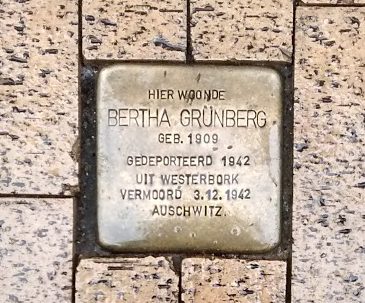
Also in Groningen, the Jews did not escape this threat even though it was perhaps not as violent on a large scale such as in the big cities like Amsterdam, Den Haag and Rotterdam. Since 1750 the Jews had obtained refuge and citizenship in the city of Groningen. Now they were being harassed and beaten by the Nazis. The Jewish synagogue [9] was shut down and Jews had their businesses taken away and families were sent to concentration camps. The Jewish synagogue building still stands to-day but is no longer in use in Groningen. Its flourishing Jewish population was almost decimated by Nazi policy and cruelty. Mom recalls a Jewish neighbour who came into the bakery store and asked whether Dad would be willing to buy his business as he had received orders to report the next morning with his family to Nazi headquarters. Later I asked Mom, why did you not do something, and she said it was a pitiful sight as there was nothing one could do. It was tough to act because of the strong control of the Nazis over the daily affairs of the citizens’ lives. They had the weapons and were always ready to use them and force fear into the hearts of the citizens. Helping Jews in those days would be punishable by death. They did not hesitate to shoot people. Their ‘excuse slogan’, that it is ‘all sabotage’ came easily out of their mouths.
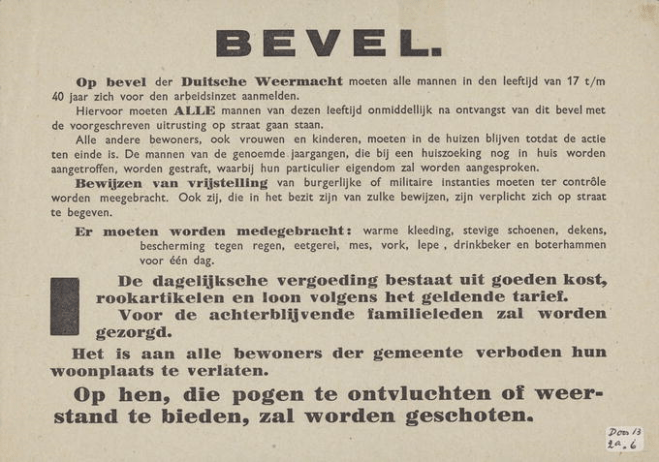
The reality of this ‘tyranny’ that people had to endure was driven home to me when with my parents, we visited the ‘Five days in May’ (‘The Sweetest Spring’ – ‘De Mooiste Lente’) exhibit of the Canada Armed Forces in Ottawa back in the summer of 1990 [10]. In that display they exhibited original hand bills that the Nazis would post on the streets indicating that they were going to round up the menfolk for factory labour [11] in Germany. All able males (17 to 40 years old) were to report and stand ready with a few belongings at the street curb for pick-up. Those that refused and tried to get away ‘would be shot’. No ifs or buts. This was the way it was.

JS October 16, 2023
[1] In 1933 my dad up served his time in the Dutch Army. [2] NSB: Nationale Socialistise Beweging (National Socialist Organization) founded in 1931 and by 1936 turned anti-Semitic. By 1937 their representatives showed little respect for parliamentary procedures and had to be called to order by the Speaker for physical & verbal abuse. They collaborated with the Germans. [3] In Gospel of Mark chapter 13 verse 7 and Gospel of Matthew chapter 24 verse 6 we read: ‘You will hear of wars, or that war is coming, but don’t lose heart. These things will have to happen, although it won’t mean the end yet.’ (Translation: The Voice) [4] They called their mode of war: Blitzkrieg – lightening war, fast mobile forces with concentrated firepower and air support. [5] Read the Jan Groenewegen’s story (Opa Cor Groenewegen’s oldest brother) about the Germans attacking Rotterdam and vicinity from his home on the island of Rozenburg across the river from Maassluis. [6] The Queen was married to Prince Hendrik (Duke of Mecklenburg-Schwerin) the Prince was a playboy and the marriage was not successful, however after several miscarriages, a daughter Juliana was born who succeeded her. Queen Wilhelmina (abdicated) resigned in 1948 – reigning 58 years) [7] Queen Wilhelmina vowed to stay in Holland but after many urgent appeals to leave, was picked up by the English warship ‘HMS Hereward’ from the port ‘Hoek van Holland’.’ She spent the entire war time in England broadcasting radio messages to the Dutch. Her daughter Princess Juliana and husband Prince Bernhardt spent the war years in Ottawa where Princess Margriet was born.(January 19,1943) [8] The resistance groups would steal food stamps so that those who were sheltering, the boys and men who had gone ‘underground’, (not work for Germany or because they had committed sabotage etc.) would be able to purchase the necessary things for food etc. [9] The Synagogue was constructed in 1756 in the Folkinge Straat, (one of the oldest streets in the city from 11th century)but was closed and sold in 1952. Deportation of Jews started in August 1942 with 600 people and continued till 1943. Few Groninger Jews escaped the terror of the Nazis. [10] In 1990 my parents listed their Burlington townhouse for sale and moved in 1991 to Ebenezer Senior Homes on Stone Church Road beside the Can. Ref. Church. Both my mom and dad were already showing their age. [11] These searches, roundup raids were called ‘Razzia’. On October 1st, 1944 in the town of Putten one of the worst and most vicious ‘Razzia’ of revenge took place because the local German commander had been attacked by the resistance just outside the town.
 On the Road