Cornelis 1914 – 1994 and Adriana (Sjaan, Jane) nee Voorberg 1913 – 2002

The Story of Cor and Sjaan (Jane) Groenewegen was written by Cor Groenewegen (included are his excerpts written for Sam Hann’s Journal) carefully typed and edited by daughter Louisa F. Bruinsma
There is a Dutch saying that goes like this: ‘In het heden ligt het verleden, In het nu wat worden zal!‘ which freely translated into English is: ‘What we have today, came to pass yesterday! What the future will bring; will much depend, how we live and work today!‘ or ‘In the present lies the past, The today will shape the future!‘
Great miracles have happened in the short lives of immigrants in the great countries such as USA and Canada. We must not become haughty in our hearts but say with Psalm 75: ‘0 God, we give thanks, We call on Thy name and recount Thy wondrous deeds.‘
Our family looks back to 1947 when Cor and Jane Groenewegen and their five children, between the ages of two months and five years, crossed the Atlantic Ocean in the S.S. Waterman, a ship originally designed as a military vessel to transport soldiers. The Lord gave us two more children in Canada and 18 grandchildren.
My grandfather was a farmer, so I wanted to become a farmer. He was a God-fearing man and was always warning us to love the Lord’s good commandments. When my grandfather lost his wife and became very old, he loved his children and grandchildren so much he wanted us to see him at least once a week. He watched his children and grandchildren. When we fell into sin, he really warned us that the wages of sin is death! When he was getting weaker before his death, I, as a young boy, asked him, “Grandpa, are you ready to die to meet God in heaven?” His answer was, “Yes. He that is God is the God of salvation and unto God belongs the issues of death. “
My father, Teunis Zent Groenewegen (which translated means ‘Green Ways’), was born on a small island called Rozenburg. This island was born out of the North Sea around the time our Savior was born in Bethlehem.
There is a saying, “The sea gives and the sea takes.” Through the ages some places on this earth are swallowed up in stormy days by the sea but many small and large islands of the Netherlands have their existence from low and high tide, and especially on stormy days, land disappears, and other places grow fast when sand and clay (sometimes mixed) come to the shore. Over the ages this created large and small islands which we can see on the map as South Holland and the province of Zeeland. Many ‘Rozenburgers’ left the small island of Rozenburg from this small country called The Netherlands during the last 150 years to come to Canada and the USA.
I will try to display the great things the Lord has performed in the life of the Groenewegen family.
Both Mom and I are of about the same age. Mom is born April 5, 1913 and I, Cornelis, was born March 7, 1914, both on the island Rozenburg, the Netherlands. Cornelis’ parents had 14 children. We grew up in a time when parents had to work hard to establish and operate Christian schools, schools which later received government funds. My mother’s father was Pieter Kleiwegt (translated “clay road”). He was a contractor who my brother, the late Peter Groenewegen, who lived in Blenheim, is named after. My grandfather built the high and big windmill which is still standing as a monument at Rozenburg, South Holland. Wind was what gave power in the days before gasoline engines and electricity. When I was five years old in 1919, my father bought a farm next to the windmill, and we became good friends with the mill people. The windmill was there to cut grain for men and beast.
The name of the family who were these good neighbours was Klaas VanderWilt. Sometimes as children we were allowed to climb all the steps to go to the top to over see the island Rozenburg with the great river, “The Waterweg”, which brought the great sea ships to the harbour from New York. But someday in the year of our Lord 1947 we, me and Jane and five children, and many other families and single men and women, were going with a ship called “The Waterman” through this river on the way to a far country called Canada. But more on this later.
There is not so much to write concerning the Kleiwegt family because not many of them immigrated to the other side of the Ocean. Only one family we know of is in Canada, Klaas Kleiweg on Vancouver Island. Other brothers and sisters of the Groenewegen tribe who crossed the ocean after the Second World War are: Peter and Mensk Groenewegen in Blenheim, ON, Cornelis and Jane Groenewegen in Burlington, ON, Leendert and Willy (Groenewegen) Boers in Ancaster, ON, and Jan and Dith (Groenewegen) VanderEnde in Chatham, ON.
Two sons of my uncle, Cornelis Groenewegen (who was very proud that I was named after him), also emigrated: Cornelis Groenewegen in Brantford, ON, and Huibrecht Groenewegen in Hamilton, ON. This uncle Cornelis was very proud to have someone named after him and I had to come often to his house, but especially on Sunday after church. When I became twelve years of age, he came to my birthday with a very good watch.
My father’s father was Jan Groenewegen a “kleine boer” (small farmer). As a boy of twelve my father did not like to work on the farm. Although he was born a farmer but he was also a businessman. For some reason my mother’s father did not like the Groenewegen family, so the few times they could see each other were not many, so the only solution was to get married. Both had a spirit of enterprise which is maybe why I later decided to step on a boat and cross the ocean.
As a boy of twelve one night he was in his bed on the floor above where his parents slept, and overheard his parents discussing the great financial problems of the great depression of that time. Oma said to Opa that business was bad and they could not pay their bills. His mother came up with a great idea. “Jan,” she said, “What about the two great baskets we have. Next morning we fill them with eggs, put a yoke on Teunis’ shoulder with the eggs in the baskets and send him to the city of Maasluis to peddle them.” There was little market for the eggs in Rozenburg. That night my father could not sleep. He saw himself selling eggs in Maasluis, meaning he did not need to work any longer in the fields, which he hated. And there he went. He built up such a large egg business that his father could not fill all his orders. So he had to go to other farmers to buy eggs. The business went so well he had a little cart with a large dog in the front to pull it and he could even sit on it.
One day he got a big setback when he was riding on a road which was on the top of a dike. The dog saw another dog beneath the dike and went after it with the result that the cart with all the eggs rolled over and over below the dike and all the eggs were broken. My father was a hard working and progressive businessman and his business was always growing!
I remember when I became five years old, he had built up a big business. My mother handled a grocery store and he was a trader in cattle and horses. But it was difficult doing business in the great first World War. He bought a 7 hectare (18 acres) farm in 1919 and from then rented land so his farm was 40 hectares (100 acres). He had a barn with pigs and in winter also a barn with cattle.
My brother Herb had to learn how to grow produce in greenhouses so we had also three greenhouses growing early lettuce, tomatoes and grapes. He was a very social person. I remember when I was a boy of twelve he took me to the great cattle markets. And anyone who saw my Dad from afar, it was always “Hello, Teun! Hoe gaat het?” His colleagues greeted him with much honour. Laborers loved to work for him. Eventually he became a cattle salesman, and went to the great markets in Delft and Rotterdam. He was a good father.
Our family had six sons and eight daughters. I have seen my nine month old brother die of measles. My brothers and sisters: Jan – born February 3, 1906 – 1974; Marie – born June 7, 1907 – 1983; Ans – born October 18, 1908 – 1987; Mien – born September 23, 1910 – 1962; Huib – born November 22, 1911 – 1990; Pete – born November 11,1912 – 1993; Cor – born March 7, 1914 – 1994; Klaas – born March 23, 1915 – ?; Catharina – born July 16, 1916 – ?; Willy – born October 18, 1918 –?; Nel – born August 3, 1921 – 1979; Coby – born February 22, 1923 – 1990; Edith (Dith) – born January 5, 1926 –
I had a great and God-fearing mother who brought forth fourteen children, and still could sing psalms in the night when life was sometimes very hard for her. What a great faith she had! Singing psalms in the night when there was no money available in the depression in the 1930s. There was often no money when she needed to buy clothes for a large family. During those days there were often peddlers in manufacturing that went door to door, especially on country roads. They came to our place when father was gone to the cattle market, because they knew he would not let them in the door and would say “Not money here!” I remember one day when father was not home that a textile peddler came inside and put two cases of textiles on the kitchen table and said, “Vrouw Groenewegen, take all what you need, if you have money or not!” We were clothed with used clothes and even when we worked on the farm more than 60 hours a week, we did not receive pocket money and went to church with used clothing from the rich.
I was born on March 7, 1914, just when the great first World War started. At the age of four, I remember an uncle became a soldier and had a nice coloured uniform and walked around with a long sable. When he had a weekend off he visited us after church on a Sunday, and I was creeping behind his chair. I had to take a hold of his sword he had hanging on his hip. There were many streams and lowlands in Holland, and for children it was dangerous to come close to these; many children drowned. One big event for me was when I was maybe three, I was playing with a little boat in a deep creek and I lost control of it, and when I was trying to grasp it, I fell in the deep water. It was just at the time my mother with the maid had a coffee break. The maid came running down and rescued me just in time before I drowned. For the rest of her life, I showed my thankfulness to her for saving my life. Her name was Mien Kuister and she later married Willem Pols.
I liked to go especially to the large market places where cattle and horses were bought and sold. A favorite toy of mine was a small wooden horse. I was not so good at skating on ice. One time I got hurt so bad when I fell that I stayed away from the ice! It was very important to learn to ride a bicycle because a car was only for the very rich. When one was learning to bike, he or she had the attention of the whole neighborhood.
My oldest sister Marie had just finished grade 6, completing her education, and holding my hand, brought me on April 1, 1919 to the Christian School, just a few minutes walk from our home. Because the schools became so secular our parents and grandparents started their own Christian schools. The public schools were paid by the government. According to law we must finish education up to grade 6. Only the rich could afford using the high schools. Christian schools were paid for by parent and other supporters. Thanks to Dr. Abraham Kuiper and others, we had not only a school named “Christian”, but I shall never forget during the six years of learning, not only learning that two times two is four, but taking Bible lessons, and learning to sing the psalms and hymns without using a book. We had to memorize not only psalms and hymns but much of the Heidelberg Catechism and the Scriptures.
History and Bible lessons were my favorite lessons but I did not like to sit in a classroom. The best time of the day was at noon. Then we could eat a bag full with sandwiches and after that we could play for a half hour. We finished school at 3 P. M. and I rushed home to help my Dad feed and milk the cows. When we became 8 years of age we had to learn and practice how to milk a cow by hand. Holidays and vacations? We did not know what these words meant. I finished education when I was 11 years old and according to the law, I finished grade 6. Our parents went with us or brought us every night to the sleeping room at evening and taught us to pray before going to sleep, and in the morning we had to pray and go on our knees for a blessing for the day and give thanks before and after every meal.
As a child I liked horses but was afraid of the horse stable. It was dangerous to come close to a horse when she was eating oats. It was great entertainment when one could show off and sit on top of a horse or sit at the driver seat of a wagon to steer one or more horses.
The second floor of our house was the sleeping place for the boys, and, to let my busy mother have some time for fix our worn out socks every evening time, we had all to go to bed at 7 o’clock so that we were well prepared for the next day. My best friends were made from those who attended catechism classes and young people Bible study society. We studied there also Christian politics and Christian labour relations. These societies existed for women also. My wife, Jane, was a leader (president) these. She can tell you of her experience.
Roughly estimated (according to the election for parliament) a third of the population of Holland was Roman Catholic and two-thirds Protestant or Liberal. Dr. Abraham Kuiper, along with a great number of scholars, created a great reformation not only in the Church of Jesus Christ but also in politics, economics and education. All kinds of Christian organizations sprouted out of the low lands in Holland, even in sports and entertainment.
In 1913 – 1,939 on our island of 2,500 people (or 70%) was Protestant. Every church denomination had, if it was possible, their own Christian school. If not possible, they worked together. They also worked together in political organizations. Later on, when they became larger, large church denominations had their own political parties.
We had no running water on our island. The water supply was from the roofs of the homes on a rainy day, from a well and a creek (“sloot”) which was about 15 ft. wide and circled through the fields for draining the land and supplied drinking water for the cattle. There were so many rainy days that seldom did we have a shortage of water. We were the only city that had this luxury . There was no radio or TV. We had a so-called harmonium organ. Everyone who was able was taught to play it. Especially on Sundays, the family with young and old friends and relatives, would gather around the organ and sing psalms and hymns. A favorite was Psalm 146: “Praise the Lord. who reigns forever! 0 my soul, bring him your praise. I will bless my God and Maker and exalt Him all my days. Praises to my God, I will sing; while I live, I’ll laud my King.”
Life was not as complicated but more normal. People had more time to live as a family and read and study the Bible. We had young people’s society and old people societies which had meetings once a week to study the Word of God.
When I was born there were no cars or trucks. Transportation was by boat or horse and wagon. I remember when the first automobile came to the island; it was pulled by a horse because it I would not run for some reason they did not know. A motor bike had a large motor, and when it started it gave a large noise of which I was afraid, and ran away from it as fast as I could. Even when I was conscripted into the army (Jan. 2, 1934), the gasoline engine was coming in the army, but the great guns were still pulled by the horses.
When I was 17 years old, I went for one full year to work at a dairy farmer on the other side of the river, named “The New Waterway”, the river where the large ocean liners travel to the big harbour of Rotterdam. Milking was done only by man’s hand at that time. Imagine milking 14 cows twice a day by hand, besides all the other work like feeding cows and putting the manure with horse and cart over the fields. To be a young man of twenty as I was in 1934 meant that according to the law of the land, I had to become a soldier. One reason I wanted to become a soldier was so I could wear the uniform of the cavalry and ride a horse. That was for myself not an obstacle because I wanted to become a policeman on a horse in those days. But for my father, a farmer, it was a great obstacle because he had to replace me on the farm with a hired man whom he had to pay wages, and it was depression time. It was very tough for farmers. We got only 3 cents a litre for milk, and some farm products there was no market for! I had to sell potatoes which were hard to sell. I sent an application to become a policeman on a horse, but there were so many applications, and they did not need that many, and the government was also short of money.
When I joined the cavalry I was taught how to cut off the heads of the enemy who could also perhaps be riding on a horse. Training and service was a total of 15 months. It taught me a great lesson, how to cope with critical and unpleasant circumstances. The big guns on wheels were also pulled by six horses. It was a very rough life. But I was a soldier with a deep desire from the heart to defend the nation I belonged to. It was six months of training and the other nine months we were prepared to defend our nation. We had also the honour of participating in a parade of opening the “Tweede Kamer of Staten General” (House of Commons) and the funeral of old Queen Emma, mother and grandmother of Queen Wilhelmina and Queen Juliana. It was also a tremendous experience to live far from your parents and Christian friends. But what a great experience of life it was!
Then the great depression came in the 1930 until the great war broke loose. Jane was working hard for her family (Voorberg) selling and delivering shoes. Farming was so bad that some produce was destroyed because there were no buyers. The year 1939 brought a great change in our life. The great depression in the economy was still on. Mom and I were engaged for a number of years and, as normal, we longed for the day we could get married.
When it became time for the five sons who worked on the farm to get married, Dad could not give us wages, not even pocket money. The only money we received was for church collections, for young people society’s fees and pipe tobacco and cigars. We did not know that cigarette smoking was poisonous.
One son after another went out and started their own business. The milk we shipped received only two and a half cents a litre, and there was not even a market for some of the produce that we had grown. Rozenburg potatoes were hard to sell in depression time because they were not round, but a form of flesh and could only be sold for cattle feed. So my father sent me to sell our potatoes to cattle farmers on the other side of the river called the “Niewe Waterweg” (new waterway) where farmers could not grow their own potatoes because of the low lands. That went so well that I sold all my father’s potatoes, as well as some from our neighbours.
To get married one needed a steady income which was not available, and I knew Mom’s father (Johannes Voorberg) would only give his daughter to me to get married if I had a steady income. So when I was twenty-four I went to my Dad and told him of my critical situation. I said, “You cannot give me wages, and I want to get married. Can I get a day off and go by bike (a distance of about 25 km) to the Hague and have a look at how potatoes are sold there? I want to build up a potato business there, because I lived there for 15 months as a soldier, and know a little of that city, and for sure all people eat potatoes there!” He looked at me with tears in his eyes but gave me permission to leave the farm. He said, “Cor, you are the last one of my five sons who is still working with me on the farm. If you leave, I will have to stop farming. But, you can go there and do some business for me. The Hague is the residence of our government from whom we rent about 40 hectares of land. On a great part of it nothing will grow because of the salt water which has flooded our rich soil so that nothing will grow on it, as you know. They had promised to put a dike around it, but so far nothing has been done. We should be relieved from paying rent for the land, and have to get them to speed up the building of the dike.”
So I went on bike the 25 km to the Hague. It took all day to get the man in charge. His answer was, “We will keep it in mind.” Whether or not the dike was ever built, I do not know. But the salt water and the depression were the reasons my father had to stop farming. So how could we exist with no income?
My oldest brother, Jan, already had a family. Before he was married he had used the free evening hours to go by bike to the farmers to sell seeds and farm machinery. The Gereformeerde (Reformed) Church built a new church and he bought the old one. A contractor did a good job of making living quarters from the balcony and the bottom floor into a machine shop. He had the Groenewegen’s Cor “ondernemings geest” (ingenuity entrepraneurship), an enterprising spirit which he had inherited from his father. His son-in-law still lives and operates his business there.
Brother Peter joined Jan in his farm machine business until he and his family also came to Canada in June 1951. He was a truck driver for me hauling potatoes from Leamington. Eventually he bought a farm in Blenheim and we lost a good truck driver as well as a good man that bought potatoes in Leamington for us.
I will never forget the day that we as brothers met together to discuss the matter of how much each of us could bring to support our parents. From there on we had to layaway money to support them, although for none of us a problem because the Lord showered us with blessings!
When I started peddling potatoes in Den Haag, I met in the street a man who also came from Rozenburg and had worked at my father’s farm. He had a street route with a horse in front of a great four wheel wagon with fruit and vegetables displayed and his wife operated a vegetable store. When we met in the street I was peddling. He said, “So Cor, zit jij hier te etteren op de straat?” Because it was depression time and all business was so bad that some streets with stores were all empty and storekeepers were broke. He had taken over an established business. His wife operated a vegetable store while he was out with the horse and wagon on the streets. But I had to learn how to sell potatoes in a city where people lived in small homes, which did not have room for a 75 lb bag of potatoes.
But things went very well in spite of a tough life. The Lord has given me an ideal boarding house. I do not know if I wrote this story already. But when I saw on the street a bakfiets (a bike with a platform box on three wheels) which could hold 500 kilograms potatoes, I rented one for 250 cents which is two guilders and fifty cents a week, and so long as I could not rent a warehouse I could load potatoes and store them in this bicycle and bakfiets garage. I said, “That is the deal, and can you tell me where to find a boarding house for me?” “Ah!” he said. “You are just the person my mother and father-in-law need in their home with her two sons. They need a boy in their house like you.” And he took his motor bike and there we went to Ohm Street comer Valkenboslaan second floor, and there was his mother-in-law who gave me not only lodging and a bed to sleep on and plenty of food, but was for me as an angel from heaven! When, especially in the first days, sometimes I had peddled with a half ton of 500 kg potatoes on the 3 wheel bike’s platform, and had not even the half sold, she saw it on my face and she was for me an angel from heaven. They were Roman Catholic and did not read the Bible much, but the first day I said, “Mevrouw, we are used to read the Bible by the table after every meal and my father did this.” She said, “Cor, and you can do it here so that we can hear it!. So I did. What a great woman she was. Years later Mom and I were at her last hours of living, and we are convinced she is also saved by the blood of the lamb of God.
When I think back on these tough days, I must also see the hand of my Father in heaven who gave me a boarding house with a great woman who thought it was her duty soon as I came in every evening or dropped in at day time to lift me up with not only excellent food and drinks but also with a character as an angel from heaven. A mother could not have been better to me as she was. Boy, how you would feel at night! Only a few of the streets were paved and many had brick decks which were rough to ride on with 500 kg. of potatoes. It was not too bad so long as you could start unloading them soon. Then the work to move it became better and better. What a disappointment it was at the end of the day when you had to unload those which were not sold.
“So, Cor,” she would say when I came home tired and depressed, “I have some addresses here which want your potatoes!” That I could store a truck load of potatoes in a “rijwiel stalling” (bike garage) was gracious of Mr. Piot, but the place was not free from freezing and winter was coming. I told all my troubles to my boarding lady.
One evening I got home very tired of driving a bike of potatoes. Mrs. VanderKlauw, my “kost vrouw”, said, “Cor, you have to be at the Loosduinse Weg, right? That man has a home with a store for rent at Noorderbeekstraat 141 for three gilders and 75 cents! When your business has increased enough you can be married and you have a place to store your potatoes. Your wife can sell potatoes in the store and you on the street. You have to be there at 7:30 PM this evening.” I think she got this information from the newspaper. So I went there after supper. I will never forget the deal that I made that evening. I could get in only if I signed a yearly contract. I said, “I do not know if I will be in business that long!” But the man was eager to rent out his store, especially since so many stores along the street were all empty. He said, “All the people in the street eat potatoes. You sell on the street while your wife sells at home!” I could rent it for 3 guilders a week and the living quarters on top of it for 6 guilders, but who would want to live at a place with an empty store at the front?
So my business expenses were 3 guilders and 75 cents and 2.50 for the bakfiets. And the man was right. The business flourished. After peddling potatoes from door to door for three months I had enough income from customers to show my girlfriend’s father and asked him to give me permission to get married with his daughter, Jane, in February 1939. So he gave his daughter who had so faithfully worked for his family shoe business permission to get married with a potato peddler. We just lived there for a year, because we had to move to a larger place, Bilthovenselaan 86, in a good neighbourhood. It had a very big store which could hold big truckloads of potatoes.
But after a few months the Second World War started, and, as a trained soldier, I got mobilized. I had to put the soldier uniform again over my body when the second great World War started in August 1939. The business was flourishing because the great depression was on and potatoes were cheap food. Farmers received only 1 1/2 cents a kilogram for potatoes. Mom and I were both working hard in 1939 to establish the potato business when the Second World War was started (Holland was invaded on May 10, 1940) by the National Socialist leader, Adolf Hitler. So, as a veteran soldier I got mobilized to go back into the army.
The first days the army was mobilized were very exciting and confusing. The place of the army I belonged to was assigned was not even known and we had to find out where to find it. I was sent to different places in the country but they did not accept me because they could not find me in the list. Six other boys had the same experience and one Saturday morning we, as seven trained soldiers, gathered together in the same circumstances and took the following decision: Since we had tickets for trains to bring us to any destination we decided to go to our own wives for the weekend and gather together at a certain place on Monday morning to go from there to an army for horse riders outside the Hague. So we found one another on Monday morning and went from there to a army place where they had horses in stables in an old cavern for horses and horse riders. There were the horses which were claimed from farmers and others for the army in time of war. So we were claimed to look over the horses which were claimed of the farmers for the eventual coming war over our country.
When I came home that Saturday evening, Mom was very perplexed and happy to see me so soon back at home when our country was in great danger. She had many troubles to get a person to replace me. I found out she did better without that man, who was good, but not for our business. By the providence of the Lord the residents of that part of the army were moved to the same city in which we were living. My great boss in the army, named Ritmeester, was as a father for us. The soldiers which were married and lived in The Hague could go home from 4:30 to the next morning at 8 A.M.
I was stationed in The Hague (Den Haag), so I decided to cancel the services of the man who was helping and said, “Jane, I am only half bike ride from where I have to serve. As soon as the service is finished at 4:30, I will jump on the bike and be here by 5 o’clock and could stay there until 8 A.M. When you have potatoes ready in 10 kilo bags, I will do every evening what I am used to doing in the day time!” “Okay,” she said. “And I will help you deliver these potatoes. I will put a rope on the “bakfiets” on three wheels (which held 500 kilos potatoes) and will go before you to pull the vehicle and we will try to finish every night a route.” So we kept the business going. Mom continued the potato business during the daytime while I was in the army and I worked late at night in the business because it was in the same city. Sometimes it was 11 o’clock before we met the last customer who would sometimes say, “I just told my husband when the potato man has been we should go to bed!”
Some time later my big boss in the army found out what I was doing in my free time, He said, “When you need a horse and wagon just tell me, Corny!” I never did use it, but when I saw that there was not much to do I sometimes got permission to do some work in the daytime in our business, so that even in war time, our business was growing very fast and even became bigger. That time our cousin, Cor Groenewegen, and Gerrit Kerkhof (brother-in-law) were also soldiers that were mobilized in Den Haag. They found our home a “gezellig” (cozy) house to come over. But they saw our hard work, and often they came at evenings and put a rope on the “bakfiets” to pull me. That went so much faster, we even had time to have a coffee break before we went back to the army camp and especially on Sundays they came when there was no unnecessary work done, even in the army. So we had a fruitful and “gezellige” day of the Lord together. And the business was growing even during the time of war and while I was a soldier! What a blessing was bestowed on us. That time whole streets were built with small stores. Big stores came later. Many of the stores were empty. Doing business was tough.
In nineteen forty-four, during the church liberation (Vrijmaaking) Rev. Koopman was our minister. When he came to visit us our oldest daughter, Nellie, asked him, “En wanneer laat U nou eens zingen: “U alleen, U loven wij, Ja, wij loven U, 0 Heer. Want U naam zoo rijk van eer, Is tot onze vreugd naarbij. Dien vertelt men in ons land, al de wond’ren uwer hand.” (“We, O God, we sing your praise, And our thankfulness proclaim. Near us is your holy name; Just and glorious are your ways. People praise you everywhere And your wondrous works declare.”) Book of Praise-Genevan Psalm 75:1
Note: There is little in Cor’s story about events during the War except for the story of the ‘spoon’ and the ‘Razzia’ told by Sjaan:
After the Second World War, the USA and Canada opened their borders to Dutch people. Boats and airplanes full of immigrants landed in Halifax and Montreal. The Lord put the idea of immigration to a far unknown country into our hearts so we had to step on the ship. After some preparation, Jane and I and five little children went on June 17,1947, the first load of “The Waterman”, a ship loaded down with Dutch families and their baggage. The trip took nine days and then we landed in Montreal harbour, Canada on June 26, 1947!
It was a wonderful trip, but the ship was NOT suitable accommodation for families with small children. It was built for soldiers. It had large rooms with beds on top of each other. We had to stand in rows to get out food. After a few days many got seasick and vomited and spent day and night on deck throwing up over the railing. Males and females were separated and the mothers had small babies with them. Many women with small children were very busy. We still praise and wonder at the mothers with small children, for their brave and hard work they have performed during the trip. I’ll let my wonderful partner, Jane, tell herself of their experiences. Marian was a baby and John had a special diet. For myself, in spite of the discomfort on the ship, I remember the great beauty I enjoyed when the waves were very high and when I was standing at the front or on the other end of the ship. It was a wonderful sight to see one end of the ship going way high above the water and the other end going deep into the water. Then I remembered the song: ‘t Scheepke onder Jezus’ hoede, met de kruisvlag hoog in top, neemt als arke der verlossing allen die in nood zijn op. Al slaat de zee ook hoog en hol en zweept de storm ons voort,
wij hebben ‘s Vaders Zoon aan boord, en ‘t veilig strand voor oog. Translation: In the good ship of our Captain, We are sailing o’er life’s sea, Pilgrims to a better haven, Heirs to heaven’s victory. Though angry clouds sweep fast and wild. And breaking billows roar, We’re safe with Jesus at the helm To pilot us to shore. (translation: Leendert Kooij)
Only Ted got sick. We had a worship service on Sunday organized by some active immigrants with Mr. Keuning as speaker. We sang the psalms we had learned in the Christian schools and families. The psalms were spread over the waves of the ocean.
On June 26, 1947 we landed at the harbour in Montreal. From there we went by train to Toronto and then transferred trains to Bradford. The Christian Reformed immigration society was well prepared to receive us. Old timers were there to help the new comers travel to their destination and did a tremendous job of helping all of us get settled. The majority of immigrants were Christian and of the Reformed heritage. The Reformed community was busy meeting us on the train stations even already when we left the boat to guide us to a farm to work and had a house available.
The big move of people from Holland meant the families of farmers had a number of people ready and able to help them on their farmers. At that time Canada had opened its borders to farmers, and many of us were farmers as our occupation. Because we could not understand or read the English language, we were dependent on the ‘oldtimers’ to help up reach our destination. We did have some troubles in our travelling. We were to go to Bradford, but one of the leaders who helped and guided the newcomers put us on the wrong train. Instead of going to Bradford we were on the train to Brantford. At the first stop in Hamilton, we found out and we had to go back to Toronto again and from there to Bradford. So we arrived by train in Toronto and transferred to Bradford.
Note: (After some time came family Peter Groenewegen, then the Leendert (Tante Willy) Boers family and John (Tante Dith) VanderEnde.)
We came to our destination planned by the immigration office to a farm in Lefroy. The people (Hofland, Box 82) were very good to us, but we did not fit in their way of living and farming, so the good people of the immigration found a place for us (after 6 weeks) outside the city of St. Catharines, a farm with milking cows and at least forty acres of grapes. It was a place that fit both me and the family. The farmer’s name was Youngblood. He has a trucking business and bought and sold grain.
Many other Dutch families landed in this area, about 90% of them worked as farm help. Some had the use of a pick-up truck of the farmer that they worked for and were willing to pick us up for government sponsored English lessons and church services etc. But the house we lived in was very uncomfortable and very cold in the winter, especially when Mom became sick and ended up in the hospital. But she can give more information of this experience than I can. One of our good friends, also an immigrant, said, “Cor, there is an opening at the Larkin Farms at Queenston Heights.” This was located between Niagara Falls and Queenston where the Brock’s Monument is. I thought this must be a wonderful place and a good place to work! 600 Acres! When the manager, Frank Digweed, saw me, he hired me right away and sent a man, Dave, with a truck and loaded all our household and family and there we went to a new experience.
What a beautiful place to live, close to the Brock’s monument and hydro installation, and when a strong east wind came we could hear the falling waters of the great Niagara Falls. The manager, Frank Digweed, was very good to us. The manager lived in a castle. The workers lived in wonderful cement homes with a good size vegetable garden. The manager knew about my knowledge of fruit and that I knew how to handle it. When I was working there a half year, I said, “Mr. Digweed, your can help me start a business, and I will buy many of your apples.”
“If we can rent the house that we lived in then I would buy a truck and go in the business I was in the old country selling potatoes, fruit and vegetables and I would buy your apples.” So, the big boss let me rent the house which had a great large basement for storing fruit and vegetables. But I needed a 2 ton truck. I would not take the risk of buying a used one. A 2 ton truck then, in 1958, was $3,000, which I did not have. But we, as immigrants, were one family. I had only to ask only once one of my good immigrant friends and the down payment for the truck was right there.
By that time, cousin Herb Groenewegen was already coming from Holland and wanted to be married and to work on this farm. I said to the manager, “Herb, a strong young man, wants to work here and he can live with us. You can give him the same thing you gave me: a house, garden, free apples and wages. But I would also stay in the house with my family.” “So,” he said, “let him come over and I want to see him. And so Herb came and he made the deal. Not long after, Herb married and they got a home on the farm and we could rent the house from the farm to continue the business which was growing very fast. It was a large concrete home with a large basement. We could store truck loads of potatoes. Herb could make some extra money to help me loading or unloading fruit and potatoes.
That time a Christian Reformed Church was organized in St. Catharines under the supervision of Rev. Personaire and we used the truck to pick up many people. The “Liberated” (Vrijgemaakte-Artiekel 31) Canadian Reformed churches also began to organize churches and one was started in Hamilton. So we cleaned the truck on Saturday evenings and put many orange crates in it because we had a truck load of people to pick up on the way to Hamilton, including Fenwick and Smithville.
But one day the manager of the Larkin Farm, Mr. Digweed, who had become our best friend, said, “Cor, you have to look for another place because we need the house for another hired man!” And we started looking in the area surrounding Hamilton. We could not afford to do much driving around, but drove where people lived and asked for advice, and all of these people ate potatoes and vegetables. So with driving around and talking to people, I tried to sell 75 lb bags of potatoes or a basket of onions or carrots. How did I find that first load of potatoes? I was a stranger and did not know much of life outside of the Niagara Falls area. I went to an immigration meeting in Hamilton, ON and there were many immigrants assembled around this area. And they told me, “Potatoes you can buy close by” and showed me the next morning how to get to the Marshall farm in Ancaster on Highway 53. So I slept overnight at a friend, named Mr. Oosthoek in Aldershot, and went next morning to Fred Marshall’s farm. He said, “It is too wet to dig potatoes this day, but Jerome, the farmer next to him, was there. He said, “Come with me. I have potatoes ready to sell in my barn.” I had cheques with me but he would not accept these from a stranger. I could buy only 30 bags potatoes of 75 lbs. That was all the cash I had. But it was enough to start a retail potato business in Niagara Falls. I peddled potatoes from door to door and it really went. That time of the year people started buying potatoes for all winter so I sold one load after another.
Then some immigrant friend who worked on a farm said, “I went with the farmer I work for to the Welland produce market which is every Saturday. You should go there too. It is a terrific good retail market.” So I went there the very next Saturday morning and Ted was 8 years old and went with me. We had to ask people how to get to WeIland, and, yes, we got there, and sold, I think, all the potatoes we had on the truck. That was the fall of 1948 when we sold there the first bag potatoes. It did not take long. We went there and sometimes we sold even two truck loads (mostly retail) with potatoes, carrots, onions and apples. We really started to count the blessing of the Lord! Many of our Dutch immigrant friends were happy to help me on that busy day, and we had a good time together that Saturday in Welland.
I did much driving in the area surrounding Hamilton because there we had church on Sunday. One day I stopped at a house on Upper James St. between Stone Church Road and Mohawk Road. There I saw an empty lot with a cave behind it, ideal for potato storage. I asked the resident of the house if she knew the owner of that property. “Oh yes,” she said, “It is the retired father of Dr. Bethune in that stone house next door. See him.”
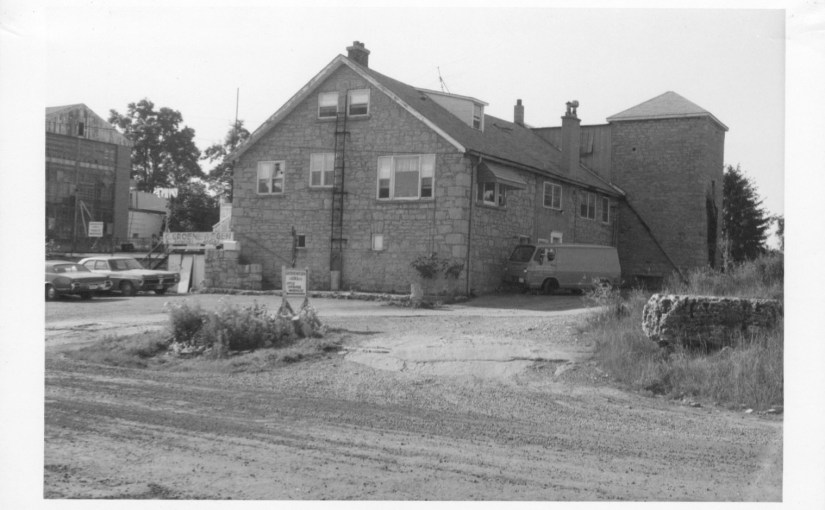
That was the first time I met that great fellow neighbour. When I met him I found out he was a great human being, of which people later informed he was a graceful Samaritan. He took the time to let me talk and answered questions. He found out who I was for a person. Then he said, “Go with me and I will show you that barn, but I keep the silo for myself. It was a stone high barn, even the silo was stone, and the inside was around, also made of stone. The basement was ideal for storing potatoes because it was hewn out of rock which made for cool moisture. Above this was room for living quarters and there was also some land behind. The price was five thousand dollars ($5,000) and he was willing to give the mortgage on it. Praise the Lord. What a deal! After a few years, when the retired doctor died, we bought his house, the silo and more land where we later built castles of empty crates we bought and sold as well as driveways to the top floors of a building we built because the back land was higher.
Praise the Lord for he is good. His faithfulness endures for ever and ever!
We brought with us from Holland the tradition of building churches and Christian day schools and Christian high schools. We had a business in used and new fruit and vegetable containers. Some people ask, “How did you ever get into the used vegetable crate business?” That time we had to bring bags with us when bringing potatoes to farms or pay good money for them. So I was gathering used potato bags and asking customers to give the empty bags in return. Anyone who had some to sell we bought because new ones were expensive. Farmers were even eager to buy used bags because the price was much different. So I gathered as many bags as I could and made even some profit this way.
When I started the vegetable business farmers were very eager to buy used crates because new ones are always very expensive and the farmers never see them back because the long distance from grower to the consumer. So there came a time when our used containers business overshadowed the vegetable business. The business was getting bigger and bigger, because I had many good people who wanted to work for us. We had trucks hauling concrete blocks from Aldershot even to deliver in Toronto.
It fit very well into the trucking business. When we hauled fruit and vegetables from the Bradford and Leamington area, we hardly drove and empty truck. Loads of crates were taken to the vegetable and fruit grower. I should mention the very good and trustworthy people who worked for us. First of all, Mr. Whaley and Gerrit Boot, who put all the building up or remodeled the building on Upper James and Limeridge Road East. The oldest son, Ted Groenewegen (now with his own business at the Food Terminal in Toronto – retired 2022), John Groenewegen (now living in Newmarket, later to London, ON) and the rest of the seven children have all more or less packed potatoes and or built wire-bound crates and helped loading and unloading trucks. Even my wife and mother of seven children helped to load trucks for crates and potatoes when a truck came in and all the men were gone on the road. Most of the business was mostly retail potatoes when all the men were gone.
I think Ted was 8 years of age, when I started peddling potatoes on the streets of Niagara Falls, Stanford and St. Catharines and he was even a encouraging figure to me. He helped me peddling, and had a potato in his pocket to show people. And he sold many bags, because that potato became very shiny in the pocket of his pants! When the people saw the potato, they bought a 75 lb. bag! Since he was eight or so Ted liked my business. As soon as he had a chance he jumped in the truck I drove. He grew up right alongside me. And he liked it so much and learned so much of it, that he now does his business without a truck, and just has an office with a telephone in it! He also has a phone in his car, which is also a great disadvantage.
We succeeded because in the first place the blessing of the Lord was in all that we did, but also for the good men who liked to work for us. One customer asked me, How do you get such good men working for you?
“Die ver van U de weelde zoekt Vergaat eerlang en word vervloekt! Gij roeit hen uit de afhoereren En U den trotse nek toekeren Maar ‘t is mij goed mij zaligst lot Nabij te wezen bij mijn God. ‘k Vertrouw op Hem geheel en al, Den Heer’, wiens werk ik roemen zal.”
“Those who from you have gone astray shall perish in their evil way. You will destroy all who, false-hearted from your commandments have departed. But as for me, in God I trust, For with his presence I am blest. My refuge is the LORD alone; I will proclaim all he has done” –Book of Praise Genevan Psalm 73 verse 9

- Featured picture -20 Limeridge Road East 1957
- Above family & relatives picture from 1984 -45th Anniversary
This story was transcribed and edited by (daughter) Louisa Bruinsma ( 1993)

JS Posted December 4, 2025
 Chapter 6 – In the shadow of the Martini


 On the Road