JS December 19, 2021

JS December 19, 2021

Production started in 1963 with around 100 billion cubic metres (3.57 trillion cubic feet) per year during the first first 10 years and gradually pared down to 35 billion cubic feet. So far 60% of the field’s capacity have been extracted with the remaining 39 trillion cubic feet lasting another 50 years it is estimated.
This find has won large volumes of profits for the Dutch Government and has contributed largely to the wealth of its population. It is estimated that revenues from this gas extraction since 1965 are 417 billion Euros and at times produced for the Dutch Mining sector a large share of the Dutch GDP (in 1985 it was 7.9% since then down to 4%) however even with declining extractions the revenue is significant for the Mining industry.
The Groningen gas field is operated by the Nederlandse Aardolie Maatschappij BV (NAM), a joint venture with Royal Dutch Shell and Exxon Mobile and supplies 50% of natural gas needs for the Netherlands. The other 50% is harvested from wells in the North Sea. At the moment the Dutch extract every 10 days, comparable cubic volumes as large as the size of the ‘IJsselmeer’, a huge lake (area 1,100 km2) in the center of Holland.
As the revenues climbed in 1980 so did the earthquakes. Something was wrong in ‘Pronkje, Stad en Ommelaand’. The strong fertile clay was breaking up in frightening ‘events’ at several places and het ‘volk’ were rudely awakened by shocks and trilling of the earth. Cracks started to appear in structures and houses. Cracks were also now apparent in the euphoria of the win and winners for NAM and the Dutch government. By 1991 seismicity records kept showed a rate of about five (earthquake) events per year. Since 2003, the number of these events and magnitudes started to increase leading in 2012 to the largest ever recorded of 3.6 on the Richter scale causing lots of damage to houses and structures throughout the gas area. There was much damage. Studies confirmed that as the depletion of the gas field continued there appeared to be a close link between induced seismicity and reservoir compaction. In other words, the natural consistency of the ground under the farms and towns of Groningen had been shifted, modified and robbed of their native and consistent expansion abilities causing flows of substances on the move from various pressure areas creating upheavals and underground ‘streams’ grinding underneath the feet of the province’s citizens. And they were not only traumatized by the sudden ‘events’ but were losing their tempers as it seemed that NAM and the government traded accuses off against each other as to who was to blame and who should pay for the damage. Many houses and other structures needed to be shored up and walls re-enforced while the good citizens were losing their homes to being condemned unfit and too dangerous to live in. The ‘huis-vrede’ (home-peace) had been threatened and damaged.
Requests (applications) of remuneration claims for damages were discussed and in the beginning honored and approved although the ‘proper paper for filing’ the claims was a horrific nightmare. Claims boundary eligibility regions were set and reset because who could predict where the next quake would come. As the gas extraction was cut back claims limits were also scaled back accordingly leaving many people (especially since 2012) with being lost in the bureaucracy with many becoming tired of the fight for their rights even though they had no control over the ongoing quakes (these seismicity were called ‘events’). There were a lot of protests (fakkel en kaarsen) and a lot of ‘Blah, Blah, Blah’.
In the village of Overschild, with a population of 500, just east of the City of Groningen, over 80% of the homes will be demolished as they have been condemned to being unsafe to live in. New houses with ‘earthquake resistant foundations’ are now being built. A nightmare for the citizen experiencing the breakdown of their homes as they knew them. Although they seem to be the lucky ones, there are many who having lived in their homes for 40/50 years are giving up hope to ever ‘in their lifetime’ be compensated for their structural damages and losses. There are a registered 26,809 addresses that have noted instances of structural damage. Of these about 10,000 are waiting for a visit by inspectors from the ‘Staatstoezicht op de Mijnen’ government group who have a 7 year window to determine all damages.
Not only are there structural damages but even the teachers at school notice how the tremors are emotionally scarring some of the children who are experiencing these sudden terrifying shocks in their communities. It is affecting their school work and their relational family well-being.
It seems that the ‘Den Hague’ government is staying far away from the good citizens of Groningen. Demonstrations, protests and discussions only leave long pauses of getting ‘nowhere’ in providing an end to the gas extraction. Oh yes, there is a plan (2022, 2025 or maybe 2030) but it gets modified from time to time and yes, the premier Mr. Mark Rutte came to visit Loppersum but that turned out to be just a political token. Many told him to just ‘Oprutte’ a regional slang expression meaning ‘Get Lost!’ What will be next?????
JS November 26, 2021
And then………….on November 16, 2021 this news.
Anger reigns in Garrelsweer in Groningen after a heavy 3.2 earthquake
A shock – literally – went through the Groningen village of Garrelsweer last night. How is the damage after this massive earthquake? This is an article from ‘Trouw’ a dutch newspaper. Every day a selection of the best articles from newspapers and magazines appears on NU.nl.
Wim Vreeling was woken up at around a quarter to two last night by loud rumblings in his house. There was a bang, after which he almost rolled out of bed in the dark from the vibrations. Immediately the thoughts of the church steward of the village church in Garrelsweer in Groningen went to the golden weathercock on top of his church. “Imagine another blow like that,” he thought. “I have to have the church tower checked.”
Vreeling is one of the 450 inhabitants of the village of Garrelsweer, where one of the strongest earthquakes – with a magnitude of 3.2 – of the last two years was recorded last night. Residents were awakened in the pitch dark by clattering wardrobes or trembling bedsteads. A few who were still awake, such as the couple Ron Otte and Caroline Marang, were able to see the shock wave. Marang: “The walls and the ceiling danced, as if we were on a boat. The corner where the kitchen is located came up. I don’t know yet whether we have any damage, but I was completely shocked.”
Steward Vreeling too, and that is why he immediately reported his concerns about the church tower, on which the heavy golden weathercock rests on Tuesday morning. The engineers who immediately came to have a look confirmed his fears.
After the quake, which could also be felt (all the way as far as) in the city of Groningen, more than two hundred Groningen residents reported their earthquake damage to the Groningen Mining Damage Institute (IMG) on Tuesday evening. Eight of those reports, including that of Vreeling, indicate that acutely unsafe situations had arisen.
Because damage is certain. Resident Fenne Feenstra counted three new cracks in her house. She immediately makes it clear that the damage is not only about cracks, but also about the feeling of insecurity. Fearing that her trembling closet would fall on her Tuesday night, she froze. “The feeling that it is not safe here, you learn to ignore it, but on a day like today you are literally shaken awake.” She now tells this to a handful of other residents, who nod in agreement. They sit together at the table in the neighborhood center of Garrelsweer, where mayor Gerard Beukema invited them on Tuesday afternoon to share what happened last night. After all these years, he knows that an earthquake makes a lot of noise among residents. Around him, residents discuss fortification procedures for their homes, complain about communication with aid workers and describe how angry they are. The shock and fear that Feenstra still felt at night quickly turned into anger, she says. “After such a night you open the newspaper and you read that Shell wants to go to England because they do not want to pay dividend tax,” she says with tears in her eyes. “They’re evading their social responsibility, again.”
For more reports also check Wikipedia at: https://en.wikipedia.org/wiki/Groningen_gas_field and https://www.magnuscmd.com/groningen-the-slow-ending-of-a-giant/
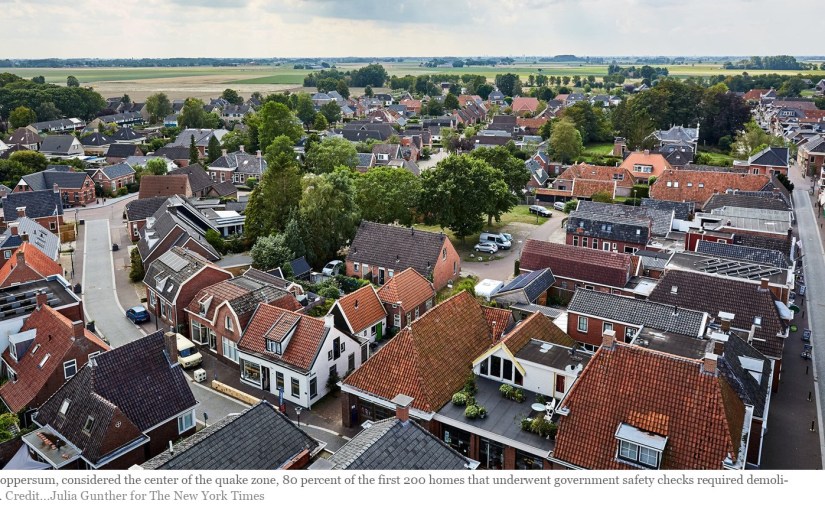
Heading under top-picture: In Loppersum, considered the center of the quake zone, 80 percent of the first 200 homes that underwent government safety checks required demolition. Credit…Julia Gunther for The New York Times
Read more at DutchNews.nl:

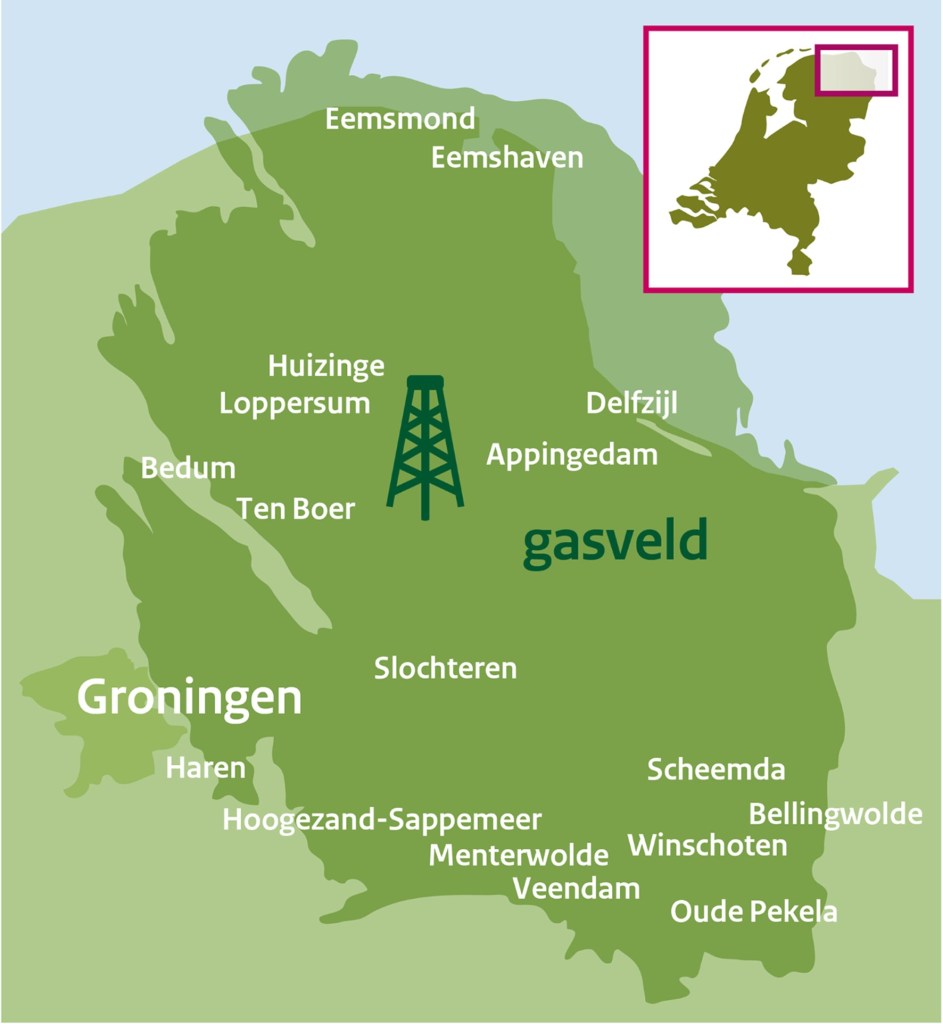
picture taken from https://en.wikipedia.org/wiki/Groningen_gas_field
Note: Update – September 23, 2023 – Dutch government says: the gas will be shut off permanently by 2024! Groningen will be awarded 22.5 billion Euros in reparation.
April 19, 2024 – Mr. Hans Vijlbrief – State Secretary, signs the law document (de Wet – ‘de gas kraan gaat dicht!’) shutting down the well (for good!) where the original discovery (1959) was made. They were looking for oil but found gas. Ceremony took place today in a field near Kolham, Groningen.
May 29, 2024 – Drilling for gas allowed 20 miles north of Schiermonnikoog Island, just off the coat of Groningen.https://www.dutchnews.nl/2024/05/schiermonnikoog-gas-drilling-can-go-ahead-after-all/
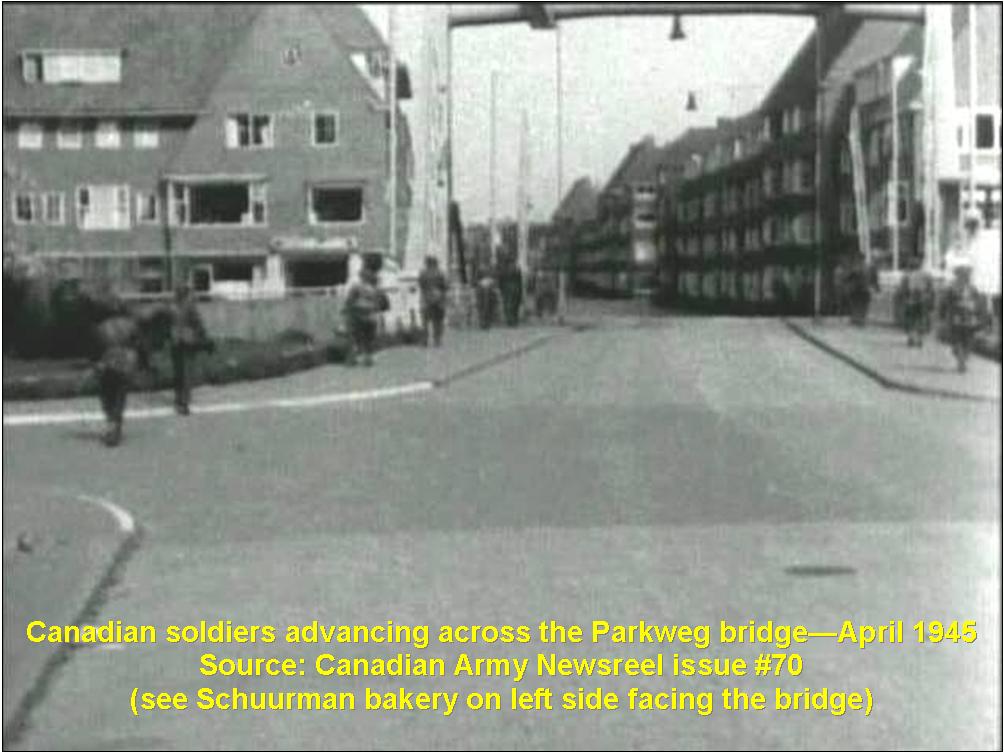
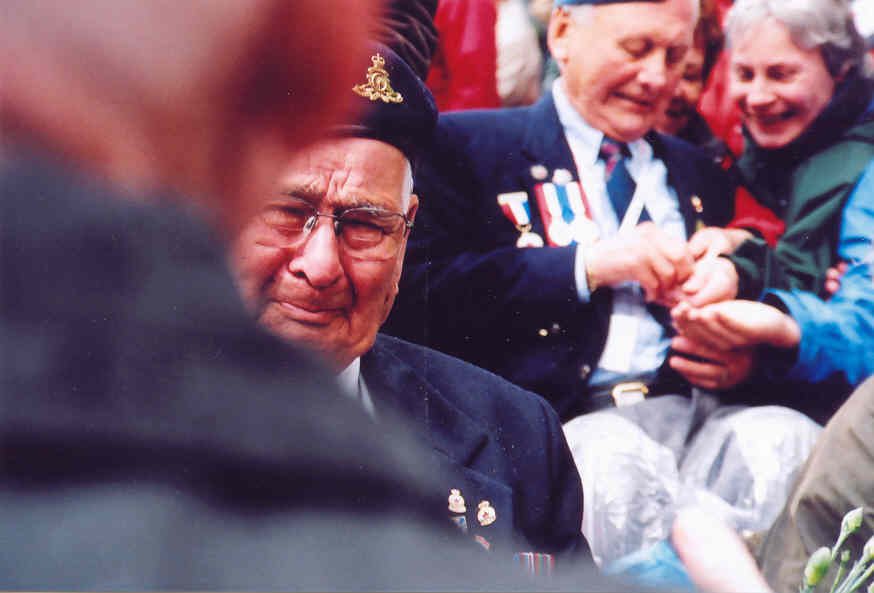
Groningen, the Netherlands on April 13, 1945 my family and I were hiding in the building on the left. These Canadian soldiers were our liberators. NEVER FORGET!


A mutual heartfelt thanks! for the Canadian veterans by the Dutch people.

JS November 11, 2021
Or is this the tip of the iceberg of the Liberal Party’s political dark-side? Bottom line – to be a little prejudiced is OK for the Government but not for Canadians or their non-profit organizations. Or a little bit of trampling by the Government on Canadian charter rights is OK? You be the Judge.
Court finds Ottawa’s anti-abortion test for summer jobs funding within bounds
CHRISTOPHER REYNOLDS – OTTAWA – THE CANADIAN PRESS PUBLISHED OCTOBER 25, 2021
A Federal Court judge has found it was reasonable for Ottawa to require applicants to its summer-jobs program to declare themselves in support of abortion rights in order to get funding.
In a decision Friday, Justice Catherine Kane dismissed a legal challenge to the federal government from Toronto Right to Life as well as its former president and a student who’d hoped to work at the organization.
The court case came after the Liberal government added wording to the Canada Summer Jobs program application that required groups to say neither their core mandates nor the jobs being funded actively worked to undermine constitutional, human and reproductive rights.
Faith-based groups felt the wording went against their religious beliefs, so the Liberals reworked the declaration and eligibility rules for 2019 to make applicants say they don’t work to infringe any Canadian’s legal rights. However, the new ruling says the program’s pro-choice attestation fell within the labour minister’s authority and had a “minimal” impact on the court applicants’ charter rights.
“The minister did not act for an improper purpose, rely on irrelevant considerations, or show bad faith or a closed mind in making this decision,” Kane wrote.
“Given that the decision reflects a proportionate balancing, it is a reasonable decision.”
The jobs program aims to encourage small businesses and non-profits to bring on students and others looking for early experience by subsidizing wages for summer workers.
Informal consultations in late 2018 helped convince the government to change the wording for the following year’s version of the program.
The head of the Abortion Rights Coalition of Canada said at the time that the retooled language achieved the same aim of ensuring that “anti-choice groups,” among others, would still be ineligible for funding.
After the government put the reproductive-rights language in the 2018 application, funding rejections increased 12-fold. Only one of 63 groups flagged to the government as problematic by pro-choice groups received funding.
Blaise Alleyne, former head and current vice-president of Toronto Right to Life, said the group is “disappointed” with the ruling.
“We believe it’s a violation of our charter rights to put a values test on a government program like that, and deny applicants on the basis of their beliefs, rather than relevant eligibility criteria,” Alleyne said in an e-mail.
He said the organization is reviewing the decision, which dismissed its request for a judicial review, and considering next steps.
Employment and Social Development Canada said the summer-jobs program plays a key role in “ensuring that young people have the supports” needed to build successful careers.
“The government of Canada is committed to ensuring that the Canada Summer Jobs program supports quality job opportunities for youth that, among other things, take place in safe, inclusive and healthy work environments,” the department said in an e-mail.
This content appears as provided to The Globe by the originating wire service. It has not been edited by Globe staff.
A Hamilton Spectator reader comments on the above news feed hits the nail on the head!
Regarding “Ruling says anti-abortion test for summer jobs within bounds” (Oct. 26): Even before 2017, when the Trudeau government linked views on abortion to access to the Canada Summer Jobs program, I have been highly concerned about our path toward totalitarianism. Now that this attempt at thought control has been endorsed by the courts, we should all be very, very concerned. This has nothing to do with abortion, but has everything to do with your opinions and your right to express them, personally or in a group. How long before you are denied access to services and opportunities because you don’t accept the government’s viewpoint on such issues as climate change, open borders or foreign policy? Will your pension, access to medical care or admission to university be compromised? If you think these things cannot happen to you, consider all the jobs and careers you have seen evaporate under the repressive doctrine of cancel culture.
The reader then comments on the fact that the Spec had No Comments to make. He then concluded with the question – Where is your outrage?
JS – November 1, 2021
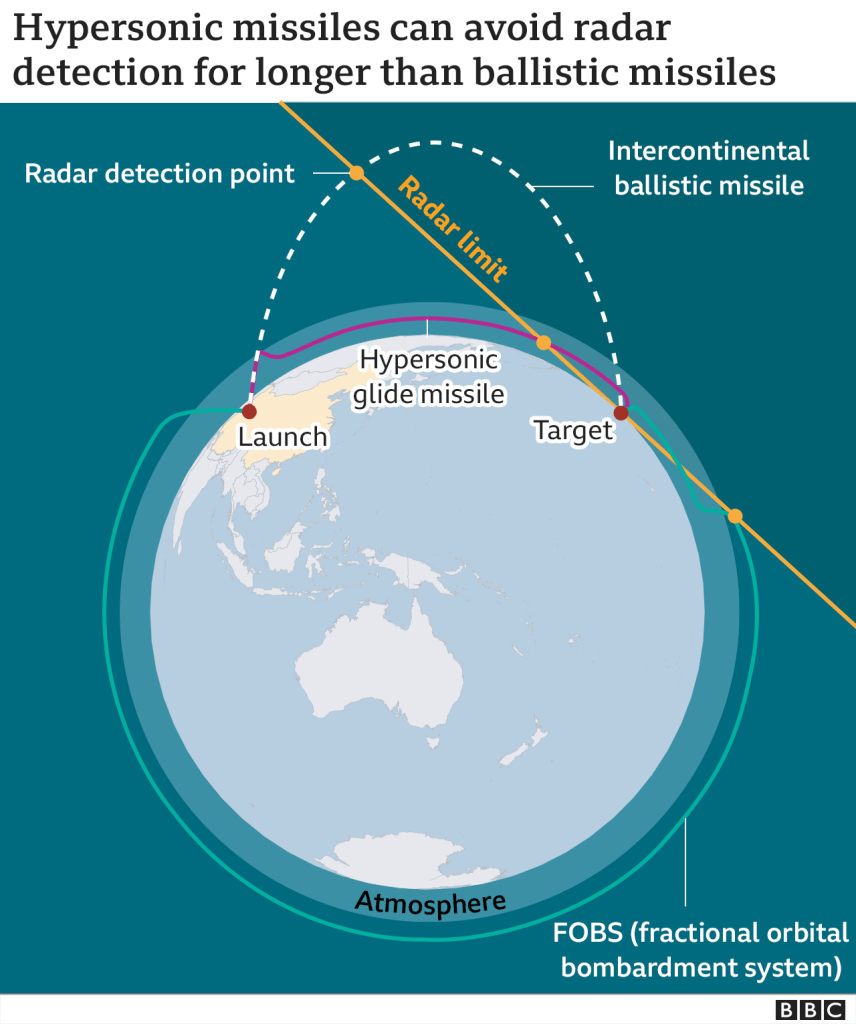
China has launched a hypersonic missile: Could it spark a new arms race?

Some of you may remember Barry McGuires song: ‘Eve of Destruction’ (1965)
Don’t you understand what I’m trying to say?
Can’t you feel the fear that I’m feeling today?
If the button is pushed, there’s no running away
There’ll be no one to save with the world in a grave
Take a look around you boy, it’s bound to scare you, boy
But you tell me over and over and over again, my friend
Ah, you don’t believe we’re on the eve of destruction
New York Times (Oct 27, 2021) had this recent report – WASHINGTON — “China’s testing of a hypersonic missile designed to evade American nuclear defenses was “very close” to a “Sputnik moment” for the United States, Gen. Mark A. Milley, the chairman of the Joint Chiefs of Staff, said Wednesday in the first official confirmation of how Beijing’s demonstration of its weapon capabilities had taken American officials by surprise. The tests, which could revive fears of a Cold War-like arms race, come as Beijing is spending heavily to modernize its military and may be seeking to expand its nuclear arsenal.”
And these were the head lines on the BBC News website (October 25, 2021): “Is China’s present missile development program a contest of strength that will be used as a threat to extend their political and moral supremacy over the world?”
Here is an excerpt from that article: “Some advocates of rapid US nuclear modernization have seen the recent Chinese tests as “a Sputnik moment” as a reference copy to the surprise and alarm registered in the US at the Soviet Union’s first orbital satellite in the late 1950s.”
“However, but some experts would disagree and don’t believe this test by China creates a new threat. James Acton of the Carnegie Endowment for International Peace says the US has been vulnerable to nuclear attack by China since at least the 1980s.”
Are some of the powerful nations stealthily and silently back into the STAR WARS competitiveness scenarios of the “Cold War” and the Reagan era? Being a teenager in the 50s, I remember the shock of reading that front page headline in the Globe and Mail newspapers on that 1957 October 4th early morning when I picked up my paper-route newspaper bundles for delivery along King Street, King William, Rebecca, Wilson, Mary Streets and Ferguson Ave in the city of Hamilton. The Russians had won the “cold war space race” and we were all in big trouble. The alarm sirens that had been strategically located around the city in the previous years to warn of nuclear attack were now our only defenses to save our lives. ( I think Hamilton had 5 of those)

The USA (read the Western World) now had lost their prominent scientific advantage for space weapon superiority and we would soon be in a war we would never be able to win. The anxiety of that thought was never far from my mind. The nuclear Cold War had been lost.
Although this was an anxious time, the population of the day continued with their work, studies and chores as before. What could they have done otherwise? Nevertheless there hung a threatening (cloud) in the sky. What if somebody slipped up or an unforeseen mechanical accident occurred? Where would we be safe?…………… Being a Christian, I asked, with these all-powerful weapons how can God defend us now? In fact why did God allow the Russians to race ahead of the USA and us? My anxiety about this threat always hung in the back-ground of my thoughts and prayers through my teenage years.
These thoughts were in the minds of others also and were expressed in Folks Songs of that day like: ‘Were have all the flowers gone’ by Peter, Paul & Mary, the Kingston Trio, Joan Baez, Brothers Four and many, many other singers. (Especially during the Vietnam war days)
Perhaps Peter Seeger expresses it the best in this song with Judy Collins: Turn, turn, turn, there is a season…….(based on Ecclesiastes chapter 3, verse 8 and on) which has this fitting ending:
To everything (turn, turn, turn)
There is a season (turn, turn, turn)
And a time for every purpose, under heaven
A time to gain, a time to lose
A time to rend, a time to sew
A time to love, a time to hate
A time for peace, I swear it’s not too late
I also recently ran across a poem by I.F. Stone, (1907 – 1989) an investigative journalist and author who wrote it to commemorate V-E Day in 1985.
Prayer To A Displaced Person
Our father,
Who art in Heaven
Where shall we find You
When contending armies
Build battle stations
In the skies, jostling
For high ground
In outer space?
Where then will we hear
The Herald Angels sing?
Will You become
A displaced person
Searching among the stars
For a place
To lay Your head?
Who needs God
When particle beams
Spray death across
Infinite spaces
And lasers overwhelm
Your trivial lightnings
And the aboriginal void
You found in the beginning
Yawns again
To swallow You
And Your Creation
Why did You plant that tree
And temp us with the fruit?
Now our rebellion
Is at Your gate.
Where are we going with this at a time when our Climate Change dilemma – Covid 19 pandemic and war and poverty with stark economic inequality is seen all around us? When will WE ever learn!
JS October 29, 2021
The first epistle of Peter chapter 5, verse 7 reminds us: ‘Cast all your cares [all your anxieties, all your worries, and all your concerns, once and for all] on Him, for He cares about you [with deepest affection, and watches over you very carefully]. Translation: amplified Bible
And Gospel of Luke chapter 21, verses 25 – 28: There will be earth-shattering events—the heavens themselves will seem to be shaken with signs in the sun, in the moon, and in the stars. And across the earth the outsider nations will feel powerless and terrified in the face of a roaring flood of fear and foreboding, crashing like tidal waves upon them. 26 “What’s happening to the world?” people will wonder. The cosmic order will be destabilized. 27 And then, at that point, they will see the Son of Man coming in a cloud with power and blazing glory. 28 So when the troubles begin, don’t be afraid. Look up—raise your head high, because the truth is that your liberation is fast approaching. Translation: the Voice
NOTE on Website: Spacing.ca/TORONTO a Chris Bateman article dated November 12, 2015;
…… In 1967, a fault at a downtown telephone exchange triggered dozens of sirens across the city for about 10 minutes. The police were flooded with calls, though no-one was scared, according to reports.
“The only thing that panics people here is when the Leafs lose 10 straight,” a police official said.
As the threat of nuclear war diminished through the 70s and 80s, the Ontario siren system began to fall into disrepair. Lightning strikes and damage by vandals with rifles triggered periodical false alarms. In 1979, a badly timed activation of 50 sirens between Port Credit and Oshawa caused nervous moments for several local residents.
“Some called police and local media to ask whether the alarm was a warning that SkyLab was about to fall on Toronto, ” the Globe and Mail reported.
By 1980, there were 1,704 sirens dotted across the country, according to the Toronto Star. “Most of the sirens have gone the way of the wind, or torn down with utility poles when lines and poles were replaced.” The downtown siren at Yonge and Richmond was still standing at the time, though it now seems to be gone.
NOTE: November 16, 2021 – BBCNews – On Monday, Russia carried out the A-Sat (anti-satellite) test from Plesetsk Cosmodrome, about 800km north of Moscow. The missile destroyed an old Soviet spy satellite, called Kosmos 1408….causing 1,500 pieces of large orbiting objects…… and thousands of smaller fragments some 440km to 520km above the Earth, threatening the ISS, China’s Tiangong space station and other spacecraft. Many countries now have their own A-Sat systems; the US, Russia, China and others have been developing weapons of this kind since the 1950s……and have conducted similar tests since as early as 1985. The proliferation of small satellite technologies will likely see the annual launchings rise above 1,000 satellites a year, greatly increasing space junk garbage.
As October the 31st, 2021 approaches, I will again remember the Reformation (restoration) of our Christian Faith told through the story of the Life of Martin Luther. (1483 – 1546)
My father, back in the early 1950s, when I was 10 years old, had given me a small soft cover book with many pictures that described the life events of Martin Luther, the Reformer. It made a large impression on me. The message was clear: the message of the Truth of our Gospel is in the Bible and can only be received by faith.
This message was presented in a classic film made in 1953. A black and white movie of Martin Luther’s Gospel Truth discovery. This movie can now be found on YOUTUBE a Louis de Rochement film by Luthern Church Productions – Martin Luther | with Niall MacGinnis | John Ruddock | Pierre Lefevre. A copy of this movie was bought by John vanderBoom, director of the Bible League of Canada (then known as the Canadian Home Bible League) and shown to many churches in Canada through the 1960s as a fundraiser for the promotion of the placement of Bibles around the world.
Here below is the narrative in the scene of that movie that was the turning point of Martin Luther’s life search and found for him the rest for what he perceived was his sinful soul and the punishment of an angry God. Luther’s life journey, ‘spiritual angst’ about the anger of God’s dealing in judgement with sinners, to a loving and faithful Father and Saviour. To atone for his sinful soul Martin had stopped his Law studies and entered an Augustinian monastery to devote his life and studies to knowing how he could be right with God. He was ordained as a priest and continued his studies of Scripture and to search rest for his soul
At minute 26 in the movie: The setting is the Wittenberg’s Castle church where Martin Luther was pastor and served as professor at Duke Frederick’s Wittenberg University. In this scene, the church Vicar shows to Martin Luther and members of the church, his newly collected acquisition of holy relics.
Vicar: All fragments of Saint Jerome and Saint Chrysostom and from the veil sprinkled with the blood of the Saviour; a morsel of the very bread eaten at the last supper; this, a nail driven into our Lord’s feet and hands; a fragment of the true cross. The Vicar then says: with these and all the others I have brought, if a pilgrim were to venerate (revere; give respect to) every single relic in our church, they would be forgiven by God of their time in purgatory: 1 million, nine hundred and two thousand, two hundred and two years, and two hundred and seventy days. He then turns and says: Now, brother Martin………………. but Martin Luther is seen perplexed and upset as he leaves the sanctuary of the church in a hurry.
Later, the Vicar visits Martin Luther in his study. Vicar: Doctor Martin, you don’t think much of my acquisitions.
Luther replies: I’m not sure that Christ does. Dear Vicar, I wish I could be the kind of Christian that only sees and hears, believes and worships and there’s that.
Vicar: Doctor Luther, relics are not an end in themselves they’re merely symbols of holy men and women whose sanctity enables them to intercede in our behalf before God.
Luther: Symbols, it’s true, but if the symbol is replacing the meaning-ness of faith then meaning itself is lost, and if it is the other, I say if then we are lost, lost and damned.
Vicar: this (pointing to the crucifix on the wall) is a simple tool, but is it God’s supreme gift of His only Son we adore. This symbol, the splinters of the wood, the rest of the nails that we worship, this crucifix makes the agony of Christ more vivid for the simple Christian, the little peasant with his prayer to St. Christopher for a safe journey, the poor widow with a tiny Madonna, the soldier going into battle with his rosary, yes – even the Duke of Wittenberg with his noble gifts to our church. Would you take all these away, doctor Luther? You the people’s priest. You cannot afford to shatter their faith by tearing away it’s visible supports.
Luther: As their priest responsible to God for their souls can I afford not to. Symbols to inspire devotion, yes, but crutches to uphold a tottering faith?
Vicar: doctor Luther whence all this sudden doubt?
Luther: This is no sudden doubt but a growing certainty. Dear Vicar, what little certainty I have you gave to me, you heard my sin, you sent me to Rome to fortify my faith; you sent me to Scripture to find my God; you brought me here to Wittenberg to preach his Word; and now here in my room I’ve been preparing my lectures on the epistles of Paul to the Romans and here (pointing to an open Bible) I think I’ve found the truth at last and when I found it, it was as though the gates of heaven were open to me.
The Vicar sits down and reads: Paul’s Epistle to the Romans chapter 1 : verse 17 in Latin (iustitia enim Dei in eo revelatur ex fide in fidem sicut scriptum est iustus autem ex fide vivit)
Luther recounts: ‘For in the Gospel righteousness of God is revealed from faith to faith as it is written: the just shall live by faith!’ and so where do we find anything here of relics, Vicar? By faith mankind lives and is made righteous, not by what we do for ourselves. Not the veneration of relics, singing of masses, pilgrimages to Rome will one purchase pardon for their sins, but by faith in what God has done for them already through his son Jesus Christ.
Vicar: doctor Martin, if you leave the Christian to live only by faith, if you sweep away all good works, all these glorious things and you dismiss them as mere crutches, what will you put in their place?
Martin Luther: Christ, mankind only needs Jesus Christ; THE JUST SHALL LIVE BY FAITH ALONE!
Song: In Christ Alone
JS October 22, 2021
(the above narrative is ‘as I heard it’ and may differ slightly from the Movie score)
It is a week before Thanksgiving (Oct 11, 2021) and I seem to be caught in a spin. Like a spinning wheel that revolves around and around and seems to constantly return to the same starting point. It is the now ‘normal’ that is confusing. Going to the store the other day I forgot to wear a mask and was intercepted by a young fellow shouting: “Sir, you need to wear a mask”. I apologized and went back to my car and got my mask on. What is happening to us?
Going to church is now a contest of sucking in enough breath of air to sing the hymn on the worship screen. Like sucking through a straw. It is difficult to sing the Lord’s praises with a mask on for an octogenarian like me; I do not understand why the 40 or so people in the church sanctuary (big enough for 300 + people) need to wear masks. But if we are all fully vaxxed the chances of spreading something affecting each other is very remote. Is it not? It’s a provincial Covid restriction rule they say.
That brings me to the present Canadian situation.
In the Province of Alberta, medical staff are exhausted they say; because the hospitals are full of Covid patients who have NOT been vaxxed. The Saskatchewan hospitals are also full. Medical staff is warning of a disaster to come, where some Covid people will be triaged to lesser care because of staff shortages. We also hear much news of medical nurses quitting their jobs, too much stress and too many extra hours of work have become unmanageable situations. New Brunswick is facing the same dilemma. Where will it all end? The army is coming to help out they say, but will that stop new no-vaxx Covid cases?. These are head issues in the sense that, how do to you convince someone to consider another truth. This is war but not the kind an army can fix or blow away. (the average 7 day increase in positive tests in Alberta right now is 10.9%; in Saskatchewan it is 13.3%; why so high there? Ontario is only 1.9% but then Ontario has been under stricter rules than other Provinces and I guess that has paid off in subduing the spread of this vicious virus.)
And still there are people protesting, No Vax. And there are also people protesting No masks. Some are saying ‘my body my choice’. Yes, but a choice to get VERY sick? is a BAD choice!
The media shows us video clips of people in ICU with all the technology we know of, strapped to their bodies to help them breathe, to live. There are stories of people suddenly missing a loved one; healthy one week and the next a funeral. And some do not believe it can hurt them. Others say you are mistrusting God if you get the shot. Can it truly be so?
Next, we have the No certificates, mandated to prove we are vaxxed in order to be safe for others who also are attending the restaurants, sports events and other group get-to-gethers? This is a privacy concern they say, and not the business of others to know. But have they ever been stopped to show their driver’s license or health card? Of course; so ‘Where is the beef?’ (a slogan from a Wendy’s hamburger Ad in 1984. It increased sales by 31%. Maybe we should use it to draw the attention of the No vax crowd?)
The production, research and advance of this vaccine has been nothing but a heaven sent miracle effort. I know much of the world believes this is ‘look at us’ taking control of our lives, but I really consider this be a gift from God. Yes, smart people made it, but our created reality has made smart people (see note at bottom) able and possible to get it done. It almost reminds you of that sermon on the book of Psalms, song number 8 (a King David song, a song fit for a King) and also the quote in the letter to the Hebrews in chapter 2; where we read “Yet you have made him (mankind) a little lower than the heavenly beings and crowned him him with glory and honor. You have given him dominion over the works of your hands….” Mankind made in the “likeness of God” has been endowed and enabled by the Eternal to discover and make this medical breakthrough for our time. A God given gift. We agree with the Kingly Psalmist when he says: Lord, our Lord, how majestic is your name in all the earth! Oh, the common grace God freely gives!
Shall we waste this gift, reject it and despise its usefulness. No way!
Are there issues with this about how to protect everyone? Yes. Are we concerned that our egos and privacy will make us feel more or less important than others? No doubt. But let’s together see this through. Will the virus be gone soon, like the Spanish flu or the eradication of small pox and polio? Nah, I think we will always need to be on our toes. And remember the rebelliousness in ourselves will not always be overcome by the kindnesses of this world. Just see what happens when we participate in our national religion called “Politics”. Everyone for himself! Give it to the other team and give it often.
So then how will we celebrate Thanksgiving? Lets give a handshake for the Amens of thankfulness for the fruit of the land, including the fruit of medical research and discovery of all types of ‘sweet fruits’ to make us well again and drive away sadness, despair and the angry-nous of all; disease and sickness, viruses that attack and devour the old and the young. (to date almost 5 million world wide)
We will celebrate in humbleness and sincerity and acknowledge that our lives are but a ‘breath’ and that we are not ourselves but are part and of the Eternal’s big plan. Let’s do our part. Be kind get your shots! and give thanks to God for His marvelous gifts to mankind!
The 3rd and last verse of ‘We Gather Together’ a favourite Thanksgiving hymn is:
We all do extol you, our leader triumphant,
And pray that you still our defender wilt be.
Let your congregation escape tribulation; (like the virus and other oppressions)
Your name be ever praised! O Lord, make us free!
JS October 4, 2021
NOTE: God has given ability to mankind by his Spirit. In the Book of Exodus, at the construct of the Temple, chapter 31; verses 1 through 5 it tells us: The Lord said to Moses, 2 “See, I (the Lord) have called by name Bezalel the son of Uri, son of Hur, of the tribe of Judah, 3 and I have filled him with the Spirit of God, with ability and intelligence, with knowledge and all craftsmanship, 4 to devise artistic designs, to work in gold, silver, and bronze, 5 in cutting stones for setting, and in carving wood, to work in every craft.
The following are listed as registered Political Parties in Canada (2021)
On the whim of one person, Justin Trudeau, Canada was cast into an election mode in the middle of a rising Covid-19 Delta pandemic. He said Canada needs him to show the way forward as we are in crisis mode. Many new initiatives need to be started by a strong unlimited political power. The Liberal Party!
And so we started the roller caster on the scripted track but it soon began to sway and became undone. What have we experienced so far?
No vaxxers protests near hospitals overrun by sick no-vaxxers; hiding personal vaccination status especially among (candidates) Conservatives; 620 million dollars wasted for election expenses; evading clear direction on vaccine passports; Jason Kenney’s blunder on “Open for the Summer” Alberta announcement boomeranging back with large number of ICU non-vaxxed sick people; USA border openings: Masks on orders in public indoor places; the rise of the Freedom Party otherwise known as People’s Party of Canada with Maxine Bernier; Trudeau’s claim only the Liberals (read: Justin) can solve Canadian problems; accusations by all parties of Gov’t neglect on Native issues (graves of children at Residential schools, land claims; water on Reservations); Covid-19 issues; Pipe lines; Climate change; Day care initiatives; messy plans and execution of ‘out of Afghanistan’ rescue of “friends of Canada”; housing crisis; and then the other little irritants of sexual misconducts and racist remarks (Oh boy, the internet has a long memory) and finally the National Debt among others.
With attack ads sickening the beautiful Fall of 2021, it is probably a good thing that the election is only 36 days long!
My prediction is a Liberal/Conservative near tie with all other parties increasing their votes and maybe we will have a few seats in Parliament for the unknown, even though the First Past the Post system will not be lenient in seeing ALL voices heard on the Hill, only those who shout the loudest!
When all is DONE, may respect, fairness and kindness still be the law of the land!
So much for democracy.
Like a real JELLY-PUDDING, the new government of Canada will quiver, tremble, shake, vibrate and almost flop over, but steady up as always.
Peace be with you. JS Monday morning 9 AM September 20, 2021
Book of Proverbs 29 verse 18 reads: “Where there is no vision from God, the people run wild, but those who adhere to God’s instruction know genuine happiness”. Translation: The Voice
The early Tuesday (Sep21) results are a mirror of the 2019 before: 158 (157) Lib; 119 (121) Con; 34 (32) BQ; 25 (24) NDP; 2 (3) Green; (1) Indep
You Tuber ‘Beau of the Fifth Column’ states:
For the USA this August 2021, the forecasts tell us that 100,000 people will die of Covid-19 in the next 90 days.
Covid-19 statistics gathered in the last 12 months indicate that if you wear a mask when out and about in the public, the number of deaths will drop to half (50%) so that number would be 50,000. 50,000 lives are saved. Although still too much, this (simple) prevention method seems effortless! Just wear a mask!
This means that if you do this, you can SAVE the lives of people like possibly your neighbour, your friend and yourself.
People, this is a no brainer. So why are you not doing this?
See: the Beau of the Fifth Column You tube info
JS AUGUST 30, 2021
I love cutting the grass.
The smell of the new mowed grass of this outdoor activity is a very soothing exercise. Well, except maybe the noise! I love the way all grass stands at the same height and when trimmed along the edges it produces a neat, clear and exact fresh look. The up and down or across the lawn movement give me a good sense of accomplished satisfaction. You can see where you have laboured as you move row to row. Although it is very mechanical and rote, it is at the same time relaxing. Many a thought has crossed my mind as I progressed in my work. This may sound strange but always thoughts of Psalm 103 ring through my head – ‘Our days on earth are like grass; like wildflowers, we bloom and die. The wind blows, and we are gone— as though we had never been here. The Africaans version of this Genevan version of the psalm perhaps says it best: ‘Die mens – soos gras is al sy lewensdae, ‘n blom wat ons aanskou met welbehae, maar wat kortstondig is en baie teer. Sodra die rukwind oor die veld gekom het, dan knak die steel wat lustig daar geblom het: dis weg – sy staanplek ken hom selfs nie meer.’ If you are able to read this language it gives a very colourful description of our life-span event and lays the emphasis on the shortness of it all. (‘the winds of life – a sudden (unexpected) gust ‘een ruk-wind’) can snap its beauty and it disappears without trace!) There is much show and beauty but then a sudden end with a thought of: who knows who this was? who cares to know their resting place, for over time that all will vanish from the everyday events.
You may think what an odd thing to do is to think about your end. Cemetery dismal thoughts………but know this headline of verse 8 of Psalm 103 and is often read after the remembrance celebration of the Lord Supper event in our churches: Listen to this (again in Afrkaans): Barmhartig en genadig is die HERE, lankmoedig en groot van goedertierenheid. Hy sal nie vir altyd twis en nie vir ewig die toorn behou nie. Hy handel met ons nie na ons sondes en vergeld ons nie na ons ongeregtighede nie. Want so hoog as die hemel is bo die aarde, so geweldig is sy goedertierenheid oor die wat Hom vrees. So ver as die ooste verwyderd is van die weste, so ver verwyder Hy ons oortredinge van ons. Soos ‘n vader hom ontferm oor die kinders, so ontferm die HERE Hom oor die wat Hom vrees. Want Hy, Hy weet watter maaksel ons is, gedagtig dat ons stof is. ‘As far as the east is from the west, [so] far hath he removed our transgressions from us. Like as a father pitieth [his] children, [so] the LORD pitieth them that fear him.’
This is the comfort for a lifetime of rest for your soul. As the (murderer turned chaplain) prisoner said: ‘When I was down and miserable because of my past life and then for the first time read this declaration from God’s Word for my life, a whole new chapter opened up for me. Just imagine my struggle with God: vanished in a moment: ‘for God promised as the East never meets the West; SO FAR HAS HE REMOVED MY MISTAKES AND REBELLION FROM HIS MIND! What a declaration of forgiveness! How could I not but be a servant for Him! Praise God!
And so, this promise is for all of us who do the daily ordinary (failings) things we do. Your life will be a cutting the grass exercise, forgiveness is guaranteed at every step and even your past will look smooth and neatly trimmed because the promises of Psalm 103 gives you that pleasure.
JS August 1, 2021
A quote from the poet – Emily Barret Browning (1806-1861) “Earth’s crammed with heaven, And every common bush afire with God; And only he who sees takes off his shoes; The rest sit round it and pluck blackberries“.
Lang zal hij/zij leven, (Long may he/she live!)
In de gloria,
In de gloria,
In de gloria,
Hip, hip, hip, (hieperdepiep) hoera!
This is an old Dutch song that is sung when someone has a birthday or other significant celebratory event in their life. Notice each phrase is repeated three times for special emphasis. The GLORIA has a special mention here, I think it means as long as life lasts and from then on and into an eternal different plain, FOREVER. Usually the person so honored would then distribute an edible gift to those present. (at school, everyone in the class would be offered a candy, or a piece of cake or cookie)
This year is a special year of celebrations for me. Not only is it my 80th birthday but also it will be exactly a year ago that I had my by-pass surgery. I received a miracle, I have healed and life is good!
There is so much in our lives to be thankful about. The recent events (July 2021) in the world, (floods in Europe and tornadoes in Barrie, ON, so close to home) made me realize again that the edge of despair is always close by. I am more aware of my most blessed position and residence, now that I will become an octogenarian, than ever before in my life.
In my father’s generation there are only a few who lived to be this old. My mother Trientje Oosterveld was 80 when she died; my dad, Derk was 78; my father’s mother, Oma Titia (Grasdijk) was 87, (she was a strong woman); my Opa Jan was 74; my Great-Opa Derk was 73; my dad’s older sister was 97, (she was still biking in her 80s) his one brother died at 56; the other brother was 80. On my mother’s side most of (her brothers and sisters) my aunts and uncles, died in their 70s or early 80s.
It has become a habit for me to note the obituaries in the Hamilton Spectator especially on Saturdays morning when there seems to be a long list of persons who have passed away during the previous week. I read that many are in the 80s and 90s and I am taking note!
Life is good! Longevity is what everyone wants and seeks for in their life. Medical advances, access to care, prescriptions or herbal additions are abundant in every pharmacy and the discovery and promotion of drugs and health products continue to be produced and manufactured everyday that have helped many persons manage and recover from health issues and concerns that killed people 100 years or even 50 years ago. Treatments and cures of every kind can be obtained and purchased. Some of these are extremely expensive as they are produced in small limited batches for exceptional diseases that only the rich or the well insured can afford. The promos for health products knows no end. Hospital medical surgery techniques now are wonderful and almost magical. (See the Covid treatments and vaccines development recently) Thank God for the Canadian Health Care benefits that we as citizens enjoy in this country.
But besides all of these wonders there is also much disappointment in that the obituaries, which do not cease, eloquently continue to describe and record the griefs and sorrows for the passing of a loved one. There is no end. It is what life is.
But life still also has its great “I’m alive” moments.
One of the greatest pleasures for me is to sit quietly outside in the early morning in a garden, a camping spot or place of restfulness somewhere, and just listen to your surroundings: the sound of a summer breeze in the trees; the song of a little wren; the fluttering of a bee, working already with the early morning light doing what bees do – busily gathering honey and spreading life’s fertility from plant to plant; lake water crystal clear lapping at the edge of a sandy beach; the sight of an ant carrying to its nest food for winter; the occasional tweet of the cardinal and the majestic posture of a blue heron in a misty sunlit pond and the bright yellow petals of the sunflower standing tall among its garden companions.
How sweet it all is. This then is a time to give thanks. A time for a soul to remember the goodness of life. A time to give thanks and say a prayer to the Giver of Life, to feel humbled by the created world we see, touch, smell and hear. Go ahead take a breath and smell aura of the garden. Doesn’t that give you a crisp new feeling of new hope, new starts, and the joy of ‘just being alive’ satisfaction?
And as you listen closely with you heart and soul, you will hear the whisper of God in the breeze, echoing in your resting soul stillness.
“For you my child, I made all this, come, enjoy, work and be joyful; till in the GLORIA.”
July 18, 2021 (on being 80 years young) JS
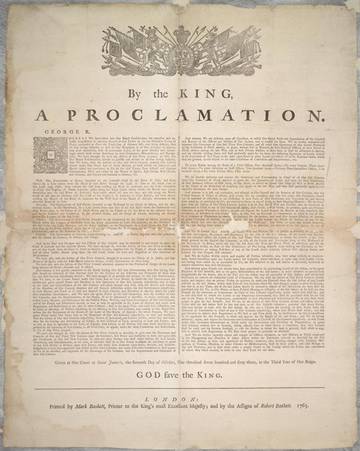
1763 – A Proclamation by King George 3rd of England

the 1982 – Canadian Charter of Rights and Freedoms

are they still in effect and effective for all CANADIANS?
June 11, 2008 Prime Minister Harper apologized to the Native community. Where are we now?
Still blind to our HISTORY?
See ‘Listening to History’ sculpture Meyer Gardens Grand Rapids Mich. USA
Top of Blog picture taken by JS – Horseshoe Falls, Niagara Falls, Canada
July 2, 2021 JS
The fear that gripped me (affecting us all) last March 2020 when it was ‘breaking news’ that a deadly virus was present in my neighbourhood, was removed for me this week-end by getting that 2nd shot of the Pfizer vaccine. It promises good protection from the virus and will give much needed reassurance in all of us moving slowly back to our normal way of life.
Halleluiah! Yes, literally ‘Praise God’ for the vaccines.
I know many would not express it that way as they would say: Science and good research and facilities operated by excellent minds made this happen. I appreciate and understand that praise for the efforts and smarts of the laboratorial medical men & women with the pharmaceutical enterprises ( and government funded vaccines) are to be commended and thanked, but hey- without the gifts of ‘earthly materials’ it would not be possible. These are the essence of the created world, with its unlimited resources, creatures and human beings and along with its many other wonders (wonderful) are a surely a God-like thing!
At a Mega-Clinic event, over 26,000 arms took the shot on Sunday, at the Toronto Scotia Bank Arena, a North American and perhaps a world record for vaccinations in one day at one location. Only in Canada you say?
Now 30% plus of Canadians have had 2 shots of these amazing vaccines for protection against the Covid-19 virus. May God be praised! and many protected from this deadly virus.
‘There is so much here (in the world), O Eternal One, so much You have made.
By the wise way in which You create, riches and creatures fill the earth.’
Book of Psalms 104 verse 24 translation The Voice
June 29, 2021 JS
Since writing about the Kamloops Residential School news and the whole issue of misguided leadership of church and state, I came across a news piece written by Reinder Smith a journalist (verslaggever) with RTV Noord. (a TV radio station in the province of Groningen, The Netherlands) He writes about an anniversary and a ship called ‘De Leusden’.
‘De Leusden’, a ship in which the City of Groningen, The Netherlands and the local Chamber of Commerce had a 1/9th ownership, sailed with the fleet of ships that the Dutch commercial traders had setup in 1621 known as the ‘De West-Indische Compagnie (WIC). This company profited much from the slave-trade-commerce, so prevalent in 1600s to early 1800s. This year (2021) will be the 400th Anniversary since that inaugural beginning. Reinder Smith remarks that he had not noticed any references to this 400th event in the present local news. Perhaps that is due to all the thoughts, questions and negative re-actions that we have noted (some call it our ‘woke’) in the last year or so about remembering and honoring historic figures and events. (Think statues, names on buildings, sport clubs and educational centers etc.)
‘De Leusden’ sailed for the Gold Coast (Ghana) to the fort called ‘Le Mina’ (built by the Portugese in 1482) on March 1, 1737 from the island Texel to facilitate the transport of persons (read – slaves) from there to the Dutch colony of Suriname (Paramaribo) to be sold for do slave-work on the sugar plantations. The sugar plantations were very prosperous for the Dutch. (see – ‘Hoe duur was de suiker’ – a book in Dutch by Cynthia McLeod and produced as a movie in 2013)
On November 19,1737 at ‘Le Mina’, they loaded onboard; 680 slave prison persons, a substantial load, thus promising great profitability even though the records of other slavery trade transports indicated that many would not survive the voyage across the Atlantic. (on a previous voyage ‘De Leusden’ had taken in 687 slaves and only 280 reached Suriname alive)
As the ship approached land, on January 1, 1738, the weather turned bad and Outtjes, the captain, sailed up the wrong river, the un-navigable Marowijne river instead of the usual Suriname river, causing the ship to hit a sandbank, flounder and capsize. The crew then proceeded to nail shut all the exits to the hold were the 680 slaves were housed, less the crew be in danger of being over-run, as space on the life boats were sufficient for the 73 sailors only.
The 664 persons in the hold of the ship died a terrible cruel death. There were 16 slaves that survived as they happened to be on deck when the ship sank and these were sold in Paramaribo (Suriname’s capital) for 4,140 guilders.
A trunk containing 23 kilos of gold however was rescued from the ship before it sank. The gold rescuers insisted they be paid for its salvage, which they eventually received.
Leo Balai‘s book – ‘Slave Ship Leusden: A Story of Mutiny, Shipwreck and Murder’ published in 2014 has pulled this story out of the forgotten history of The Netherlands.
At the time of the tragedy there is a record of letters concerning payment for the gold salvage, but shockingly no words or indications of regret and sorrow over the lives of 664 persons who died and drowned mercilessly on the ‘De Leusden’s’ final voyage. This was the worst loss of lives for a sea-ship tragedy in the history of seafaring for The Netherlands.
For sometime after there were conversations about raising a monument on the bank of the Marwijne river commemorating this event, however the project just faded away.
Where are we today? We have shut the door on many of these historic instances, trying hard to forget?, all these lessons we should have learned from. Many wrongs have been instigated by our collective ‘I think its OK’ culture, but on closer examination lacked any kind of compassion, justice or peace.
Think about it! Do something about it! Be part of the solution! To those who are able: Can you at least apologize and say ‘you are sorry?’
The Christian Reformed Church of North America CRCNA Contemporary testimony # 53 states:
“We call on all governments (individuals and persons) to do public justice and to protect the rights and freedoms of individuals, groups, and institutions so that each may do their tasks.
We urge governments and pledge ourselves to safeguard children and the elderly
from abuse and exploitation, to bring justice to the poor and oppressed,
and to promote the freedom to speak, work, worship, and associate.”
Picture taken from: Loopnews Emancipation Monuments of the Caribbean
JS June 13, 2021
Two hundred and fifteen remains of children have been located in unmarked burial sites at the Kamloops Indian Residential School (Roman Catholic Church administered) in British Columbia province, which was closed in 1977. There were 139 of these Government schools identified of which the Truth and Reconciliation Commission of Canada Report said were established “primarily to break their link (the native children) to their culture and identity”. Estimates of unreported deaths of indigenous children at all residential schools is believed to be as high as 6,000. There is a registry of listed deaths at the University of Manitoba and was created and is maintained by the National Centre for Truth and Reconciliation (NCTR). An example of structural racism. A road full of tears and cries unspeakable!
Who were they and who were their parents and where did they come from; what were their ages; why did they die?
It is shocking to know or not know who buried these children and who made the decision to dispose of them in an unmarked and unknown graves. It is even more shocking to learn that the last of these schools were closed in the 1990s and that recommended actions to tell the truth about these institutions have been documented and agreed to but not acted on for a long time already. Maybe the ‘don’t talk about it’ would make it go away? Or too many people have a guilty conscience? (the teachers, principals, administrators, church officials and government officers)
This is just part of our past here in Canada but what about the rest of the world. Just now the USA remembers with reluctance, the 1921 Tulsa Black Wall Massacre, incited by city officials and the white community; where 35 blocks of Black neighbourhoods were destroyed and up to 300 people died, hundreds were injured and over 10,000 people lost their homes. A race riot. Again a place of unmarked mass graves.
What about other events going back in the recorded history of the world. To name a few unknowns: The massacre of people in the Congo by the King of Belgium (King Leopold the ll) forcing the local natives into slave labour (with punshment) for the harvesting of natural rubber. (think Dunlop tires) Prompting a Belgian expression of regret to the Congo government in 2020. What about the genocidal events perpetrated on the Herero and Namaqua tribes in Namibia by German colonization. Estimates are that 100,000 Namibians (reports from Missionaries) were killed as they revolted again the colonizers taking over their land. (in recent news of May 2021 the German government agreed to pay 1.1 billion Euros over 30 years – a mere pittance!)
Thinking about all of this will take us back to the Slave trade of the 1600s where the Dutch and English traders, owners and sailors (upstanding people in their home communities) of the ships that were used to transport captive native tribes people (many sold by their own people) from Africa to North America. And what about the whole aspect of colonization. So many sharp edges on the getting of wealth and man’s unbridled thirst for more and more.
The Charter Rights (Doctrine of Discovery) of the explorers as they ‘discovered’ new lands in their journeys of discovery (?) claimed possession and jurisdiction to new found lands and continents with the Pope’s blessing. As a 12 year old Aboriginal boy from Australia has said: ‘What did they (white explorers) think happened; we have always been here. This is our land, our home.’
How many of these domination actions can you name? I have listed a few. Think not just of racism against the African people but count the atrocities of wars; against Jews, Christians, Natives, black, yellow or white, religious and patriotic and all for the glory of god and the Emperors.
A stream of never ending assaults! Unbelievable! Unbearable! Unrepayable! Embarrassing, cruel and wrong!
All of us, even the ‘unreligious or un-spiritualistic’ person will find within their ‘souls’ the inkling bothersome conscious awareness that all of this is not right, not the way it should be. Not following the ‘golden rule’.
Why do we have this notion of feeling that the earthly human bus, full of ‘souls’ has left the road and is in the ditch? Do we have the ‘towing’ capacity to put it back where it should be, on the road?
The biblical command: Love God and your neighbour as yourself or the words of an old African-American man: ‘Love God and be kind to your neighbour!’ Sums it all up. How easy and how difficult!
Book of Proverbs 3: 9 – Make no plans that could result in injury to your neighbour; after all, he should be more secure because he lives near you. translation: the Voice
May you be blessed with: ‘Sterkte’
JS June 2, 2021
Related song: The prayer of the children by Kurt Bestor
May 4, 2021 – We are in the last stretch……..
Over 30% of Canadians have now received their first shot. The medical people tell us that when we get to 60% to 75% the virus should start to disappear and with that many vaccinated persons the chances of catching a severe case of Covid sickness should be limited to like a mild flu. The experts say we can get back to normal maybe in the later part of this year’s 2021 summer. It all depends on vaccine availability and the population’s desire to get vaccinated.
The information about blood-clotting for the Johnson & Johnson and the Astra-Zeneca vaccines complicates the administration of the sparse supply of the vaccines now on hand. Many people who have obtained an inoculation appointment are now changing their minds and asking for another vaccine. This will slow down the volume of those inoculated and will make it longer to obtain crowd immunity.
We have been promised (emphasis is on the word ‘promised’) millions of Pfizer and Moderna supplies coming each week in the month of May 2021 which hopefully will increase the volume of people with at least one shot driving us toward the where the sickness caused by the virus will not be so severe and only be mild. This will eventually result in the eradication of the virus altogether.
We are tired and languishing. But yes, we are seeing the end of the tunnel. The darkness is turning to more hopeful signs of normalcy.
However, for now the numbers are still bad (Ontario has over 900 people in ICU) we are encouraged by the forward striving of Health care for Covid patients and the ‘promises’ of more vaccines.
The ‘anti-vaxxers’ are still loud and strong. It is tough to convince them (like squeezing a camel through the eye of a needle) that the Covid restrictions** are not about personal and civil rights but about defeating the virus. And even though there are many stories of people who had loved-ones affected by the Covid and strongly advise others to take care; get vaccinated; this virus is brutal, no kidding!
Do not let your guard down, use common sense, be safe, protect yourself; protect your neighbour.
Together we can get there.
JS – May 5, 2021 –
Soon it will be May 10 again – This is the time when we remember what our parents’ generation and their families experienced during the 5 years of the 2nd World War.
This is Jan Groenewegen’s story of May 10, 1940 – Rozenburg (Rozenburg is a small island in the Waterweg (opposite the town of Maassluis) leading from the Port of Rotterdam to the North Sea)
May 10, 1940! WAR IN THE WEST … … … … … … … … ..
GERMANY AGAINST THE NETHERLANDS, BELGIUM AND FRANCE.
Memories of the first days of the war – experienced and written up by Jan Groenewegen (1906 – 1974) brother of Cor Groenewegen , Rozenburg, NL (translated by Petronella Schuurman – Groenewegen from the original Dutch document into English – April 27, 2011)

Published by JS – Burlington, April 30, 2021
What we as locals experienced during this time.
Rozenburg, NL – Early in the morning of Friday, May 10, 1940 – Many people are gathered in groups, staring at the sky. Some have already seen aerial dogfights. Our fast hunters, the G l ‘s, against German aircraft. Others have seen burning aircraft crash. Many faces show serious warnings of anxiety, yet people stay generally calm.
It is noteworthy, how low the enemy planes are flying. Before noon rumours are circulated with all sorts of stories. Radio announcements state that the German troops in the early morning crossed the border at various places. There is fierce resistance and many enemy aircraft are brought down. But there are also reports of ejected parachute troops landing in various areas.
In the morning at approx. half past three I wake up and my wife asks, “Do you hear all those aircraft?” Yes, I hear the planes, which in itself is nothing special, but there seems to be an usually large number of them in the air.
I get out of bed and come into the kitchen where I can see the sky over the harbour Waterway is indeed flooded with many black monsters. I walk into the front room and see only one man standing on the road, who seemingly appears to be enjoying the nice weather. At the neighbours, Van Riel and Sala, I see no one. However, I hear in the distance some shooting. I think that is probably the Dutch Airforce holding training maneuvers and decide, being still sleepy, to go back to bed.
Around seven o’clock, I get up and wash myself. I hear someone stumbling up the iron stairs. It is Krijn Pols, one of our machinists who steps into the kitchen and calmly observes: “They are really at it!” “Yes, is my answer, they certainly are holding great training maneuvers. ”Great training maneuvers? Man, we’re in the middle of a war, we’re in the thick of it!” ”War?” I ask surprised, “With whom?” ”With the Germans,” said Krijn. He goes to work and I’m going to wash and dress and have a tea.
It’s a miracle that I take everything so calmly, although I simultaneously observe a great apprehension inside of me wanting to challenge this intruder. When I come down in the shop the staff is at work, but whenever bombers or large transport aircraft fly over the “Buurt”, (ie neighbourhood),everyone runs outside to the road.
Picture of the business of Jan, Piet & Klaas in Rozenburg
Just before noon, as I am standing by his garage with Adr. Hartman, speaking to him, we hear distant machine gun fire in the air. Later we hear that those were aerial dogfights in the west direction of the coast.
At the same time – almost half past eleven – I see in the direction of the Staaldiepsedijk (but known to the residents of Rozenburg – as the Brielseheuvel) an aircraft circling low, and then dropping out of sight. We get the impression that this is a German unit that has landed. Hartman and I take steps to immediately jump in my “Opel” and drive to the “Heul”. There are many people standing on the causeway. From them we learn that in indeed a German plane has landed in the” Droespolder “, situated close near the bush owned by the Brothers Oosterlee. This machine landed in a wheat field owned by Jaap van Dorp. Twelve soldiers get out and start pushing to turn the plane so that it could take off again, but then immediately disappear into the nearby woods, to take cover. We drive by car as quick as possible back to the “de Buurt”, to the town hall to let the mayor know what has happened. Jaap van Dorp on his motorcycle riding at high speed had arrived a little earlier to bring the same message of doom.
The mayor phones army captain Smeele located in the “Sheurpolder” and requests as soon as possible that they send a military unit. This is not immediately possible, as in the Noordbankpolder, close to the Sheurpolder another German plane with l4 soldiers had also landed. This plane could not take off as it ended up in a ditch, with the landing gear broken off. The division of Dutch soldiers in the Scheurpolder were already engaged trying to capture the landed Germans. It was not easy to do as in the meantime they had taken cover in one of the barns of the Noordbank. So we could not expect help from there at this time.
The German soldiers had now left their cover in the Droespolder and had traveled to “de Heul”. There they asked Leen Luyendyk if he could tell them where they could find someone to lend them a truck. Leen referred them to Jan J. A. Pols by the Zandweg who had a Chevrolet for transporting cattle and vegetables to the auction at the market. Jan Pols had already seen this coming and had disabled his car just in time.
However. later Leen Luyvendijk was charged and arrested as he had provided information to the enemy and was sent to jail at Fort Hoek van Holland.
But the Germans were still at large and military aid was uncertain.
Already during mobilization a searchlight had been mounted in the “Oudepolder” Kerkdijk – close to Reijer van Gaalen’s, in his pasture, with a group of military operators. These soldiers had fired their guns at the German planes flying over the fields. Apparently the Germans did not like this, because early in the afternoon, a plane flew over very low, and dropped a few bombs in Blankenburg . One of those bombs fell in the ditch right behind the transformer boxes depot opposite the shoe store of Joh. Voorberg and the bookstore of J. M. Robbemond. As a result the windows and roof tiles of the surrounding houses, including Korsen Jack Kleijwegt, Pleun Breukel, C. Quak, the painter and the shop and café Sissy Santos were largely destroyed. It was fortunate that the bomb fell behind the dike and transformer boxes depot, but nevertheless it was a miracle that in this densely populated neighbourhood there were no personal injuries.
Old Joor Poldervaart stood on the dike, but because he was extraordinary hard of hearing barely noticed the bombs. When someone mentioned that a bomb had just exploded he said, “Oh, is that what it was? I thought I heard something.”
The second bomb fell outside the polder onto the so called “Zeven margen”, not far from the farm of Arie Barendregt Joh.z.
John Klink, an employee of Jack de Jong Sr. so called “the man of Trippie” had been busy spreading fertilizer. This man must have possessed imperturbable nerves, because the bomb exploded so close by him as he was spreading the fertilizer, that he was lifted, several feet off the ground by the air pressure. When he landed on the ground, he calmly continued his work. He apparently felt that you cannot stop for every “little” thing.
The “deafening noise” of aircraft continued to fill the air. All around, one could here stories and rumours that were more or less embellished. Later we discovered what had been true or false. Thus, the radio reported that an armoured train crossing a bridge to Maastricht full of German soldiers had been blown up. It was said that German paratroopers in peasant clothing and in Dutch army uniforms, had landed in Holland. In some cities N.S.B.ers (Dutch who sympathized with the Germans) had fired on Dutch soldiers and that there were many betrayals done everywhere.
Meanwhile, our mayor Esquire L.G. Just de la Paisieres telephoned for reinforcement to help capture the Germans who had landed in the Droespolder. This help proved still not possible, even though the mayor called a number of addresses, no soldiers could be transferred to assist with this. However, some operators who manned the searchlight from the Oudepolder were summoned to the center of Rozenburg.
Indeed, it was anticipated that the landed Germans, who were heavily armed, would try to occupy the town post office. The German soldiers were now out of the Graspolderdijk and were moving in the direction to the Waterweg.
During the afternoon it was told by Piet Van Darn that some Germans had called at the Zanddijk demanding to make a telephone call.
When I came home in the afternoon there were two Dutch soldiers from the searchlight in the Oudepolder, sitting in our livingroom. They had opened the windows and sat with their guns facing outward. This measure was necessary to monitor and guard the town post office. If in case the enemy soldiers would decide to actually get to the post office this was sure to cause a firefight. So my wife with Cootje and taking along what was most needed, decided to leave our house in order to avoid any potential hazards. Tea had been made and I poured the troops a cup and lit a cigarette and tried to remain as calm as possible.
The German soldiers did not show themselves.
After the mayor had tried in vain all afternoon to get a military detachment to come to Rozenburg, he decided to take and make a radical decision. Some forty members of the Rozenburg Civilian Guard (Burgerwacht) were called in the afternoon to report to J. van der Knaap. We were all given a rifle and a couple rounds of live ammunition. Daughters of J. Van der Knaap pinned a band around the arm of each of us, so that we would be recognizable to each other.
Under the leadership of the Commander of the Civilian Guard Jac. Moll F.z. and former President Mr S.C. Heiden, we went by bicycle in the direction of Zanddijk.
At the corner of Zanddijk – Zandweg he split us into two groups. One group led by Commander Jac. Moll would advance along the Vinkdijk. The other group under the command of S.C. van Helden went over the Zandweg to the Heul, so that via the Graspolderdijk we could reach our goal. In this way, the German soldiers were approached from two sides. Meanwhile however, they had nestled in the grain barn of Adam Barendregt Nz, on the Vinkdijk, behind the house and the marketgarden of A.van derVliet. When our group approached the Heul, Mr. VanHelden called a halt and asked for a volunteer to bike to the Graspolderdijk to see if the Germans had remained in their quarters. For this Ariel van der Meijde of “Kiewietenburg” made himself available.
Van der Meijde left his gun behind and rode as an ordinary citizen slowly through the Graspolderdijk. When Van Meijde did not immediately return the commander asked for two more two volunteers to move approx. two hundred meters further down the dike and act as an observation post. R.C.Booden, the butcher and I (Jan Groenewegen, jo b.) volunteered. We took position behind a thorn hedge where we could overlook the polder, so that if the Germans attacked us it would not be unexpected. Meanwhile, Van Meijde returned and reported that the enemy was still in the Barendregt barn. He also reported that the other half of our group of Civilian Guards were approx. 300 meters before the “Vink”, directly behind a levee. Hence they had a good view of the barn where the Germans were hiding.
Our Commander had no intention to attack the Germans, since we still hoped that a group of regular soldiers would arrive from the Scheurpolder. Indeed there were fairly reliable reports that some were coming. Anton (Tone) and Rocus (Rook) Geluk of the Scheurpolder just came from there with the wife of Rook and her child in their car. They were the ones who could tell us if soldiers were on their way to help us. In the car sat a Dutch soldier, black as a gypsy with a revolver in his hand. He said, in the afternoon, after a fierce gun scrimmage on the Noordbank (de Vluchtheuvel), some landed enemy soldiers had been overpowered and taken prisoner. However, before we had any further assurance that help was on the way, our Commander took a different decision. He asked if there was a volunteer who could go to the Germans and summon them to surrender.
It was Daan Weeda who volunteered and per motorcycle proceeded to the covered barn of Barendregt. Weeda had worked in Germany for some time, so that made him a good candidate for the job.
Some time passed and it began to get dark when finally from the direction of Staaldiepsedijk, I heard a truck approaching. It was the long awaited soldiers from the Scheurpolder! Among them was a Rozenburger, namely Peter Joh. Doorduin L.z. After their officer had received information from us about the situation, the truck drove cautiously toward the Germans. Our group also started to move towards the German location.
Meanwhile volunteer Daan Weeda had returned and reported that the Germans wanted to give themselves up. Initially they were not going to, because they felt to be surrounded by English and they certainly did not want to surrender to the English. Daan Weeda had assured them that they were surrounded by a predominance of Dutch soldiers. The Germans asked Daan Weeda at his solemn word that all were Dutch. After Daan Weeda had explicitly managed to convince them of that fact, then the Germans finally declared their willingness to surrender. If our forty Civilian Guards with rifles – mostly untrained – had been pushed into a firefight with them, then it would have been a disastrous outcome for us, because these 12 German soldiers were armed with rifles, hand grenades in their boots, and a heavy machine gun and revolvers. Luckily it did not come to a fight.
Along with the group of Dutch soldiers who had already arrived, there came from the other side, along the dike of the Crown Lands Estate, another truck, with a detachment of Dutch soldiers. Our commander decided that the honour of the capture was given to the first group of soldiers who had arrived first from the ScheurPolder.
However, the Germans were surrounded on two sides to make sure they surrendered without firing a shot. Their machine gun and machine gun cartridges, etc. more than 12 boxes, were loaded on the trucks. That was not the only thing they had with them, but also: vitamin tablets, morphine tablets, powders, medicines and supplies for many days. It was even said that they had tablets with them, on which they could live for more than thirty days! The German soldiers were now lined up with the Dutch soldiers in front and the Civilian Guard taking up the rear, and so the procession marched to “de Buurt” (neighbourhood), on to the town hall.
On the Zanddijk, were many people, and when we marched through, there was a spontaneous singing of the national anthem “Wihelmus.”
While we were marching, another German plane flew over very low, and could have opened machine gun fire on us. But the darkness had already set in, so they probably could not see us from the plane. Also in the “de Buurt” where the word had gotten out, there were many spectators along the route.
The captain of the Scheur Polder was initially planning to accommodate the Germans in the barn of Abr. Qualm – next to the mill.
Since the barn was difficult to lock up, he judged it better to take them to take the Scheur Polder and then transfer them to the Fort at Hoek van Holland. Some more trucks were needed for transport, as the vehicles of the Dutch soldiers would otherwise be too crowded. The vehicles of truckers J. van of Houtfen, A L Noordermeer, were used for this unique transport, – a total of four –. Dutch soldiers were placed around the Germans for security. Since two of the Rozenburg trucks had to come back, the mayor was asked to appoint an escort. For one it was J. Marsman and for the other, I, Jan Groenewegen was appointed.
It was about half past eleven when the convoy of soldiers and prisoners left the “Buurt” and drove in the direction of the Scheur Polder. It was very dark and we were of course driving with our lights extinguished. The captain led in the front car, and from there gave orders. Thus the entourage rode with Dutch soldiers, two Civilian Guards and twelve captured German soldiers, slowly, and cautiously through the night. Luckily it was pretty quiet in the air. The roar of aircraft engines, machine guns and artillery fire was temporarily silenced. Only in the distance we could hear occasional noise. I sat in the cab of a truck next to a military driver. He said he lived in Tilburg. He had heard rumours that Tilburg was bombed and he was very concerned and anxious for his wife and child. To reassure him, I could tell him I had heard nothing about a bombardment in Tilburg. (We later heard that there had been no bombing in Tilburg) There were so many rumours circulating that it was better not to believe anything unless it was absolutely confirmed.
At the junction Zanddijk – Zandweg, a soldier jumped on the running board of our car in order to catch a ride. We offered him a seat in the cabin, but he declined, it was going OK he said. So I gave him a cigarette, which he gratefully accepted. Later I heard that he was named “the Belsch”. His nationality was Dutch, but he had spent a long time in Belgium. It seemed he used two or three dialects interchangeably, because he was difficult to understand.
At the beginning of the Zandweg, near the house of Mr. ter Haar, the captain signaled a stop. “The Belsch” jumped off the footboard. But because the sheath of his bayonet was between his knees, he slid underneath the still moving vehicle. We felt the rear wheels going over him and thought the worst. I jumped out of the cab and to our great surprise, “the Belsch” crawled out from under the truck. When I asked him whether anything was wrong he replied soberly: “Nothing! The wheel just went over my leg!” (L vdHout and A. Klapwijk were the drivers). “Is your leg not broken? No, I have a good set of legs. Everything is in order! ” “I advised him to go and sit in the cab, but he disappeared again so he could receive orders from the captain.
After this interlude we drove further on the Zandweg, along the Staaldiepsedijk, through the Krabbe Polder. On the “Krabbedijk” near the bakery of Simon van den Berg we had to stop. The captain wanted to inspect everything.
That gave me and some others the opportunity to get a few sandwiches and a glass of beer. When I wanted to pay I found that my wallet was lost … … … ..
And then the procession went on through the night, we passed by the “Vereniging tot Landverbetering”, i.e. the Society for Land Improvement, the Zeehondpolder, Schutsluis, Noordbankpolder (the Seal Polder, the lock, and the northbank polder) and so without any further problems we reached the dunes of the Scheur Polder.
At the beginning of the Scheurpolder roadway, near the farm of P.H. DeBruyne, and the brothers Geluk, the truck belonging to A L Noordermeer caught fire and so stayed temporarily behind. The other vehicles drove on to the “de Blokkeet”, also known as” (Volkskeet) People Hut “, or “The Shack “. This was the command post of the officers and also the quarters of the Dutch soldiers.
That same night the German prisoners were transported to the Fort at Hoek van Holland.
In the canteen I asked “the Belsch” if I could look at his leg. He pulled off his shoe and pulled stocking down to show that his leg was only slightly bruised. He was absolutely right: He did have good legs! But later I heard that he had to sit the following day because one leg was stiff and sore. In the canteen we noticed two coffins.
Here were the bodies of Lieutenant Theunissen and the soldier from Rotterdam. Both coffins were covered with the Dutch flag. These two brave men had already sacrificed their lives for the fatherland in the struggle for justice and freedom!
So, how did this tragedy in the Scheurpolder occur? Here are the details.
In the morning (it’s still the first day of the war, May 10) a German transport plane had landed in the Noord Bank Polder carrying 14 enemy soldiers. The landing was improperly executed because the pilot did not approach the field in its length but in its width, which was considerably smaller and near a spot where it was horizontally separated by ditches. While taxiing over the field, the first ditch became a fatal obstacle. The landing gear broke off and the plane finally collapsed a few dozen meters further onto its belly. Takeoff was therefore impossible. The Germans got out and headed for the farm “Noord Bank” from which the residents had already fled. Only the superintendent was still present. He was forced under gun threats to cut the phone lines. The Germans then nestled in one of the barns of the “Noord Bank”.
Meanwhile, scouts of the Dutch soldiers in the Scheur Polder had duly observed the landing of German aircraft. At that time, however, they could not miss any soldiers to go and possibly capture the German troops. The anti-air craft battery platoon also had their hands full with their defence against the German low-flying Heinkels etc. and giving protecting for the coast terrain. Captain Smeele decided to harass the Germans in the carriage barn of the “Noord Bank” with grenades fired from the “Scheur Polder”. The barn was shot in half and the Germans took refuge in a ditch behind the farm workers’ houses.
Captain Smeele also had to focus on the other side, the north bank of the waterway. There were about 70 German soldiers who had been dropped off by a military transport aircraft that had landed on a piece of land behind the “Staalduinse Bosch” at the Maasdijk on the river side. The coastal batteries from Hoek of Holland now took the “Bosch Staalduinse” under fire.
In the afternoon a group of approx. 15 Dutch troops were sent to the “Noord Bank” under the command of Lieutenant Theunissen.
On the dike where the road to the Norwegian bank, also called “Schulppad” ended, the group split in two columns. One had to go to out along the Zeedijk to the Brielsche Maas and so get behind the ‘Eende Kooi’ around the dike and then right across to the Noord Bank. The other column led by Lieutenant Theunissen would proceed along the dike of the “Schulppad”, so-called “Dooie Gat”, and then directly to the “Noord Bank”. In this way, the enemy would be surrounded and trapped. In the middle of the polder between the Eende Kooi and Schulppaddijk and about halfway the Noord Bank, lay the crippled German (plane) Juncker. When about opposite to the plane, Lieutenant Theunissen called for a halt.
Through his binoculars on the “Noord Bank” he saw the enemy soldiers on the hill entrenched in a ditch. Believing that the other column was now at its agreed point near the Eende Kooi dike, he ordered machine gunner Huub Raymakers to fire his machine gun first at the plane to see if there were any more Germans left behind or in the Junker. This order did not fall on deaf ears, because Huub Raymakers was a good soldier, who was just itching for a fight. However there were no longer any Germans in or around the plane.
Then Lieutenant Theunissen commanded his soldiers to take up their positions behind the dike and instructed that the guns and the machine gun be set up and aimed at the ditch of the dike in front of the “Noord Bank”. “Fire!” commanded the lieutenant and a volley was directed at the ditch. The action was obviously to close for comfort for the enemy because suddenly a white cloth flag went up. They wanted to surrender!
Theunissen rose up from behind the levee and along with him a soldier from Rotterdam who had been lying next to him. At that moment a very tragic event happened. One of the Dutch soldiers continued firing several times. The Germans, thinking that the fight was continuing, fired back and Lieutenant Theunissen was hit and fell backwards! DEAD!
The soldier from Rotterdam dies beside him moments later! This was a terrible critical moment. Two dead, including the commander, so now the group leadership was gone. A corporal of the Navy takes the lead and gives Huub Raymakers the assignment to go over the dike and through the polder to contact the other column behind the Eende Kooi dike for help.
When Raymakers rolls down the dike and crosses the road, bullets whistle around his ears. He gains the ditch that runs through the polder and so crawling through the ditch comes to the other dike. Since the road, called the Schulppad, is also under fire from the Germans, it is impossible for him to go on. Raymakers then returns back to the dike again and finds just four of his comrades, the corporal is gone and with the machine gun! “Where is the Corporal?” he asked “the Belsch” who had stayed, replies, “he has run away and taken the machine-gun too!”
The soldiers now abandoned with a heartfelt manner air their anger at the cowardly behaviour of the corporal. This is an awkward situation for the remaining men.
Two dead, two wounded and a corporal gone with the machine gun. Raymakers asks the others whether they are also planning to flee. “THAT NEVER!” says “the Belsch”. The others also confirm they are not thinking to just walk away.
Raymakers then takes the lead. From behind the dike, fire is again opened on the Germans. Whether the group behind the Eende Kooi opened fire, or because possibly the Germans were thinking they are now surrounded by a major force, again the white flag rises up for the second time! “We will now be more careful, Raymakers said, you guys stay behind the dike here, I’ll nab them.” Does Raymakers think he can do it alone? No, that is impossible!
He was strongly aware that if the Germans knew that there are only a few Dutch soldiers behind the dike, they would change their mind and would not surrender.
Raymakers therefore devises an equally daring and cheeky-like – cunning plan.
Arriving at the group of Germans – still hidden in the ditch at the bottom of the “Noord Bank” hill – he summons them to throw down their arms, which they promptly do. Then he tells the German soldiers, that they must go over – in one by one intervals – to his companions behind the dike. He orders them to walk on the Schulppad and not go behind the dike before they are in sight of the downed aircraft.
He begins by taking away the weapons of the first German and then sends him along the agreed upon route. When this man had gone far enough, he tells the second to go and so the progress starts with intervals – up to the last man. He threatens them individually that they would inevitably be shot if they did not follow his orders … ..
After the last man Raymakers goes back to his group behind the dike.
“The Belsch” loved it! He enthusiastically enjoyed the look on the faces of the stunned Germans when they arrived behind the dike and see only four soldiers … … … ….
Some of them were cursing like sailors. But yes, they were disarmed, so it was over for them. Now – finally – the other column from the Eende Kooi comes along and together they march the prisoners to the Scheur Polder. These Germans were then transferred to the Fort at Hoek van Holland.
The cowardly corporal, who absconded with the machine gun, meanwhile was locked up in the same Fort!
These were some of the trials and tribulations on the first day of the war on our island.
We arrive back to the ‘town center’ later that night from the Scheur Polder without further delay. In the office of the Civilian Defense Guards I found the mayor Esquire L G Just de la Paisieres and give him a report of our trip.
May 11, 1940 – Saturday The next morning early, the hum and drone of aircraft starts again. Going to work or doing business was the furthest from our minds. Everywhere you saw groups of people together discussing the overwhelming news of the German invasion communicated in the news and through the radio. It was said that already in the first days of the war, our air defense fighters had shot down 185 German aircrafts. That the IJssel line held its ground and that the enemy near Mill (N.Br.) had been beaten back. Moreover, we have relied on our Grebbeline and Waterline and with the Afsluitdike and our G 1 airforce fighters that we would beat them! We did not, however know, that most of these fast jets had been made inoperable through obscure causes, or that a large part of our army had already been paralyzed and beaten.
Saturday, I drove along with the Civilian Guard police patrol car. We passed through the Crown Domain Estate, the Krabbe Polder and Brielse Hill and then back to the “Buurt”. There was nothing special to note, except the constant drone of planes, the roar of the guns from Hoek van Holland and the rattle of machine guns in the distance. However, some citizens were starting in making shelters to protect them from the planes.
In the evening we were assigned some soldiers that would stay with us in our house. A division of soldiers from the Scheur Polder had been sent to monitor the post office. The office of our business would be set up for as a sleeping place for a sergeant and four soldiers. One of the soldiers Hugh Raymakers, a Brabander came and boarded with us. Sergeant Kiers was by Van Riel and the rest stayed with other neighbours. Sergeant Kiers came to me that night asking if I could deliver with my Opel (car), an order that he wanted to convey to Captain Smeele in the Scheur Polder. Herman Oosterman also a Civilian Guard would come along. We took our guns with us.
It was already dark when we left. Again we drove with lights extinguished. On the Way to the Krabbe Polder some soldiers suddenly appeared from the grass shoulder of the road and called on me to stop. One of them came with a gun in his hand to the door and asked who we were. “Civilian Guards,” was our reply. “Legimitatiebewijs!” (Permission and identification papers) said the soldier. Well we did not have any. I pointed to the orange band around my arm. “Anyone can get a band,” remarked the soldier casually. In the meantime, I stepped out of the car. Suddenly the soldier turned his gun on my chest. He shouted excitedly: “Guys, they have guns in their car!” I did not feel comfortable with that particular gun against my jacket. “There is nothing special that we as Civilian Guards have guns with us,” I remarked. “I see that you are soldiers from the Scheur Polder, well we are on the way to Captain Smeele with an order from Sergeant Kiers.” “And you, I told the soldier that was still holding his gun against my chest, are private Hendersen who was once with us on a soldier’s night out last winter in Rozenburg and who played so brilliantly on the accordion.”
Finally, one of the soldiers seemed to recognize me and thus the danger was averted. We could drive on. The turmoil of the soldiers could be explained because all of us had heard rumours of treason. It had been told that the Germans were helped by the NSBers who would shoot up light flares that would signal the German pilots so they would know where they could land. Also sniper fire from houses and hidden places had been observed that had killed some Dutch soldiers … ….
There were a few individuals in Rozenburg who were picked up and taken to the Fort at Hoek van Holland. Among others, Mr. R. Sloots, the manager of the Association for Land Improvement and Mr. G. Staal of Scheur Polder farm, both suspected of favouring the enemy. Some who had been arrested were later released because they were found to be innocent. To minimize risk, however, most known local NSBers were searched out and locked up.
As we continued our way through the Crown Lands and onto the dike along the waterway near the lock, we unexpectedly came upon a truck with some soldiers. Some came directly at us and asked what we intended. When I told them that we were on the way to Captain Smeele, they asked us to notify him that they were stranded with a faulty vehicle.
Just as I looked across to the bridge at the Schutsluis (lock) the lock Keepers House, I suddenly saw someone raise a rifle with bayonet in front of the windshield of our car. I stopped and asked the soldier what that was all about. “Who are you?” he asked. We introduced ourselves and the soldier asked us to go back to the lieutenant, as he also had a message for Captain Smeele. The lieutenant asked us that when we got back to Rozenburg whether we could contact Warden Kruyswijk and the (duck) cage farmer Van der Meer, who had been evacuated there. We had to ask for the keys to the locked Schutsluis building. The Lieutenant with his men would welcome the opportunity to make this their home as long as was needed. We promised we would do so.
Then finally we could go on our way to the Scheur Polder to deliver our message from Captain Sergeant Kiers to Captain Smeele. It had become a journey with obstacles.. … … ….
Warden Kruyswijk was billeted in town with constable Hardenbol and so off we went to get the keys to his house. Kooi boss Van der Meer was in Zanddijk with his parents in the “verrolde” house, behind the Christian Reformed Church. Here, just that afternoon, another fallen son had been brought home. He as a sailor on the Waterway, had just been killed. He had been onboard a pilot boat, which they said had a cargo of gold on board and was on its way to England but then had been bombed (betrayed by treason?)
Kooi boss van der Meer rode back to the Schutsluis (lock). When we arrived we were immediately brought to the Lieutenant. The house of Van der Meer in the meantime had been opened by the soldiers by sticking their bayonets in the door! The Lieutenant took the keys and asked us about the overall situation. Meanwhile he kept his revolver in his hand, even when he was lighting up his cigarette! Van der Meer took some mattresses out of his house and brought them into the back of the car.
On the way back through the Crown Domain Estate, between “number one” and “The Vink” I thought I saw a truck coming. It was pitch dark, so I sounded my horn with all my might, but the truck continued with renewed speed. In order to avoid a collision, I threw the wheel to the left and drove into the ditch at the bottom of the dike. The impact was severe. The Kooi boss in the back seat banged into my back and landed on my neck. Herman Oosterman who had his rifle between his knees, got hit by the barrel of his gun giving him a big bump on his forehead. We jumped out of the car and concluded that it was Henk Hoffmann, Jaspert van der Hout’s driver who delivered us that ‘bargain’. I asked him how he could be so dumb and stupid, with no light to drive at such a speed.
But Hoffman was shaking from nerves and from the blow and the terror of the collision. He said he had to pick up soldiers in the Scheur Polder. We advised him to slow down a bit, as his wild driving could attract a couple of gunshots from deployed guards here and there. Hoffmann said that as he approached the ship’s light at the Vinkseweg he had seen something suspicious and sent someone back to the “Buurt” to get some soldiers to investigate. “What have you seen?” we asked. Yes, he suspected that spies or whoever were toying with the lights.
When we drove by we could see nothing suspicious. We saw lights flickering in the ship’s light but that in our opinion was only a reflection.
On the Zanddike there suddenly again appeared a car in front of us. We had to stop. It turned out to be a expensive luxury car. It was the “two-seater Buick” with a ‘Dicky’ seat owned by G. Staalduinen from Scheur polder. Out of the ‘Dicky’ seat jumped two soldiers with bayonets on their rifles and came over to our car. “Identify yourselves!” they yelled. “Civilian Guards” I cried.
After they had looked us over we could continue. But they also asked us if we had come along the ship’s light by the “Vinksweg” and had seen anything suspicious. We told of our meeting with Henk Hoffman, but expressed the suspicion that he had probably been mistaken by the reflections in the mirrors.
It was about half past twelve now before we returned to the town police station to report by the mayor. “So,” I said to the mayor, “I don’t like to go out again as Civilian guard without proper identification and permission papers. The risk to be shot by a Dutch soldier cannot be underestimated at this time.”
TWO DAYS OF WAR WERE OVER
Sunday May l2, 1940 – First Pentecost Day
Church services just continued as always, although less crowded. Many people had duties and service responsibilities such as a Civilian guards or as air protection defence personnel, but some groups are also busy digging shelters, for private or shared use.
From the battlefront we hear only vague confusing rumours, such as: Our troops are withdrawning from the IJssel line but have kept their stand at the Grebbeberg at Rhenen, where there is fierce fighting. In the “Peel” there is a stand off. Germans are seeming to try to reach the Afsluitdike from Friesland. They are bombing the Fort at Kornwerderzand, from the air but without result. This Fort covers the Afsluisdike and any attempt by the Germans to gain the dike comes to failure. Also there appears to be two Dutch destroyers in the Wadden Sea, which also control access to the Afsluitsdike with their deadly fire. Then this news: that many Germans are killed in their still persistent efforts to capture the Afsluitsdike.
At the town hall there is a constant watch by Civilian Guards. This Sunday morning it’s my turn. A group of workers are busy in front of the police station digging a bomb shelter. The police station is in fact designated as headquarters for the Air Protection defence. Young girls are listening to the radio reports that give the route of the enemy aircrafts and then write these into a report. The girls do this together by rotating two hours on and two hours off. The mayor is very busy with incessant telephone calls, telegrams, meetings etc. Meanwhile, I walk with a rifle over my shoulder back and forth in front of the town hall. I smoke one cigarette after another and occasionally check out the bomb shelter construction. Around eleven we get coffee. By twelve there is a little distraction. A German bomber comes flying low over from the west, behind the mill of Van der Wilt. Suddenly he is overtaken by a Dutch hunter. “Ha!” we thought, now we shall see something! The hunter streaks through the sky with machine guns rattling, but then veers off in another direction. The bomber was not hit conclusively, as it seems to continue its way undisturbed. Too bad, this was an incomprehensible setback.
The Sunday does not bring any further noteworthy events. As directed by the Commander of the Civilian Guard, I do duty again in the evening at Maassluis ferry moorings together with Civilian Guard Bouw Leeuwenburgh. The guard duties would last four hours. We went in at six o’clock. It was pretty cold and so we camp behind the bicycle hut of brothers Van Dam to keep warm. Our task was to stop all persons who wanted to board the ferry and then ask to see their ID proof and if they carry with them suitcases and packages to open them for us to check.
During the early evening we are busy. There are mostly people from (provinces of) Brabant and Zeeland going home or to visit family. There were some for The Hague, Haarlem, Amsterdam and even for Den Helder. Many were on bicycle, some even on foot.
Train travel was not without problems and not always possible. The military had first say to the trains as necessary troop transportation. Some railway lines and bridges had been destroyed and made impassable. Some areas were occupied by German paratroopers. The island IJsselmonde e.g. was from the first day of war – May 10 – occupied by the enemy. It was also told that out of some Rhine-ships in the Rotterdam port, on the morning when the war broke out, there suddenly many Germans soldiers appeared. Even news that out of the Velo factories near the Barendrecht bridge armored vehicles and tanks appeared suddenly. In any case, it was determined that on the first day of the war all the bridges on the island IJsselmonde had easily fallen into Germans hands. But not the Maasbrug bridge in Rotterdam. On this bridge, the Marines of Rotterdam immortalized their reputation. With fierce anger they defended the bridge and held it till our final surrender.
About this action the following was first told to us: Any German soldier, who tried from the left bank to approach the bridge was a marked child of death. One enemy soldier, who had come close to the bridge and had taken hold of a machine gun, thus swiping the bridge, was suddenly attacked and killed by a Marine! This Marine had crawled along the outside of the bridge railing from the other side and had taken the German completely by surprise. Germans in rubber boats who had tried to gain the right riverbank were stopped dead by the Marines who awaited them on the banks and with the butt of their rifle smashed the brains of the enemy or kicked them back into the water and drowned them. “This saves bullets,” said the Marines. After the first days of the war, the story was that most of the Marines had been killed. Later it appeared that only few were killed right there. The destroyer the “Jan van Galen” had helped to protect the Maasbruggen and thereby also played a big part in launching the defence of Rotterdam. Also that it had shot down a few German fighters. In the last days of the war, however, this hunter was hit and sunk.
On the second day after the ‘capitulation’ (the Dutch stopped fighting) (Thursday May l6) when I visited devastated Rotterdam, I could still see traces of the struggle for the Maasbrug. There were spots of blood on and before the bridge, shot through uniforms, guns, etc. On the broken iron joists of the bridge I could see were the bullets had banged against the steel railings. Here and there were still vehicles riddled by bullets. The iron lion statues on “the Lion Bridge” also had bullet marks! Here and there pieces were shot off and a lion was missing an eye. Nevertheless, the lions still stood proud and fierce glaring into the world! Was not that the true symbol of the Dutch Lion? Although injured, but once recovered, again shaking his mane proudly!
Back to the guard duty at the Maassluis ferry. Among the passengers who we had checked was one of Austrian nationality. Everything that was German, or appeared as so was distrusted. We detained this young man briefly, and sent a message to the police station. Village constable Hardenbol came and checked his papers and subsequently let him through for transit. Some Dutchmen who heard this young man, including a lawyer (he said he was a lawyer), made a lot of fuss around this arrest, especially since they thereby also missed the ferry. The “lawyer” had an especially big mouth. I exhorted him to calm down as he might be the next one to be detained. That helped!
As the evening progressed it became quieter, and steadily colder up on the Hill. I buttoned up my coat as tightly as possible and we started to walk back and forth without really warming up any. Finally we came up with an idea to send someone to Stoffel van Dam to get the key to the bicycle shop. When we got this we could go inside and find some wood through a hatch from under the floor, so we could warm up the stove!
“There, said Bouw Leeuwenburgh, that’s better!” From then on we took turns outside to keep watch. It was now dark and if someone did come along, we held up our rifle as a stop sign.
Mr. ter Haar, the Ferry Commissioner came around to ask us whether we knew who had the key for the siren unit. He suspected that the mayor had sent someone to take away the key. He was clearly annoyed and grumbled that he would not let himself be treated as a rascal (kwaai jonge). Since he was known as a NSBer (Nazi sympathizer), naturally he was not to be trusted. (with the key)
Around ten o’clock, we were relieved by the blacksmith Peter Moree and someone else, and we could go home. I came in through the office, and there rested the ‘guardians’ of our post office, and in the middle sleeping quietly Sergeant Kiers. It was the first time in the three days of the war that I could turn in for some night rest.
Second Pentecost day – Monday May 13, 1940
It is obvious not a real celebration day under these circumstances. The sufferings of war, the insecurity, the fate of our boys on the battle lines, the many stories doing the rounds, the constant drone of enemy aircraft, tends to prevent people to think about the meaning of Pentecost. They think of the impact that the war has, what is the meaning of this all. Increasingly the focus is on the West! Where is the assistance that is so often spoken about? Where are the British? Where are those planes? Where is the famous British fleet? Didn’t they promise they would help us against the Germans? All these questions are constantly asked, but remains to be responded to … ….
The radio reports that our troops on the Grebbeberg line remain steadfast against the intruder.
Also it is reported that many planes are being shot down. But, what about “the Peel”, can they hold on there?
However, generally it seems that the enemy paratroopers and other landing troops have been captured. At the airport bases of Ypenburg and Valkenburg and near the Ockenburg estate, and in the vicinity of Dordrecht, most of the enemy paratroopers did not survive their landing on the ground.
After lunch, I am go with soldier Raymakers, upon order of Sergeant Kiers, to bring a report to Captain Smeele in the Scheur Polder. We will go with my own Opel and brother Peter Groenewegen will come along.
In the North Bank Polder the downed German plane lies still stranded in the middle of the beet field. Raymakers proposes to stop and investigate the plane. Just as we stop, from the other side of the “Schulppad”, (in the direction of the Scheur Polder), a truck drives up. Suddenly a shot is fired from the truck. Raymakers sees that they are the soldiers from the Scheur Polder and makes a sweeping motion with his left arm to stop.
They drive towards us. “Why did you shoot?” Raymakers asked.. “Oh, that was only meant as a warning”, they said, “to find out who you were”.
I asked Raymakers why the others responded to his arm signal. He said that this sign was a recognised army signal for all soldiers.
The driver of the truck was Henk Hoffman (again) and the men were on their way to remove the gas tanks from the German Juncker.
We leave the Opel standing at the roadside and walk in between the beets to the aircraft. Now from nearby, we could see the broken landing gear of the plane. As Raymakers had already indicated the plane had been fired at by a machine gun. Well, the aircraft was full of bullet holes. My brother Peter and I got into the plane to check it out thoroughly. There was room for twelve people. On both sides of the plane were six fixed seats and two seats behind the steering mechanism. One of the soldiers had apparently been airsick. One seat was smeared with food debris, apparently brought up from someone’s stomach. In the back of the plane was a sort of luggage department. In it we found bandages, a stretcher and other equipment that we did not recognize immediately.
There was also a manual that indicated, if necessary, how to make or repair an auxiliary wing, tail or construct a makeshift rudder that could be required in case of a possible forced landing and it looked as if it could be done actually with large clothespins. We took a look at the pilot’s seat, and then sat down and tried various manoeuvrings with the handles. We could move both the altitude and the rudder mechanisms including the flaps. Everything appeared to be functioning fine.
Meanwhile, the soldiers were busy removing the fuel tanks from the wings. Private Smit, still known to us from the O. and O. evening in the “Hall for Christian Organizations” in Rozenburg, appeared to have an innate knack for such a job.
Raymakers was looking around in the vicinity of the aircraft. When I went after him, he was walking with a German revolver and a German hat. He had also found the pilot’s notebook. “So, he said, we will hand this over to Captain Smeele.” As we walked back to the car, he tried to see whether the gun was in working order, but it seemed defective. He was so carelessly fiddling with it, that I asked him to please be more cautious. Jokingly he swung the gun over to Peter and me, but for that I was definitely not prepared. The butt of the gun appeared to hold the bullets. This became more apparent when after some fumbling, the butt closure sprung loose and eight bullets could be seen inside. Raymakers pushed the bullets neatly back in place and then tried the gun again. After pulling the trigger twice, “Pats” it went off. “You see how imprudent it was to be waving that thing just now?” I remarked.
Coming to the Opel, Raymakers wanted to go and take a look again on the other side of the dike along the “dead hole”, because from there they had also indeed shot at the Germans. Later, in “Noord Bank” he also wanted to take a look. The Germans had lain in coverage here and he wanted to take another look see. “Perhaps we can find a machine gun or maybe a dead German.” We investigated the spot and the immediate environment next to it, but our search found only footprints and shell casings.
Back to the car and in the direction of the Scheurpold onto Captain Smeele.
Raymakers volunteered the report and then presented the Captain with the objects he had found near the aircraft.
Meanwhile we went in the kitchen and soon we were given a delicious bowl of pea soup with bone, by the cook. While we sat there having our feast, the farmer of the “Scheur Polder Farm”, Mr P H de Bruijne entered the kitchen. When I asked him how it was going, De Bruijn said that he was worried about his wife and children. The constant shootings and bombings made staying in the Scheur Polder extremely unsafe. His wife and children had already spent one day and a night in the shelter. Other workers with women and children had also stayed most of the time in the shelter. I suggested to De Bruijne that he with his wife and children should come to our house. “For my wife and children I would like that,” said De Bruijne, “but I can not walk away from my farm business just like that” “Let us agree then, that our home is open to you when and if you think staying here is really no longer justified”, I offered him once more.
After the pea soup we just drove around in the Scheur Polder. It was very noisy. In the mouth of the waterway were several English warships, one constantly fired on the “Staalduinse forest”. There were still seventy or so German soldiers, who had landed there in the first day of the war. Also, whenever German planes appeared over the coast and threw bombs, the British warships fired frantically on these aircrafts! Bomb fragments flew around us and we with the soldiers jumped in the shelter, because even the return fire could be risky. The soldiers asked us how the war was going, because they had heard rumours that it was going bad for us. We tried to encourage the soldiers and advised them to calmly wait. The stories doing the rounds were indeed varied. The one story about the dike and the Grebbeberg line persisted, and it seemed to be correct. “But the Germans were on the Moerdijkbrug because it was too late to blow it up. One person said, the necessary dynamite had been removed and another said that the fuses had been disabled.
The story was that: German soldiers with a machine gun had forced a Dutch truck driver to drive them over the bridge. The Dutch soldiers on the other side saw the truck coming and did not realize what was happening till the last moment before being overwhelmed by the enemy. Already the first day of the war, 133 German paratroopers had landed in a circle on the southern side of Moerdijk. At four o’clock in the morning, German paratroopers were inside the village of Moerdijk and forced the inhabitants at gun point to show them the way! One of villagers was forced to bring one of the enemy to the civilian guard at the lock, he even mentioned the name of the lock keeper! In any case, the Moerdijk Bridge was the key to the heart of Holland. Its capture had been accomplished surprisingly quick and overwhelming – and yet so simple and easily – by the German occupation forces!
Raymakers had conveyed his message to Captain Smeele and we could now return to Rozenburg. Near the “Seal”, a farm of the “Land Improvement organization”, and near the Noord Bank, I discovered that we had almost run out of petrol.(gas) I asked Mr. Drost, the manager of the “Seal” (a good friend of mine) for some gasoline. We drove to the pasture, where the gas was stored in barrels and pumped ten litres. Raymakers gave him a receipt, so he could get payment later. After a little while as we drove up the hill where the director of the “Land Improvement Organization” lived (Mr. R. Sloots, who was accused as a NSBer during the war days and had been imprisoned in Fort at Hoek van Holland), there suddenly came a car with soldiers from the Scheur Polder. The car was on patrol and came from “the Buurt”.
While we were chatting with them, Raymakers carefully studied the Krabbe Polder and said, “Give me your binoculars again.” “What do you see?” I asked. He squinted in the direction of the A. Boogerd, farm “Noorder Farm” on the Lange Kruisweg. “There are a dozen guests there in uniform, who are they and what they are they doing?” grumbled Raymakers. “We should go in, as we need to know who they are! decided Raymakers.” So we got into the Opel, and a sergeant from the Scheur Polder, a Rotterdammer, also hops in with us. Near the “Kroondijk” past the thatched barn of L. Mol (Leendertje Sago) we stop. We crawl up against the dike and peer into the polder. Through my binoculars I saw that indeed the soldiers had located themselves in the vicinity of Staeldiep”. “We will drive a bit further,” concludes Raymakers.
At about one kilometer away from “Pothof” (the lock of “Staeldiep”), we stop again and Raymakers and the Rotterdammer sergeant with his gun in his hand creep up the dike. Piet and I follow. “We want to know who these guys are, and if they are Germans or spies we will shoot them dead (in dutch it says: we will shoot them upside down…(overhoop) “That’s good and well Raymakers, I remark, but you have nothing but a revolver and we don’t even have our guns with us.” “Let’s go over the Brielle Hill, get our guns first and try to get some more men to join us. At this moment you and the Sergeant have two revolvers but we have nothing, what is that compared to ten or eleven men. In that event if they are actual enemies and therefore might well be armed, it will definitely be goodbye for us.” They all agree.
So we get back into the car and drive at breakneck speed to the “Krabbe Dijk” and the “Brielse Hill” back to the “Buurt”. Raymakers reports to sergeant Kiers and we get another soldier Gees Visser, one of the Rozenburgers from the Zanddijk to go with us. I myself now had taken my gun from the town hall and we drive quickly away. I suggest crossing over the “Vink” to get there faster. On the “Vink” we stop to use the binoculars and explore the grass Polder. We see nothing and drive to “number one”. That was approx. 400 meters away from the “Pothof” but no matter how long we look, we see absolutely nothing.
Heijboer, who lived at “Number one” comes out and we ask him if he might have seen ten or twelve men here in the area. “Yes, they came through here in the afternoon and looked around the “Staeldiep” “Were they civilians or soldiers?” we ask. “Soldiers and sailors or marines or something,” thought Heijboer. And there was also an officer. “Could you notice if they were Germans or Dutch?” “I do not know, but we were told here that they were Germans” he says. That was all Heijboer knew.
The four of us creep back against the dike and “roll” over it, being sure not to make ourselves a target to shoot at on top of the dike, just in case there really were enemies around. From behind the dike, we look over the crest at the whole area, but find nothing. Gees Visser creeps to the waterfront, down to beyond the curve of the dike but sees nothing either. Raymakers now suspects the group is hiding behind the Dwarsdijk. That is the piece of dike from the “Pothof” to Adriaantje Mol on the waterfront. He suggests that we ride with the car to within a hundred meters from the “Pothof” then carefully park at the curb. That happens and at the agreed point we leave the Opel.
Raymakers is now just below the crown of the dike on the right and the Rotterdammer at the same point on the left. They both creep along the dike. Gees Visser goes by the ditch at the side road, and I on the other side of the road along the ditch. Following this plan, we cautiously move forward. “Look,” Raymakers says a moment later, “here they have cut the telephone wires.” Gradually we began to believe that things are not in order. “If we get on top of the Dwarsdijk, we will see more” reckons Raymakers “and take into account that the shooting may start anytime”. “Take off your safety catch,” he orders. Raymakers is a born commander! And indeed able to lead and notice all sorts of things that others do not see so readily.
While we are crawling ever so slowly, with our fingers on the trigger, I feel frankly, that this adventure could suddenly end badly. Four against ten, or more … … … .. Yet I remain remarkably calm. Raymakers advises me to stay behind because I am untrained. But, I could not let those boys go by themselves, so I follow. Down by the sidewalk Raymakers gives the signal to halt and goes on alone to the Dwarsdijk. That last little crawl up, until he can lift up his head and see the “Crown Domain Estate” is a tense moment I will never forget. After all, we were overly convinced that these people back there were waiting for us and were actual Germans or spies. Therefore we expected all the more that at any time gun fire would sound once Raymakers’ head protruded above the dike … … …But nothing happens!
Raymakers jumps up, raises his rifle and cries, “Come on!”
It’s crazy, but I felt relieved first, and secondly, hugely disappointed! But, all well and good, where did these guys go? At the next corner of the Kroondijk we see a luxury car approaching. When it gets close by us we flash a stop sign and it appears that it is M J (Teeuwisse) Lievaart, the garage owner from Rozenburg. I ask him whether he might have seen some foreign troops or possible suspious persons. Yes, he had seen an officer with sailors on the “Land Improvement”. They were laying telephone lines along the river embankment and had come through the Crown Domain Estate. So those were finally the persons we had made all the fuss about!
Back to the Opel we went and onto the “Land Improvement” to drive the Rotterdammer sergeant back to his unit. Then we drove back to town.
While on the Zanddijk we heard a plane roar and the barking of guns. We stopped and saw German bombers flying to the coast. They dropped their bombs over the English warships near Hoek of Holland, but none were hit. The British fired on the aircraft, but also without result.
This afternoon, R C (Roel) Booden, the butcher had been locked up in the cell inside the fire hall. This was due to him telling fantastic war news stories in his shop to his customers. He had said to the people that the meat supply had become totally confused. He said that there was now almost nothing available. So the mayor took this as “unnecessarily provoking unrest” and called on constable Hardenbol to lock him up.
“There were actually more people who could not control their nerves or gave their imagination free reign. Henk Hoffmann, driver of Jaspert “van der Rout, came with a truck to the Post Office and told the sergeant that there had been heavy bombardments in the Scheur Polder. Soldiers were killed and buildings were burning. Raymakers and I had just come back from that direction and knew that nothing untoward had happened. I convinced Henk Hoffmann that he should have better sense not to tell such stories, especially if you are not sure whether something is true or not. We had just come from there and so we knew the current situation. He muttered a bit with disappointment, but I warned him I would make a report of his tale if I caught him again needlessly worrying people.
While we were enjoying the evening meal, P H de Bruijne from the Scheur Polder came driving into the yard with his wife and children in his car. His wife and the children came crying out of the car. It had become very deafening and noisy in the Scheur Polder and dangerous because of the flying shrapnel. They were keen to avail themselves of my earlier offer to stay with us. Mrs de Bruijne along with the other workers wives and children had already spent two days in the shelter. Our guest room was fixed up so they had a place to sleep. This allowed De Bruijne and his wife and their children for the first time during the war days, to have a peaceful night’s sleep. This had been the second Pentecost day l940.
Tuesday, May 14, 1940 – Where are the British?
Why are there no British aircraft? Where is the British landing fleet?
These were the dominant issues raised in these first days and repeated time and time again. Before the war, they had always said that if one German soldier crosses the Dutch border, the English would come immediately and land an army on the coast.
Wasn’t there supposed to be 1500 airplanes in England, standing ready to take off and repel a German invasion of the Netherlands?
But it was now clear that the Germans had broken through “Peel Line” and that the boys at the “Grebbe Line” had had a hard time of it, but still no help from the West.
Yes, but wait! .. … …. Help did come, it was argued, there was an army, right now, of thousands of French invading the province of Brabant preparing to strike back at the Germans! But reality turned out quite different.
That morning again I had to stand guard, but it was different. Along the Bomendike, a military truck (a brand new Dodge) had rolled off the dike into the garden of Mr J C de Haas of Dorsser, right in front of his spacious house, villa ‘t West. They knew the car could not get out on its own so I asked my brother Pieter to come with a tractor. A deranged soldier had expressly driven the vehicle down the embankment because he had been told that the Germans were coming from Voorne and Putten! (two islands to the south of Rozenburg) The soldier had already poured gasoline over the hood of the car to destroy it! The Germans were not going to get his possession. Residents of the Bomendike including Freek Dijkstra Bergwerff managed to calm him down, and persuade him not to torch the vehicle and so the car was not burned.
When Piet arrived with a “Fordson” tractor, ropes and chains were attached to the car and it was pulled back up against the dike with the help of 15 or so residents of the Bomendike lending their services by pushing and shoving. Jan Aart Vark guided the “Dodge” after consultation to the Scheur Polder as that seemed the best solution.
De Bruijn left this morning for the Scheur Polder to check on his farm business.
Yes, so is the Dutch farmer. Although there are dangers threatening his business, he is not likely to let it go. There were many similar examples those days.
In the morning our BSA motorbike was claimed by Sergeant Kiers. It was given to a soldier, named Smit, who was sent to explore Voorne and Putten and Hoekse Waard. Daan Weeda was given to him as an assistant. Daan went on his own motorcycle.
From twelve noon to two o’clock Bouw Leeuwenburgh and I stood guard again at the Masssluis ferry to stop and ask passing strangers for their identification papers and to search through their suitcases etc.
Meanwhile for the citizens of Rozenburg a ban was announced on sailing to Maassluis, except with special permission from the mayor.
While we were on the Veerheuvel, (Ferry Hill) position, we suddenly saw some British planes arriving. Would this be the long awaited help coming??
Whether there were also German planes overhead, we could not perceive, but there was a lot of shooting in the air and shrapnel clattered onto the cobblestones. We took cover behind the Veerdam. There were only a few English planes unfortunately, which glowing red in the sunlight, flew further inland.
In the meantime an incessant military motorcade had arrived from the Brielle ferry to sail over to Maassluis. It appeared that during the night and already this morning many military motorcades had passed through. We feared that this was not a good sign. Our troops seemed to be in retreat. Inside the Red Cross vehicles we saw the injured. A wounded soldier was moaning in a car with a bandaged arm. Another supported by an officer wandered around, apparently in order to resist the pain.
Then I noticed Minnebreucker, the warehouse manager of the International Harvester Company from Rotterdam sitting on an automobile! We press each other’s hand and I ask him what all this troop movement is really all about and where are they going? Minnebreucker takes me aside and tells me that the Hoekse Waard where they came from has already been captured by the enemy. “Remember, said Minnebreucker, don’t let anyone know what I have told you, as it will make unnecessary trouble!”
When we return to the car some soldiers express their outrage over the betrayal by NSBers. A little further on I see Jaap Pols from “The Heul, known if not as NSBer but certainly having pro-German sympathies. I warn the soldiers not to speak loudly. “What, says Minnebreucker, I would love to knock in his brains with the butt of my rifle”. The others try to calm him. An older officer comes along and said, “Calm down guys, it doesn’t do us any good.”
A depressed mood falls over the crowd, as they all have a vague notion that it is not going well. In the afternoon we see big black clouds of smoke rising above the “Matex” gasoline and oil storage facilities in Vlaardingen.
Now there were indeed British, and Canadians, who had landed by Hoek van Holland but only with the intention of destroying warehouses and other supply dumps. They had now moved up to Vlaardingen and continued to destroy more oil tanks which continued to smoke until late in the evening. With the dark skies it appeared almost as a total eclipse.
Also in Hoek van Holland ammunition and other stocks were destroyed, so that they may not fall into German hands. There were about two hundred British and Canadian troops who had come ashore at Hoek van Holland, but left again before falling into German hands.
Arie Noordam, the farmer of the “Bonnenwoning” from the Staelduinse woods came over this afternoon for tea. He belonged to a group of soldiers who patrolled and monitored Rozenburg as well as keeping an eye on the village post office. We had not heard from Smit and Weeda all day, but by evening they showed up.
Smit had a lot to tell. They had also been to Old Beijerland and been chased by a German army truck, from which they were constantly being shot at. “The BSA, explained Smit however, could go devilish fast, so that the Germans had no chance to hit me. But that is because the engine is English workmanship”. “Nevertheless, he continued, we nearly got caught, there is a dent in the gas tank from a machine gun bullet!” However, Smit was known among his comrades as a story teller, because the dent in the tank had been there for some time. Daan Weeda also had escaped without a scratch.
By evening gloomy and serious messages began to get through. The Germans had surrounded the “Grebbeberg” and had cut-off the heroic defenders of this historic defence line. Also the Hoekse Waard was already in the hands of the enemy. While initially vague at first but becoming more persistent we heard the rumours circulating that Rotterdam had been heavily bombarded.
During the evening as we were eating at about six o’clock, Raymakers was called out by Sergeant Kiers. We looked outside and saw Sergeant Kiers with the other men of the Post Office guarding unit standing on the corner by the white iron fence in front of the house of Van Riel near the ditch. We could see that their faces were serious and that something unusual was going on. At one point a soldier from Rotterdam, put his arms and head on the white bridge railing and cried like a child … The Bruijne and his wife were with us at the window watching. “What could be wrong?” asked De Bruijne. I did not understand it either, but the fear came over me that this could relate to some very serious events.
Finally Raymakers came back into the yard. He walked like an old man and with a bowed head as he stumbled to the door: I went to meet him and asked why he looked so bleak. “I may not tell you,” Then I said, “I will ask no further questions”.
Just before the front door Raymakers turns around and asks, “Will you keep for yourself what I am about to say as long as necessary?” “Naturally, I replied, but if you are sworn to remain silent, then say nothing:” “I trust you,” said Raymakers, “and therefore I tell you this: It is over for us, the war is done. Everything is and has been in vain … ” Passionately, he adds, “And that had not been necessary, if only our army had been ready. If only there had not been so much betrayal. With a few hundred thousand soldiers and reliable officers it would not have ended this way. ”
Yes, this simple Brabant labourer, Raymakers, this man was a real Patriot, a true and good soldier. He had shown his mettle during the last five days of this war.
We arrive in the living room and my wife, De Bruijne and others ask directly what had happened. We can not tell them.
At seven o’clock the news came over the radio. Then followed the official notice that our Commander in Chief General Winkelman had consulted with our Queen and the Government and the decision had been reached to lay down our arms. The bombing of Rotterdam and the threat of the further bombing of several other cities had been the decisive factor, it was a difficult decision.
In several places there had been heavy fighting. Our soldiers did their best and many, even thousands, have given their highest sacrifice, namely their life for the Fatherland. But we have had to bow to this major force. Only now in the province of Zeeland, the struggle continues. Queen Wilhelmina and the government have crossed over to England.
Then we heard the “Wilhelmus” played … ..
It is hard to put into words what a terrible disappointment this announcement was to me in the first moments we heard it.
Our small but beautiful and free Holland, with its world-famous agricultural and horticultural concerns, cultural spheres, world known tugboat and sea merchant fleet, with its vast colonies and with its hard working people, a people with a high ideal of liberty and freedom, with its proud independent sentiment, now betrayed and overwhelmed by an army of powerful German ….. neighbours … … … … .. … ..
Separated from our beloved house of Orange that had been attached to its people with strong bonds throughout the ages we were now alone.
You feel abandoned, in a prison, unconditionally delivered into the hands of the executioner
Gone is the illusion to maintain our defence, to fight against this brutal invading killer, to keep up the struggle against this injustice, and hold out till help comes one day … … ….
In “de Buurt” the people stood here and there in groups to discuss the latest news. When later I walked with de Bruijne near the barber’s shop of Sala, they asked us if we had heard the radio messages and whether it was true that we had surrendered.
We had no choice but to say yes.
There was a defeated atmosphere among the people. Also by the town hall there were people who once again asked the question: “Is it true?” I told them I had heard the message myself via the radio. One person was angry and snapped: “Are you still not wiser than to believe this? Those are all false reports, because the radio station in Hilversum is in German hands!” Another replied: “Surrendered? Impossible! If it was really so bad, they would have called up the reservists to help out.”
What naive ideas about modern warfare this man had!
But the root cause of many of these remarks was the fact that no-one as yet could and would believe what had happened. Later that evening De Bruijne with wife and children left to return to the Scheur polder farm. During the evening it becomes clear how heavily Rotterdam had been bombed. Especially the inner city was almost completely in ruins. This bombardment on an undefended town, with hundreds of thousands of women and children by the enemy forced us to surrender. With the further threat that also Amsterdam, The Hague and Utrecht would undergo the same fate, if the Netherlands did not surrender and so to prevent even greater destructions, Commander General Winkelman while staying at “White bar” on the Vliet near Rijsoord had ordered the surrender which was signed later in the evening.
I ran into pastor Brouwer in the Veerlaan.
“Is it not terrible?” he said with emotion in his voice, “What will this bring?” Yes, Reverend, I replied, “that, only time will tell. But the bad news is that we owe this defeat to those people, who for years have screamed: “Disarmament! Disarmament!” ‘ No men and not a single penny for the army! The result is that our military was only a caricature of what we really are.”
That same evening, the soldiers left the Post Office. They all came here to say goodbye, and Sergeant Kiers thanked us with kind words for the use of our office.
It was really sad for us that these boys, with whom we had spent five exciting days of the war and with whom we had shared joys and sorrows, now had to leave.
Raymakers became very quiet. We gave him some cigarettes and apples along for his homeward journey. I went with them to Veerheuvel. Raymakers shook my hand and promised to come and look us up. Sergeant Kiers also promised in the holidays that he would again come to Rozenburg. The group stepped into the ferry boat and crossed over to Maassluis.
The war was over for us.
We are an occupied country!
Written in Rozenburg – July 2, 1944
By Jan Groenewegen the older brother of Cornelis Groenewegen.
Jan was part owner with Piet and Klaas Groenewegen (all brothers) of farm implement repair and dealership in the town of Rozenburg.
In the book of Proverb at the 26th Chapter we read: ‘A straight answer is as precious as a kiss on the lips’.
I am at a loss.
My world has changed and I am confined to my home because there is a mist out in the neighbourhoods that is unseen and very present, it is called a virus. And not only just a virus but one that is changing and become deadlier, more contagious as it mutates and emerges in different strains, Covid-19; B117; B1.617 or P1. the 3rd Wave. Some of these new strains have travelled from far away places, Brazil; UK; South Africa; India. Attached to people and unknowingly spread in our communities. Friends and acquaintances have been affected and hospitalized. Businesses closed and people have been without work. Governments are patching the community’s economic holes with MONEY but it is not enough………………! Many are anxious and emotional unwell. Many are praying for the right solutions and answers.
We are afraid! and yet……… “They predict it will end; we are in this together.” But some are in it more than others and the end? when will that be?
Daily news surrounds us with rules and regulations that become more and more unworkable or simply not at all effective. Numbers and totals, percentages are given and the whole mess becomes a quagmire of information impossible to keep track of. Daily news casts of information sessions seem to be an endless speak of same old, same old words and phrases.
Doctors and nurses are praying and pleading for help and warning of disasters for those who are smitten by the viral Covid-19 mist.
How long will this last? Will the vaccinations help? When can we return to NORMAL. It seems like a never, never place.
Who has the answers and who is still listening?
I am at a loss.
Oh, who can give us a straight answer that will be like a kiss on the lips.
JS April 21, 2021
At this time of Easter, I also want to remember the work of the Canadian Ukrainian artist William Kurelek and his major Easter project which he named “the Passion of Christ according to Saint Matthew”. The work consists of 160 paintings depicting the story of Jesus crucifixion and resurrection as recounted in the Gospel of Matthew starting at Chapter 26 to the end of the Gospel Chapter 29 verse 20.
William Kurelek 1927- 1977
William Kurelek was born in 1927 near the small town of Whitford, AB, 75 miles NE of Edmonton. His parents were Ukrainian immigrants.
He was a very high strung and imaginable boy, who loved the prairies and loved to draw. His father however wanted him to be a professional (like a lawyer) and looked down upon his love for drawing as a weak, sissy occupation. When William was seven years old the family moved to Stonewall,MB , He became a loner and was plagued by self-doubts and anguish. As he left home and studied at Toronto Art College and University of Manitoba he became tormented with thoughts of self-doubt and suicide.
He traveled to England to study painting but when his depression got worse he suffered a mental breakdown and was taken up in Maudsley Hospital where he spent 4 years and received 14 shock-treatments. It was at this low time in his life that he painted a canvas entitled: “Help me Please Help me Please Help me – Please Help”. This help came in the person of his occupational therapist, Margaret Smith who was able to help him overcome his depressions and although he had previously rejected Christianity, now began through the witness of his landlady to re-examine the Christian faith. He converted to Roman Catholicism and was married to Jean.
Out of thankful to God for his deliverance from mental anguish and the dark night of atheism, he decided in 1956 to paint the scenes of Christ’s ministry in the Gospel especially the Gospel of Matthew. It was his intention that these illustration be used by missionaries as teaching tools. He started by making about 600 sketches and in 1959 traveled to Israel to get a feel for the country and its people. In 1960 on New Year’s day he started his St. Matthew Passion paintings. Beginning with Matthew 26:17 he painted a picture for every verse ending with the last verse in Chapter 28:20.

By working in the Av. Isaacs gallery in Toronto, at night as a picture-framer, he was able to complete one painting a week. The whole series of 160 paintings took three years to do. Sometimes money was scarce that is why some of the pictures were painted on wood or other available mediums. They were eventually bought for $ 30,000.00 by a Ukrainian art dealer and his wife, Olha and Mykola Kolandkiwsky and placed in their gallery in Niagara Falls,ON.
Wm Kurelek painted many other pictures and was a social activist in that his paintings always contain a statement about the world around him. He considered his artistic abilities to be a gift from God which must be used to bring a Biblical message.
In 1977 Wm Kurelek succumbed to cancer and passed away at the age of 50. A young man yet. His dream to paint other Scripture scenes left for someone else to finish.
William Kurelek was a deeply religious man even as he was seen by many as a disturbed soul, but I believe, one who knew personally the depths of despair and the meaning of God’s grace in his life. He was deeply concerned with the moral and spiritual well-being issues of our communities. These thoughts he reflected in a number of his paintings: For example see below: Christ on the steps of the old Toronto City Hall pleading with the passersby:

Picture from Toronto Toronto by William Kurelek (that’s Jesus on the steps of Old City Hall) see website – http://torontodreamsproject.blogspot.com/2014/04/an-apocalypse-in-beaches-william.html see also NOTE on torontodreamproject.blogspot : When the CN Tower was being built, Kurelek even asked if he could pay to have a metal plaque installed on the spire: “O Supreme Builder of the Universe, help us not to make the mistake of the first tower which you confounded.” The offer was declined.
JS March 31, 2021
The St. Matthew collection was published in a book in 1975 and according to the Niagara Falls gallery website information is currently ‘out of print’.
Here are some pictures of the collection:

On the first day of the week, very early in the morning, the women took the spices they had prepared and went to the tomb. They found the stone rolled away from the tomb…….
It will be Easter again soon. Since last Easter (2020) our communities have had an up and down ride . Red zone, Grey zone, Orange zone but never a Normal zone. Let’s face it, it has been a tough year. Family visits are few and then only at a distance. Being careful, every time we go out. The masks are ever in our faces. We have come full circle back to the beginning. The 3rd wave they say.

But this virus is mean and nasty. Deadly in fact. And can be compared to the world-wide devastation that the Spanish Flu caused back in 1918-1919. (between 20 and 100 million people died, including some 50,000 Canadians.)
I think, the thing that bothers us the most is that we are not able to see the scope of it all. We are lost in the numbers and we are asking how does this affect us? How will it end? Sure the cities is where the problems are worse, but out here in rural Ontario, we are fine. And so we hear the loud and getting louder voices of denial. Those voices say: Where is the virus? We are all OK here and have not seen any bad scenes. None of my friends have been hurt. We think it is all over the top, these precautions are just scare tactics. Yet now we see (and experience close-up from friends affected) that the variants are making more people sick and appear to be harder to spot and control.
I guess what annoys (hurts) the most as the shouts of Pandemic gets louder, is that among all those voices which rebel (deny) against the ‘wise experts precautions’ (we are in this together: theme) about gatherings in groups especially without masks etc. there are many religious voices pushing the ‘it’s not so bad here’ and ‘no (authority) government’ can interfere in what we think and do especially at our worship centres and churches. Give us Freedom. Yes, they may be the ‘conservatives’ extremes, but still, should they (the ones who believe Jesus came and gave his life for the sins of the world) not be the ones that at least would consider carefulness (thankfulness) for their neighbour’s well-being? be serious in their consideration for the full expression of healthy kindness? and be thankful and compassionate for the giant exhausting efforts of our Medical care-givers? and eager to help in the task to see us all safe and the Covid patient admittance numbers go down? (see news reports about: pastor of Grace Life Church in Alberta, and Trinity Bible Chapel in Woolwich, ON and also Kingdom Worship Centre in Hamilton, ON and others)
Again and again, I have watched the reports on news media by the Premiers and Regional and City health officers who with anguish in their faces must count out to us the deaths of people everyday. Deaths that resulted sometimes from neglect and carelessness, crowds mingling together without any protection. Deaths that could have been prevented by simple kindness; wear a mask and wash your hands, stay home and minimize your contacts. Do not be a ‘spreader’ but a ‘helper’ and ‘protector’. Health leaders who in desperation demand that limits be placed on our communities to stop the spread and the filling up of hospital ICU beds with very, very sick people attended by care-givers that are tired and tired from the heavily loads they must bear with long work hours. Situations of panic and shortness of breath and energy, blood clots and life support machines. And so out of desperation our communities are put on hold and our normalcy is curtailed by sharp authoritarian rules. What is the normal again? How should we live? This is a world-wide pandemic!
Some authorities (beside masks and social distancing rules) (en)forced very strong community lock downs with no street access at certain times especially during the night to stop people from gathering in groups and having parties. Recently churches in Scotland rebelled against the harsh rule: Close the churches! No admittance! The authorities who meant well (to protect the people) when challenged in courts were found to be over zealous. Closure? No, but limited attendance with cautions, Yes! (the judge said: Yes, the virus is deadly and the care of the sick is urgent, with limited space and help and much PPE precaution.)
Is this a Freedom of Religion issue? Are the authorities telling us we cannot worship unless they give their permission? Is this obeying God versus obeying Caesar? Are we betraying our love for God by allowing to be persuaded by the governing (health concerns) authorities and the mass culture around us?
In his ruling in the Scottish case, the judge said: “It is impossible to measure the effect of those restrictions on those who hold religious beliefs. It goes beyond mere loss of companionship and an inability to attend a lunch club. I have not decided that all churches must immediately open or that it is safe to do so, or even that no restrictions at all be justified. All I have decided is that the regulations which are challenged went further than they were lawfully able to do in the circumstances which existed when they were made.” The Rev. Dr. Phillip (Glasgow) said on welcoming the ruling: “We realized the serious decisions to be made in response to the pandemic. However, the approach of the authorities to banning and criminalizing gathered church worship was clearly an over-reach and disproportionate. A dangerous precedent.” (source: BBC)
In perhaps another extreme at the Kingdom Worship Centre where people were seen in a worship video (March 18) without masks and gathering in groups in the sanctuary, the Pastor was quoted as saying: “The church has gotten so caught up with fear of Covid-19 that it thinks that people who are willing to risk their lives ( going to a worship service without masks etc) for the Gospel are careless people. That’s a lie from the pit of hell. These people care.” He further said: They (the people) need more than a mask, they need to see smiling faces, they need to feel somebody’s embrace. “The church must be willing to take the risk”. (Hamilton Spectator March 29, 2021) 10 people were later tested with Covid infections.
So where lies the moral decency and safe side on this pandemic road?
Some of us have to work, our communities must be maintained or else daily living will deteriorate with its subsequent results, our well-being then is threatened and will stop. Medical services and the like, and other maintenance concerns that contribute to that well-being for all of us are a must-do and must-have reality.
Where are you in all this? I urge you: be kind, keep your distance, wear your masks, be reasonable in your gatherings. Listen to the doctors. Remember the seniors and those who are health concerns. Let’s get THROUGH this TOGETHER. Love your neighbour as yourself. God bless you all.
They say with the coming vaccines there is light at the end of this bad time. A patch of blue sky at the end of our dark night. I hope! and I pray the vaccines will protect us and if we get sick, we will only experience a casual sickness and eventually all of us will have total indemnity and get back to NORMAL LIVING!
I will be getting my shot this week and hopefully the second a few moths later, and pray that they will be effective to protect me and so protect YOU against this terrible disease.
Happy Easter (worship) to you all. Let’s celebrate new beginnings through the power of our resurrected Lord.
JS March 21, 2021
Gospel of LUKE chapter 24: On the first day of the week, very early in the morning, the women took the spices they had prepared and went to the tomb. 2 They found the stone rolled away from the tomb, 3 but when they entered, they did not find the body of the Lord Jesus. 4 While they were wondering about this, suddenly two men in clothes that gleamed like lightning stood beside them. 5 In their fright the women bowed down with their faces to the ground, but the men said to them, “Why do you look for the living among the dead? 6 He is not here; he has risen! Remember how he told you, while he was still with you in Galilee: 7 ‘The Son of Man must be delivered over to the hands of sinners, be crucified and on the third day be raised again.’ ” 8 Then they remembered his words.
Hamilton District Christian Highschool 1956 – 2021 65 years of Blessings!
“The aim of education is the forming of an individual into an independent personality serving God according to His Word, able and willing to employ all given talents to the honour of God and for the well-being of their fellow creatures, in every area of life in where God has placed them.” Dr. Jan Waterink 1890 – 1966


Reflections for the 50th celebration in 2006:
It now seems to me such a long time ago that we attended HDCH, back when it was still in its baby shoes. The whole operation was a learning experience, both for the students, the teachers, the Board and the community. Nobody had any real training or expertise in running a High School operation, let alone managing a bunch of (recent immigrant) teenagers who were just feeling their age and getting into the local culture. (girls, boys, hit parade, hockey, cars etc) (Confession: We (I) sure didn’t make it easy for some of the teachers!) It seems we were all struggling to make ends meet, both in the family and in our church and school communities and learning the new language and culture all at the same time. What a mixed bag of concerns, challenges and opportunities! How much easier it would have been, if we had just connected with the locals!? But no, we were following the cry of Dr. Abraham Kuiper: ‘There is not one inch of human life (the world) about which Jesus does not say “mine!” I remember the first day our family arrived in Hamilton and my dad said to us, just as a matter of fact: “You are going to Christian School.” (1956)
So up the mountain we drove in our blue 1937 Dodge, along the gravel road that was then West 5th Street, past the unpaved Mohawk Road, past the Brouwer’s home on the south east corner and up to Calvin Christian School. The school was situated in a mud marsh and consisted of the original two classrooms with a recent addition of washroom space, teacher office and two more classrooms. The place was full of mud brought in by the kids during recess and when it rained hard the cement block structure leaked at times, the well (sulphur) water smelled like ‘rotten eggs’, the desks were discards from the public school. We played baseball in the marsh reeds…….. but it was a ‘Christian’ school.
When the grade eight class graduated in 1956, it was decided to push through with grade 9 and so HDCH was born. We moved from the Calvin Christian School (1958) site to Immanuel Christian Reformed Church (then the newly constructed home-to-be of the Canadian Reformed Church) at 61 Mohawk Road West. Classrooms were in the basement and it was very much a ‘homemade’ location. Two by fours and plywood separated the (rooms) grades. A year later, we moved to the ‘Mount Hamilton Christian Reformed Church’ on Upper Wellington, where there was more space. It meant however that a lot of us would need to take the city bus beyond Mohawk Road (which cost an additional fare of 15 cents). No student fare was allowed as we were an ‘unrecognized’ school. (This ‘unrecognition’ was not corrected till 1961 when the second class of HDCH students graduated and received their official ‘Ontario Junior Matriculation’ diploma). A number of St. Catharines students were also added to our numbers and they arrived by a special bus driven by teacher Tony ten Kate or rode in with Rev. Wiebe van Dijk’s (‘this is not the Cuban revolution’) car.
One more move in 1961 to downtown First Christian Reformed Church at Charlton & Hess, and then to Athens Street off Mohawk Road completed the journey to our ‘own’ school building. It was all done within five years. A tremendous effort!
What a journey it was! These were ‘heady’ times, full of youthful energy and ‘Kingdom’ dreams and visions. A small but important start in claiming the Canadian scene for the Kingship of Christ. A foundational sense of building ‘for the Lord’ that would reach all the way to many Christian Schools; Redeemer University College and other institutions like ‘CLAC’, ‘Shalom Manor’, ‘Holland Homes’, ‘Christian Stewartship Services‘ and other endeavours.
How are we doing? do we still have this ‘Christian Kingdom’ zeal? Do our children see and ‘catch’ this ‘faith’ desire that was so strong in the 50s and 60s and 70s? Are we ‘passing on’ our Christian faith and passions?
Our parents were the ‘visionaries’, we the ‘users’ and then the ‘builders’, will our children be the ‘maintainers’ and with prayer, the ‘expanders’? Will and can we all continue to constantly renew the energy of doing Christ’s work in our adopted now HOME country Canada? Are we all (still) ‘ready’ for this task? Are you ready and willing?
It is my wish that we may always be found to be faithful ‘servants’ of the Lord Jesus Christ! For the ‘Message of the Gospel of Jesus’ is salvation, glorious, full of wisdom, love and light and above all the Truth! (John18:37)
“Never be lacking in zeal, but keep your spiritual fervour, serving the Lord.”
Letter to the Romans Chapter 12 verse 11 (New International Version)
JS (2006) and Feb 23, 2021
(2021) Today HCH has a large educational complex at 92 Glancaster Rd, Ancaster, ON L9G 3K9, accommodating up to 500 students with a budget of 6 million dollars.
Top pictures – bottom row L to R: Science lesson in the kitchen of Mnt Hamilton CRC Church basement from l to r- Mr. Tony tenKate;John vanderHoek; Dick vanderSteen; Mary Appel; Ted Bootsma; Berend Hartman; Bill Hordijk – HDCH crest; the staff – Mr.Tony tenKate (science, math & music; Pastor Wiebe vanDijk (Principal – Bible); Miss Jesse Personaire (english, literature, math); Bert Witvoet (french); Lowell Witvoet (history); Picture of the Class of 1956 -57 (Grade 8 & 9) Below: Tuition certificate: 1965 -66 and Graduation Certificate (1961)


2021 will be the 30th Anniversary of the CELEBRATE RECOVERY program
Posted first on April 23, 2012 (A letter to those who study the Bible with prisoners)
I thought I had seen him before….. It happened at a Prison Bible study session and when I asked the young man, he said, yes, he had been here a couple of years ago. So what has happened? I said. The answer was somewhat evasive and I realized that it is hard to break out of a life style, especially when you are young, impressionable and are moving around in a community of like minded people. As one fellow told me: ‘Why work when I can stand on the corner of the street for a couple of hours and can get what will take another two months of hard work to earn? You shake your head and say, don’t they ever learn?
Have you ever wondered about that as you mark your Bible Study correspondence papers and write all those encouragement letters? Am I really making any sense? Will he or she make a new start in their life? How can I influence this young man or woman with the Gospel’s renewing Good News to break out of this cycle? Jesus also knew how hard it was for someone to change. He said “Healthy people don’t need a doctor—sick people do. I have come to seek those that are sick.” He knew that he had to deliberately seek them out to get through to them to deliver his message of salvation. And as we know, it not only had to do with believing what Jesus said, but then also to change your life (life-styles) and to start following him.
Take Zaccheus. What pent up thoughts and motivations were stirred in Zaccheus’ heart that he wanted to see Jesus? (Even if he looked ridiculous in climbing that tree!) My guess is that he had been gripped by the words of Jesus. They had given him a ‘key’ that cleared a way for him to break free from his involvement in shady tax dealings. This was his escape from his addiction and bondage of the power of misguided economic wealth. Did Jesus not say to Zaccheus after listening to his confession of restoring wrongs, “Surely salvation has come to this house today”. ‘Amazing grace how sweet the sound of Jesus voice.’
Only those who know that they are lacking in themselves see this renewal as the key to a new beginning. What a powerful ministry Jesus had and continues to have in the lives of people. The 12 step ‘Celebrate Recovery’ program also acknowledges this in Step 1 and 2 where it states:
• We admitted we were powerless over our addictions and compulsive behaviours and that our lives had become unmanageable. ‘I know that nothing good lives in me, that is, in my sinful nature. For I have the desire to do what is good, but I cannot carry it out’. (Letter to the Romans Chapter 7 verse 18 )
• We came to believe that a power greater than ourselves could restore us to sanity. ‘For it is God who works in you to will and to act according to his good purpose’. (Letter to the Philippians Chapter 2 verse 13)
Past studies have shown that up to 65% of the inmates in Canada’s prisons are 34 years and younger. Young men and women who will be the next influencers in the future lives of other young men and women. They will be setting the tone for our future communities and they are the ones that you are talking to in your Bible Studies and letters. Help them to see that in the un-manageableness of their lives, God’s power can forgive and heal. Be assured, you are making a difference for there are many who will never have to face a return visit to the time of their loneliness and unworthiness. Because you cared! Thank you Jesus.
The people criticized and grumbled that Jesus would dine with notorious sinners. So on another occasion not unlike this one, he told the crowd, “Healthy people don’t need a doctor—sick people do.” Then he added, “Now go and learn the meaning of this Scripture: ‘I want you to show mercy, not offer sacrifices.’ For I have come to call not those who think they are righteous, but those who know they are sinners.” (Gospel of Matthew Chapter 9 verses 12 & 13) NLT
JS February 23, 2021
Based on the successful AAA 12 Step recovery program initiated in the 1930s, the ‘Celebrate Recovery’ is a Christian ministry started in 1991 at Saddleback Church under the leadership of John Baker, a former alcoholic.
Can you see the future? Are you able to look into next month or 2 weeks from now and tell what is going to happen? Can you even see what tomorrow will bring? Well no, but we can plan what that will (hopefully) be and look-like, you say.
Well, we can plan but what it will look like for you and me is much more of a problem today, it seems to me, than it ever was before. Our lives plans have been messed around with.
Take the biggest issue of all, the Covid situation. At the present we are under ‘lockdown’ orders. Stay home we are told especially the Seniors among us. So what can you plan? Visits to the grandchildren? A cruise or a vacation in Florida? (yes, some are doing it but at what (illegal and health) risk?) (Plus restrictions as you hit the border)
Then there are the issues with children’s education, businesses closing and a general fear of getting the groceries at the local food market. The local paper says west Burlington last week has one of the highest percentage occurrences of the virus in Ontario.
We are all sapped-out hearing about these issues, especially the constant news about Seniors in Nursing and Retirement Centres being infected by the virus and losing their lives. What misery for them, loved ones and staff. Will it ever end? We are caught in a whirl wind of sickness and death.
Then we are told about the vaccines. Pfizer, Moderna, Sputnik, AstraZeneca and others. They are coming, No, they are not. We will get them, well maybe, we are not sure! Projections, Plans (there you have it!) are that in Canada we will receive 6 million doses by March 31 or maybe 4 million and for sure, all Canadian, will be vaccinated by September. In the meantime we will take away some vaccines (2 million?) from the Bank reserved for the poorer nations and maybe replace them later? Well, we plan to replace them. We all have to wait and be patient. We will come through this, except some will be through it faster (fairer) then others. (Feb 11, 2021 news: Manitoba will order it own vaccine supply (2 million doses) from Providence Therapeutics in Calgary (possibly available by the Fall 2021) as the Feds promises are poorly (un)reliable.) Where is the Truth in it all?
The USA hopes to have all its citizens vaccinated by the end of July 2021, that is 300 million people! and Canada? What about the other nations?
What a mess! People are getting so skeptical and are cooking up their own versions of the TRUE news. Let’s tell it the way we see it. Who can see the future?
Am I letting it get to me. Yah, I suppose so…….However, I consider myself blessed as I am retired and my interactions with others are limited to walks around the neighbourhood and driving my wife for shopping. But what about others who have a (closed-up) businesses, out of work, or are Care-givers and mothers who must work and interact with (Covid-possible) people everyday. Wow!
For a while there was a slogan AD on TV: we are in this together….. Well some are in it a lot more than others. But we do all need to get this bug under control TOGETHER! See it through TOGETHER! Do you hear this, Anti-maskers promoters!
Pray for those on the front-line. (and for yourselves!)
Book of Proverbs chapter 3 : verse 29 says: ‘Make no plans that could result in injury to your neighbour; after all, he should be more secure because he lives near you.’ (Translation: The Voice)
A 400 year old poem says: No man is an island entire of it self; every man is a piece of the continent, a part of the main; if a clod be washed away be the sea; Europe is the less, as well as if a promontory were, as well as any manner of thy friends or of thine own were; any man’s death diminishes me; because I am involved in mankind. And therefore never send to know for whom the bell tolls; it tolls for thee. (author: John Donne)
Give a listen to the Victoria Chorale: https://www.youtube.com/watch?v=ycbrO9XSDwY
JS Feb 12, 2021
COVID-19 – one year – the second wave – a prayer
O gracious God;
May your Name be honored and your Reign be kind and unhindered.
Deliver us from the mutating Covid-19 virus
And restore our neighbourhoods to a fullness of grace and helpfulness,
May we acknowledge our stubbornness and ignorance.
Give us wisdom, responsibility and compassion,
Because we are Yours and
Our world belongs to YOU.
Amen
Psalm 46 (A mighty fortress is our GOD)
God is our shelter and our strength.
When troubles seem near, God is nearer, and He’s ready to help.
So why run and hide?
2 No fear, no pacing, no biting fingernails.
When the earth spins out of control, we are sure and fearless.
When mountains crumble and the waters run wild, we are sure and fearless.
3 Even in heavy winds and huge waves,
or as mountains shake, we are sure and fearless.
Come, gaze, fix your eyes on what the Eternal can do.
Amazing, He has worked desolation here on this battlefield, earth.
9 God can stop wars anywhere in the world.
He can make scrap of all weapons: snap bows, shatter spears,
and burn shields. (and kill viruses)
10 “Be still, be calm, see, and understand I am the True God.
I am honored among all the nations.
I am honored over all the earth.”
11 You know the Eternal, the Commander of heavenly armies, surrounds us and protects us;
the True God of Jacob is our shelter, close to His heart.
(Translation: the Voice)
JS January 25, 2021
Now-a-days and especially at this time of Christmas, many people will be forwarding their Christmas wishes via email. Many ecards can be used for personal birthday wishes or greetings.
My neighbour sent me a Christmas ecard greeting the other day via email with a Jacquie Lawson.com card attached.
It’s the type that you click on and then it opens and plays an animated scene with a song. They are actually cute and very colourful. Some ecards are free, others will cost.
The ecard I received was a card featuring a lovely Christmas tree that made the decorated balls light up as the song progressed and came to the end by lighting the star on the top of the tree. Lovely.
The song of course was: O Tannen baum, O Tannen baum. “O Christmas tree, O Christmas tree, How are thy leaves so verdant! Not only in the summertime, But even in winter is thy prime”.etc. etc.
It reminded me of a time in the late 40s when I was just a lad, the home of my next door friend always had a Christmas tree. Not just an artificial one but a real tree with wonderful animal decorations, dwarfs, angels and balls hanging from every branch. And believe it or not, they would have real candles mounted in the tree. They would turn off the house lights, strike a match to light them and then sing the ‘O Tannen baum’ song. It had a catchy tune and so I remembered it easily.
It was a special moment, as our voices blended together, the atmosphere and the burning candles was very lovely and cozy. It all sounded like singing a hymn.
However my friend’s father kept a sharp eye on the burning candles and just in case had placed a pail of water near the tree.
So after the song was sung the candles were again extinguished till the next day. It was magic.
I remember coming home and singing the ‘O Tannenbaum’ song. My dad when he heard it said: ‘Where did you hear that’. I said: ‘at the neighbour’s, they have a lovely decorated Christmas tree and when they light the candles, they stand around it and sing this song’. So I started again, but he cut me off and said: ‘Don’t sing it anymore. Don’t you know that is idolatry, worshipping a tree. Well, our fore-fathers when they were heathens before they were converted to the Gospel by Saint Boniface, also worshipped (Oak) trees. Christmas is for celebrating God’s coming into the world and away with this idolatry. In fact, when Saint Boniface brought the gospel to the Frisians and the Batavian tribes, he himself, chopped down the trees they worshipped. Don’t you start again.’
Then as an afterthought he said: ’O yes, and telling the Gospel message cost him his life’.**
Wow, what a lesson. How do we rate today. Celebrating the real Christmas yet?
Later checking with Wikipedia, I noticed that the information on the ‘Tannenbaum’ showed a version of the song that had been Christianized with a fourth stanza:
‘O Christmas tree, O Christmas tree, How sturdy God hath made thee! Thou bidd’st us all place faithfully, Our trust in God, unchangingly! O Christmas tree, O Christmas tree, How sturdy God hath made thee!’
Well, you never know!
JS December 7, 2020