Memoirs of our forefathers and mothers

Cornelis 1914 – 1994 and Adriana (Sjaan, Jane) nee Voorberg 1913 – 2002

The Story of Cor and Sjaan (Jane) Groenewegen was written by Cor Groenewegen (included are his excerpts written for Sam Hann’s Journal) carefully typed and edited by daughter Louisa F. Bruinsma

There is a Dutch saying that goes like this: ‘In het heden ligt het verleden, In het nu wat worden zal!‘ which freely translated into English is: ‘What we have today, came to pass yesterday! What the future will bring; will much depend, how we live and work today!‘ or ‘In the present lies the past, The today will shape the future!

Great miracles have happened in the short lives of immigrants in the great countries such as USA and Canada. We must not become haughty in our hearts but say with Psalm 75: ‘0 God, we give thanks, We call on Thy name and recount Thy wondrous deeds.

Our family looks back to 1947 when Cor and Jane Groenewegen and their five children, between the ages of two months and five years, crossed the Atlantic Ocean in the S.S. Waterman, a ship originally designed as a military vessel to transport soldiers. The Lord gave us two more children in Canada and 18 grandchildren.

My grandfather was a farmer, so I wanted to become a farmer. He was a God-fearing man and was always warning us to love the Lord’s good commandments. When my grandfather lost his wife and became very old, he loved his children and grandchildren so much he wanted us to see him at least once a week. He watched his children and grandchildren. When we fell into sin, he really warned us that the wages of sin is death! When he was getting weaker before his death, I, as a young boy, asked him, “Grandpa, are you ready to die to meet God in heaven?” His answer was, “Yes. He that is God is the God of salvation and unto God belongs the issues of death. “

My father, Teunis Zent Groenewegen (which translated means ‘Green Ways’), was born on a small island called Rozenburg. This island was born out of the North Sea around the time our Savior was born in Bethlehem.

There is a saying, “The sea gives and the sea takes.” Through the ages some places on this earth are swallowed up in stormy days by the sea but many small and large islands of the Netherlands have their existence from low and high tide, and especially on stormy days, land disappears, and other places grow fast when sand and clay (sometimes mixed) come to the shore. Over the ages this created large and small islands which we can see on the map as South Holland and the province of Zeeland. Many ‘Rozenburgers’ left the small island of Rozenburg from this small country called The Netherlands during the last 150 years to come to Canada and the USA.

I will try to display the great things the Lord has performed in the life of the Groenewegen family.

Both Mom and I are of about the same age. Mom is born April 5, 1913 and I, Cornelis, was born March 7, 1914, both on the island Rozenburg, the Netherlands. Cornelis’ parents had 14 children. We grew up in a time when parents had to work hard to establish and operate Christian schools, schools which later received government funds. My mother’s father was Pieter Kleiwegt (translated “clay road”). He was a contractor who my brother, the late Peter Groenewegen, who lived in Blenheim, is named after. My grandfather built the high and big windmill which is still standing as a monument at Rozenburg, South Holland. Wind was what gave power in the days before gasoline engines and electricity. When I was five years old in 1919, my father bought a farm next to the windmill, and we became good friends with the mill people. The windmill was there to cut grain for men and beast.

The name of the family who were these good neighbours was Klaas VanderWilt. Sometimes as children we were allowed to climb all the steps to go to the top to over see the island Rozenburg with the great river, “The Waterweg”, which brought the great sea ships to the harbour from New York. But someday in the year of our Lord 1947 we, me and Jane and five children, and many other families and single men and women, were going with a ship called “The Waterman” through this river on the way to a far country called Canada. But more on this later.

There is not so much to write concerning the Kleiwegt family because not many of them immigrated to the other side of the Ocean. Only one family we know of is in Canada, Klaas Kleiweg on Vancouver Island. Other brothers and sisters of the Groenewegen tribe who crossed the ocean after the Second World War are: Peter and Mensk Groenewegen in Blenheim, ON, Cornelis and Jane Groenewegen in Burlington, ON, Leendert and Willy (Groenewegen) Boers in Ancaster, ON, and Jan and Dith (Groenewegen) VanderEnde in Chatham, ON.

Two sons of my uncle, Cornelis Groenewegen (who was very proud that I was named after him), also emigrated: Cornelis Groenewegen in Brantford, ON, and Huibrecht Groenewegen in Hamilton, ON. This uncle Cornelis was very proud to have someone named after him and I had to come often to his house, but especially on Sunday after church. When I became twelve years of age, he came to my birthday with a very good watch.

My father’s father was Jan Groenewegen a “kleine boer” (small farmer). As a boy of twelve my father did not like to work on the farm. Although he was born a farmer but he was also a businessman. For some reason my mother’s father did not like the Groenewegen family, so the few times they could see each other were not many, so the only solution was to get married. Both had a spirit of enterprise which is maybe why I later decided to step on a boat and cross the ocean.

As a boy of twelve one night he was in his bed on the floor above where his parents slept, and overheard his parents discussing the great financial problems of the great depression of that time. Oma said to Opa that business was bad and they could not pay their bills. His mother came up with a great idea. “Jan,” she said, “What about the two great baskets we have. Next morning we fill them with eggs, put a yoke on Teunis’ shoulder with the eggs in the baskets and send him to the city of Maasluis to peddle them.” There was little market for the eggs in Rozenburg. That night my father could not sleep. He saw himself selling eggs in Maasluis, meaning he did not need to work any longer in the fields, which he hated. And there he went. He built up such a large egg business that his father could not fill all his orders. So he had to go to other farmers to buy eggs. The business went so well he had a little cart with a large dog in the front to pull it and he could even sit on it.

One day he got a big setback when he was riding on a road which was on the top of a dike. The dog saw another dog beneath the dike and went after it with the result that the cart with all the eggs rolled over and over below the dike and all the eggs were broken. My father was a hard working and progressive businessman and his business was always growing!

I remember when I became five years old, he had built up a big business. My mother handled a grocery store and he was a trader in cattle and horses. But it was difficult doing business in the great first World War. He bought a 7 hectare (18 acres) farm in 1919 and from then rented land so his farm was 40 hectares (100 acres). He had a barn with pigs and in winter also a barn with cattle.

My brother Herb had to learn how to grow produce in greenhouses so we had also three greenhouses growing early lettuce, tomatoes and grapes. He was a very social person. I remember when I was a boy of twelve he took me to the great cattle markets. And anyone who saw my Dad from afar, it was always “Hello, Teun! Hoe gaat het?” His colleagues greeted him with much honour. Laborers loved to work for him. Eventually he became a cattle salesman, and went to the great markets in Delft and Rotterdam. He was a good father.

Our family had six sons and eight daughters. I have seen my nine month old brother die of measles. My brothers and sisters: Jan – born February 3, 1906 – 1974; Marie – born June 7, 1907 – 1983; Ans – born October 18, 1908 – 1987; Mien – born September 23, 1910 – 1962; Huib – born November 22, 1911 – 1990; Pete – born November 11,1912 – 1993; Cor – born March 7, 1914 – 1994; Klaas – born March 23, 1915 – ?; Catharina – born July 16, 1916 – ?; Willy – born October 18, 1918 –?; Nel – born August 3, 1921 – 1979; Coby – born February 22, 1923 – 1990; Edith (Dith) – born January 5, 1926 –

I had a great and God-fearing mother who brought forth fourteen children, and still could sing psalms in the night when life was sometimes very hard for her. What a great faith she had! Singing psalms in the night when there was no money available in the depression in the 1930s. There was often no money when she needed to buy clothes for a large family. During those days there were often peddlers in manufacturing that went door to door, especially on country roads. They came to our place when father was gone to the cattle market, because they knew he would not let them in the door and would say “Not money here!” I remember one day when father was not home that a textile peddler came inside and put two cases of textiles on the kitchen table and said, “Vrouw Groenewegen, take all what you need, if you have money or not!” We were clothed with used clothes and even when we worked on the farm more than 60 hours a week, we did not receive pocket money and went to church with used clothing from the rich.

I was born on March 7, 1914, just when the great first World War started. At the age of four, I remember an uncle became a soldier and had a nice coloured uniform and walked around with a long sable. When he had a weekend off he visited us after church on a Sunday, and I was creeping behind his chair. I had to take a hold of his sword he had hanging on his hip. There were many streams and lowlands in Holland, and for children it was dangerous to come close to these; many children drowned. One big event for me was when I was maybe three, I was playing with a little boat in a deep creek and I lost control of it, and when I was trying to grasp it, I fell in the deep water. It was just at the time my mother with the maid had a coffee break. The maid came running down and rescued me just in time before I drowned. For the rest of her life, I showed my thankfulness to her for saving my life. Her name was Mien Kuister and she later married Willem Pols.

I liked to go especially to the large market places where cattle and horses were bought and sold. A favorite toy of mine was a small wooden horse. I was not so good at skating on ice. One time I got hurt so bad when I fell that I stayed away from the ice! It was very important to learn to ride a bicycle because a car was only for the very rich. When one was learning to bike, he or she had the attention of the whole neighborhood.

My oldest sister Marie had just finished grade 6, completing her education, and holding my hand, brought me on April 1, 1919 to the Christian School, just a few minutes walk from our home. Because the schools became so secular our parents and grandparents started their own Christian schools. The public schools were paid by the government. According to law we must finish education up to grade 6. Only the rich could afford using the high schools. Christian schools were paid for by parent and other supporters. Thanks to Dr. Abraham Kuiper and others, we had not only a school named “Christian”, but I shall never forget during the six years of learning, not only learning that two times two is four, but taking Bible lessons, and learning to sing the psalms and hymns without using a book. We had to memorize not only psalms and hymns but much of the Heidelberg Catechism and the Scriptures.

History and Bible lessons were my favorite lessons but I did not like to sit in a classroom. The best time of the day was at noon. Then we could eat a bag full with sandwiches and after that we could play for a half hour. We finished school at 3 P. M. and I rushed home to help my Dad feed and milk the cows. When we became 8 years of age we had to learn and practice how to milk a cow by hand. Holidays and vacations? We did not know what these words meant. I finished education when I was 11 years old and according to the law, I finished grade 6. Our parents went with us or brought us every night to the sleeping room at evening and taught us to pray before going to sleep, and in the morning we had to pray and go on our knees for a blessing for the day and give thanks before and after every meal.

As a child I liked horses but was afraid of the horse stable. It was dangerous to come close to a horse when she was eating oats. It was great entertainment when one could show off and sit on top of a horse or sit at the driver seat of a wagon to steer one or more horses.

The second floor of our house was the sleeping place for the boys, and, to let my busy mother have some time for fix our worn out socks every evening time, we had all to go to bed at 7 o’clock so that we were well prepared for the next day. My best friends were made from those who attended catechism classes and young people Bible study society. We studied there also Christian politics and Christian labour relations. These societies existed for women also. My wife, Jane, was a leader (president) these. She can tell you of her experience.

Roughly estimated (according to the election for parliament) a third of the population of Holland was Roman Catholic and two-thirds Protestant or Liberal. Dr. Abraham Kuiper, along with a great number of scholars, created a great reformation not only in the Church of Jesus Christ but also in politics, economics and education. All kinds of Christian organizations sprouted out of the low lands in Holland, even in sports and entertainment.

In 1913 – 1,939 on our island of 2,500 people (or 70%) was Protestant. Every church denomination had, if it was possible, their own Christian school. If not possible, they worked together. They also worked together in political organizations. Later on, when they became larger, large church denominations had their own political parties.

We had no running water on our island. The water supply was from the roofs of the homes on a rainy day, from a well and a creek (“sloot”) which was about 15 ft. wide and circled through the fields for draining the land and supplied drinking water for the cattle. There were so many rainy days that seldom did we have a shortage of water. We were the only city that had this luxury . There was no radio or TV. We had a so-called harmonium organ. Everyone who was able was taught to play it. Especially on Sundays, the family with young and old friends and relatives, would gather around the organ and sing psalms and hymns. A favorite was Psalm 146: “Praise the Lord. who reigns forever! 0 my soul, bring him your praise. I will bless my God and Maker and exalt Him all my days. Praises to my God, I will sing; while I live, I’ll laud my King.”

Life was not as complicated but more normal. People had more time to live as a family and read and study the Bible. We had young people’s society and old people societies which had meetings once a week to study the Word of God.

When I was born there were no cars or trucks. Transportation was by boat or horse and wagon. I remember when the first automobile came to the island; it was pulled by a horse because it I would not run for some reason they did not know. A motor bike had a large motor, and when it started it gave a large noise of which I was afraid, and ran away from it as fast as I could. Even when I was conscripted into the army (Jan. 2, 1934), the gasoline engine was coming in the army, but the great guns were still pulled by the horses.

When I was 17 years old, I went for one full year to work at a dairy farmer on the other side of the river, named “The New Waterway”, the river where the large ocean liners travel to the big harbour of Rotterdam. Milking was done only by man’s hand at that time. Imagine milking 14 cows twice a day by hand, besides all the other work like feeding cows and putting the manure with horse and cart over the fields. To be a young man of twenty as I was in 1934 meant that according to the law of the land, I had to become a soldier. One reason I wanted to become a soldier was so I could wear the uniform of the cavalry and ride a horse. That was for myself not an obstacle because I wanted to become a policeman on a horse in those days. But for my father, a farmer, it was a great obstacle because he had to replace me on the farm with a hired man whom he had to pay wages, and it was depression time. It was very tough for farmers. We got only 3 cents a litre for milk, and some farm products there was no market for! I had to sell potatoes which were hard to sell. I sent an application to become a policeman on a horse, but there were so many applications, and they did not need that many, and the government was also short of money.

When I joined the cavalry I was taught how to cut off the heads of the enemy who could also perhaps be riding on a horse. Training and service was a total of 15 months. It taught me a great lesson, how to cope with critical and unpleasant circumstances. The big guns on wheels were also pulled by six horses. It was a very rough life. But I was a soldier with a deep desire from the heart to defend the nation I belonged to. It was six months of training and the other nine months we were prepared to defend our nation. We had also the honour of participating in a parade of opening the “Tweede Kamer of Staten General” (House of Commons) and the funeral of old Queen Emma, mother and grandmother of Queen Wilhelmina and Queen Juliana. It was also a tremendous experience to live far from your parents and Christian friends. But what a great experience of life it was!

Then the great depression came in the 1930 until the great war broke loose. Jane was working hard for her family (Voorberg) selling and delivering shoes. Farming was so bad that some produce was destroyed because there were no buyers. The year 1939 brought a great change in our life. The great depression in the economy was still on. Mom and I were engaged for a number of years and, as normal, we longed for the day we could get married.

When it became time for the five sons who worked on the farm to get married, Dad could not give us wages, not even pocket money. The only money we received was for church collections, for young people society’s fees and pipe tobacco and cigars. We did not know that cigarette smoking was poisonous.

One son after another went out and started their own business. The milk we shipped received only two and a half cents a litre, and there was not even a market for some of the produce that we had grown. Rozenburg potatoes were hard to sell in depression time because they were not round, but a form of flesh and could only be sold for cattle feed. So my father sent me to sell our potatoes to cattle farmers on the other side of the river called the “Niewe Waterweg” (new waterway) where farmers could not grow their own potatoes because of the low lands. That went so well that I sold all my father’s potatoes, as well as some from our neighbours.

To get married one needed a steady income which was not available, and I knew Mom’s father (Johannes Voorberg) would only give his daughter to me to get married if I had a steady income. So when I was twenty-four I went to my Dad and told him of my critical situation. I said, “You cannot give me wages, and I want to get married. Can I get a day off and go by bike (a distance of about 25 km) to the Hague and have a look at how potatoes are sold there? I want to build up a potato business there, because I lived there for 15 months as a soldier, and know a little of that city, and for sure all people eat potatoes there!” He looked at me with tears in his eyes but gave me permission to leave the farm. He said, “Cor, you are the last one of my five sons who is still working with me on the farm. If you leave, I will have to stop farming. But, you can go there and do some business for me. The Hague is the residence of our government from whom we rent about 40 hectares of land. On a great part of it nothing will grow because of the salt water which has flooded our rich soil so that nothing will grow on it, as you know. They had promised to put a dike around it, but so far nothing has been done. We should be relieved from paying rent for the land, and have to get them to speed up the building of the dike.”

So I went on bike the 25 km to the Hague. It took all day to get the man in charge. His answer was, “We will keep it in mind.” Whether or not the dike was ever built, I do not know. But the salt water and the depression were the reasons my father had to stop farming. So how could we exist with no income?

My oldest brother, Jan, already had a family. Before he was married he had used the free evening hours to go by bike to the farmers to sell seeds and farm machinery. The Gereformeerde (Reformed) Church built a new church and he bought the old one. A contractor did a good job of making living quarters from the balcony and the bottom floor into a machine shop. He had the Groenewegen’s Cor “ondernemings geest” (ingenuity entrepraneurship), an enterprising spirit which he had inherited from his father. His son-in-law still lives and operates his business there.

Brother Peter joined Jan in his farm machine business until he and his family also came to Canada in June 1951. He was a truck driver for me hauling potatoes from Leamington. Eventually he bought a farm in Blenheim and we lost a good truck driver as well as a good man that bought potatoes in Leamington for us.

I will never forget the day that we as brothers met together to discuss the matter of how much each of us could bring to support our parents. From there on we had to layaway money to support them, although for none of us a problem because the Lord showered us with blessings!

When I started peddling potatoes in Den Haag, I met in the street a man who also came from Rozenburg and had worked at my father’s farm. He had a street route with a horse in front of a great four wheel wagon with fruit and vegetables displayed and his wife operated a vegetable store. When we met in the street I was peddling. He said, “So Cor, zit jij hier te etteren op de straat?” Because it was depression time and all business was so bad that some streets with stores were all empty and storekeepers were broke. He had taken over an established business. His wife operated a vegetable store while he was out with the horse and wagon on the streets. But I had to learn how to sell potatoes in a city where people lived in small homes, which did not have room for a 75 lb bag of potatoes.

But things went very well in spite of a tough life. The Lord has given me an ideal boarding house. I do not know if I wrote this story already. But when I saw on the street a bakfiets (a bike with a platform box on three wheels) which could hold 500 kilograms potatoes, I rented one for 250 cents which is two guilders and fifty cents a week, and so long as I could not rent a warehouse I could load potatoes and store them in this bicycle and bakfiets garage. I said, “That is the deal, and can you tell me where to find a boarding house for me?” “Ah!” he said. “You are just the person my mother and father-in-law need in their home with her two sons. They need a boy in their house like you.” And he took his motor bike and there we went to Ohm Street comer Valkenboslaan second floor, and there was his mother-in-law who gave me not only lodging and a bed to sleep on and plenty of food, but was for me as an angel from heaven! When, especially in the first days, sometimes I had peddled with a half ton of 500 kg potatoes on the 3 wheel bike’s platform, and had not even the half sold, she saw it on my face and she was for me an angel from heaven. They were Roman Catholic and did not read the Bible much, but the first day I said, “Mevrouw, we are used to read the Bible by the table after every meal and my father did this.” She said, “Cor, and you can do it here so that we can hear it!. So I did. What a great woman she was. Years later Mom and I were at her last hours of living, and we are convinced she is also saved by the blood of the lamb of God.

When I think back on these tough days, I must also see the hand of my Father in heaven who gave me a boarding house with a great woman who thought it was her duty soon as I came in every evening or dropped in at day time to lift me up with not only excellent food and drinks but also with a character as an angel from heaven. A mother could not have been better to me as she was. Boy, how you would feel at night! Only a few of the streets were paved and many had brick decks which were rough to ride on with 500 kg. of potatoes. It was not too bad so long as you could start unloading them soon. Then the work to move it became better and better. What a disappointment it was at the end of the day when you had to unload those which were not sold.

“So, Cor,” she would say when I came home tired and depressed, “I have some addresses here which want your potatoes!” That I could store a truck load of potatoes in a “rijwiel stalling” (bike garage) was gracious of Mr. Piot, but the place was not free from freezing and winter was coming. I told all my troubles to my boarding lady.

One evening I got home very tired of driving a bike of potatoes. Mrs. VanderKlauw, my “kost vrouw”, said, “Cor, you have to be at the Loosduinse Weg, right? That man has a home with a store for rent at Noorderbeekstraat 141 for three gilders and 75 cents! When your business has increased enough you can be married and you have a place to store your potatoes. Your wife can sell potatoes in the store and you on the street. You have to be there at 7:30 PM this evening.” I think she got this information from the newspaper. So I went there after supper. I will never forget the deal that I made that evening. I could get in only if I signed a yearly contract. I said, “I do not know if I will be in business that long!” But the man was eager to rent out his store, especially since so many stores along the street were all empty. He said, “All the people in the street eat potatoes. You sell on the street while your wife sells at home!” I could rent it for 3 guilders a week and the living quarters on top of it for 6 guilders, but who would want to live at a place with an empty store at the front?

So my business expenses were 3 guilders and 75 cents and 2.50 for the bakfiets. And the man was right. The business flourished. After peddling potatoes from door to door for three months I had enough income from customers to show my girlfriend’s father and asked him to give me permission to get married with his daughter, Jane, in February 1939. So he gave his daughter who had so faithfully worked for his family shoe business permission to get married with a potato peddler. We just lived there for a year, because we had to move to a larger place, Bilthovenselaan 86, in a good neighbourhood. It had a very big store which could hold big truckloads of potatoes.

But after a few months the Second World War started, and, as a trained soldier, I got mobilized. I had to put the soldier uniform again over my body when the second great World War started in August 1939. The business was flourishing because the great depression was on and potatoes were cheap food. Farmers received only 1 1/2 cents a kilogram for potatoes. Mom and I were both working hard in 1939 to establish the potato business when the Second World War was started (Holland was invaded on May 10, 1940) by the National Socialist leader, Adolf Hitler. So, as a veteran soldier I got mobilized to go back into the army.

The first days the army was mobilized were very exciting and confusing. The place of the army I belonged to was assigned was not even known and we had to find out where to find it. I was sent to different places in the country but they did not accept me because they could not find me in the list. Six other boys had the same experience and one Saturday morning we, as seven trained soldiers, gathered together in the same circumstances and took the following decision: Since we had tickets for trains to bring us to any destination we decided to go to our own wives for the weekend and gather together at a certain place on Monday morning to go from there to an army for horse riders outside the Hague. So we found one another on Monday morning and went from there to a army place where they had horses in stables in an old cavern for horses and horse riders. There were the horses which were claimed from farmers and others for the army in time of war. So we were claimed to look over the horses which were claimed of the farmers for the eventual coming war over our country.

When I came home that Saturday evening, Mom was very perplexed and happy to see me so soon back at home when our country was in great danger. She had many troubles to get a person to replace me. I found out she did better without that man, who was good, but not for our business. By the providence of the Lord the residents of that part of the army were moved to the same city in which we were living. My great boss in the army, named Ritmeester, was as a father for us. The soldiers which were married and lived in The Hague could go home from 4:30 to the next morning at 8 A.M.

I was stationed in The Hague (Den Haag), so I decided to cancel the services of the man who was helping and said, “Jane, I am only half bike ride from where I have to serve. As soon as the service is finished at 4:30, I will jump on the bike and be here by 5 o’clock and could stay there until 8 A.M. When you have potatoes ready in 10 kilo bags, I will do every evening what I am used to doing in the day time!” “Okay,” she said. “And I will help you deliver these potatoes. I will put a rope on the “bakfiets” on three wheels (which held 500 kilos potatoes) and will go before you to pull the vehicle and we will try to finish every night a route.” So we kept the business going. Mom continued the potato business during the daytime while I was in the army and I worked late at night in the business because it was in the same city. Sometimes it was 11 o’clock before we met the last customer who would sometimes say, “I just told my husband when the potato man has been we should go to bed!”

Some time later my big boss in the army found out what I was doing in my free time, He said, “When you need a horse and wagon just tell me, Corny!” I never did use it, but when I saw that there was not much to do I sometimes got permission to do some work in the daytime in our business, so that even in war time, our business was growing very fast and even became bigger. That time our cousin, Cor Groenewegen, and Gerrit Kerkhof (brother-in-law) were also soldiers that were mobilized in Den Haag. They found our home a “gezellig” (cozy) house to come over. But they saw our hard work, and often they came at evenings and put a rope on the “bakfiets” to pull me. That went so much faster, we even had time to have a coffee break before we went back to the army camp and especially on Sundays they came when there was no unnecessary work done, even in the army. So we had a fruitful and “gezellige” day of the Lord together. And the business was growing even during the time of war and while I was a soldier! What a blessing was bestowed on us. That time whole streets were built with small stores. Big stores came later. Many of the stores were empty. Doing business was tough.

In nineteen forty-four, during the church liberation (Vrijmaaking) Rev. Koopman was our minister. When he came to visit us our oldest daughter, Nellie, asked him, “En wanneer laat U nou eens zingen: “U alleen, U loven wij, Ja, wij loven U, 0 Heer. Want U naam zoo rijk van eer, Is tot onze vreugd naarbij. Dien vertelt men in ons land, al de wond’ren uwer hand.” (“We, O God, we sing your praise, And our thankfulness proclaim. Near us is your holy name; Just and glorious are your ways. People praise you everywhere And your wondrous works declare.”) Book of Praise-Genevan Psalm 75:1

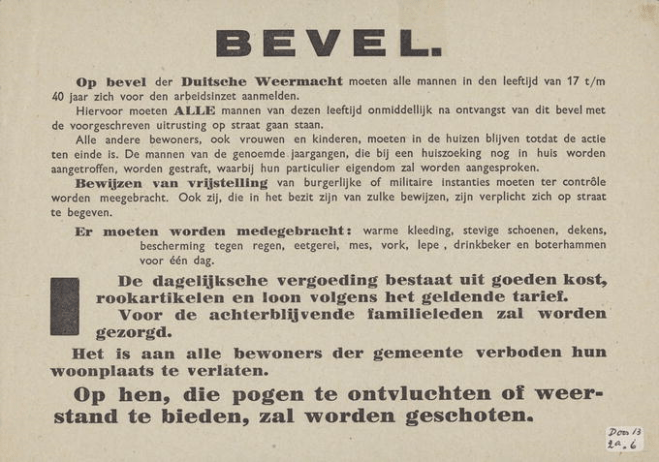
Note: There is little in Cor’s story about events during the War except for the story of the ‘spoon’ and the ‘Razzia’ told by Sjaan:

After the Second World War, the USA and Canada opened their borders to Dutch people. Boats and airplanes full of immigrants landed in Halifax and Montreal. The Lord put the idea of immigration to a far unknown country into our hearts so we had to step on the ship. After some preparation, Jane and I and five little children went on June 17,1947, the first load of “The Waterman”, a ship loaded down with Dutch families and their baggage. The trip took nine days and then we landed in Montreal harbour, Canada on June 26, 1947!

It was a wonderful trip, but the ship was NOT suitable accommodation for families with small children. It was built for soldiers. It had large rooms with beds on top of each other. We had to stand in rows to get out food. After a few days many got seasick and vomited and spent day and night on deck throwing up over the railing. Males and females were separated and the mothers had small babies with them. Many women with small children were very busy. We still praise and wonder at the mothers with small children, for their brave and hard work they have performed during the trip. I’ll let my wonderful partner, Jane, tell herself of their experiences. Marian was a baby and John had a special diet. For myself, in spite of the discomfort on the ship, I remember the great beauty I enjoyed when the waves were very high and when I was standing at the front or on the other end of the ship. It was a wonderful sight to see one end of the ship going way high above the water and the other end going deep into the water. Then I remembered the song: ‘t Scheepke onder Jezus’ hoede, met de kruisvlag hoog in top, neemt als arke der verlossing allen die in nood zijn op. Al slaat de zee ook hoog en hol en zweept de storm ons voort,
wij hebben ‘s Vaders Zoon aan boord, en ‘t veilig strand voor oog.
Translation: In the good ship of our Captain, We are sailing o’er life’s sea, Pilgrims to a better haven, Heirs to heaven’s victory. Though angry clouds sweep fast and wild. And breaking billows roar, We’re safe with Jesus at the helm To pilot us to shore. (translation: Leendert Kooij)

Only Ted got sick. We had a worship service on Sunday organized by some active immigrants with Mr. Keuning as speaker. We sang the psalms we had learned in the Christian schools and families. The psalms were spread over the waves of the ocean.

On June 26, 1947 we landed at the harbour in Montreal. From there we went by train to Toronto and then transferred trains to Bradford. The Christian Reformed immigration society was well prepared to receive us. Old timers were there to help the new comers travel to their destination and did a tremendous job of helping all of us get settled. The majority of immigrants were Christian and of the Reformed heritage. The Reformed community was busy meeting us on the train stations even already when we left the boat to guide us to a farm to work and had a house available.

The big move of people from Holland meant the families of farmers had a number of people ready and able to help them on their farmers. At that time Canada had opened its borders to farmers, and many of us were farmers as our occupation. Because we could not understand or read the English language, we were dependent on the ‘oldtimers’ to help up reach our destination. We did have some troubles in our travelling. We were to go to Bradford, but one of the leaders who helped and guided the newcomers put us on the wrong train. Instead of going to Bradford we were on the train to Brantford. At the first stop in Hamilton, we found out and we had to go back to Toronto again and from there to Bradford. So we arrived by train in Toronto and transferred to Bradford.

Note: (After some time came family Peter Groenewegen, then the Leendert (Tante Willy) Boers family and John (Tante Dith) VanderEnde.)

We came to our destination planned by the immigration office to a farm in Lefroy. The people (Hofland, Box 82) were very good to us, but we did not fit in their way of living and farming, so the good people of the immigration found a place for us (after 6 weeks) outside the city of St. Catharines, a farm with milking cows and at least forty acres of grapes. It was a place that fit both me and the family. The farmer’s name was Youngblood. He has a trucking business and bought and sold grain.

Many other Dutch families landed in this area, about 90% of them worked as farm help. Some had the use of a pick-up truck of the farmer that they worked for and were willing to pick us up for government sponsored English lessons and church services etc. But the house we lived in was very uncomfortable and very cold in the winter, especially when Mom became sick and ended up in the hospital. But she can give more information of this experience than I can. One of our good friends, also an immigrant, said, “Cor, there is an opening at the Larkin Farms at Queenston Heights.” This was located between Niagara Falls and Queenston where the Brock’s Monument is. I thought this must be a wonderful place and a good place to work! 600 Acres! When the manager, Frank Digweed, saw me, he hired me right away and sent a man, Dave, with a truck and loaded all our household and family and there we went to a new experience.

What a beautiful place to live, close to the Brock’s monument and hydro installation, and when a strong east wind came we could hear the falling waters of the great Niagara Falls. The manager, Frank Digweed, was very good to us. The manager lived in a castle. The workers lived in wonderful cement homes with a good size vegetable garden. The manager knew about my knowledge of fruit and that I knew how to handle it. When I was working there a half year, I said, “Mr. Digweed, your can help me start a business, and I will buy many of your apples.”

“If we can rent the house that we lived in then I would buy a truck and go in the business I was in the old country selling potatoes, fruit and vegetables and I would buy your apples.” So, the big boss let me rent the house which had a great large basement for storing fruit and vegetables. But I needed a 2 ton truck. I would not take the risk of buying a used one. A 2 ton truck then, in 1958, was $3,000, which I did not have. But we, as immigrants, were one family. I had only to ask only once one of my good immigrant friends and the down payment for the truck was right there.

By that time, cousin Herb Groenewegen was already coming from Holland and wanted to be married and to work on this farm. I said to the manager, “Herb, a strong young man, wants to work here and he can live with us. You can give him the same thing you gave me: a house, garden, free apples and wages. But I would also stay in the house with my family.” “So,” he said, “let him come over and I want to see him. And so Herb came and he made the deal. Not long after, Herb married and they got a home on the farm and we could rent the house from the farm to continue the business which was growing very fast. It was a large concrete home with a large basement. We could store truck loads of potatoes. Herb could make some extra money to help me loading or unloading fruit and potatoes.

That time a Christian Reformed Church was organized in St. Catharines under the supervision of Rev. Personaire and we used the truck to pick up many people. The “Liberated” (Vrijgemaakte-Artiekel 31) Canadian Reformed churches also began to organize churches and one was started in Hamilton. So we cleaned the truck on Saturday evenings and put many orange crates in it because we had a truck load of people to pick up on the way to Hamilton, including Fenwick and Smithville.

But one day the manager of the Larkin Farm, Mr. Digweed, who had become our best friend, said, “Cor, you have to look for another place because we need the house for another hired man!” And we started looking in the area surrounding Hamilton. We could not afford to do much driving around, but drove where people lived and asked for advice, and all of these people ate potatoes and vegetables. So with driving around and talking to people, I tried to sell 75 lb bags of potatoes or a basket of onions or carrots. How did I find that first load of potatoes? I was a stranger and did not know much of life outside of the Niagara Falls area. I went to an immigration meeting in Hamilton, ON and there were many immigrants assembled around this area. And they told me, “Potatoes you can buy close by” and showed me the next morning how to get to the Marshall farm in Ancaster on Highway 53. So I slept overnight at a friend, named Mr. Oosthoek in Aldershot, and went next morning to Fred Marshall’s farm. He said, “It is too wet to dig potatoes this day, but Jerome, the farmer next to him, was there. He said, “Come with me. I have potatoes ready to sell in my barn.” I had cheques with me but he would not accept these from a stranger. I could buy only 30 bags potatoes of 75 lbs. That was all the cash I had. But it was enough to start a retail potato business in Niagara Falls. I peddled potatoes from door to door and it really went. That time of the year people started buying potatoes for all winter so I sold one load after another.

Then some immigrant friend who worked on a farm said, “I went with the farmer I work for to the Welland produce market which is every Saturday. You should go there too. It is a terrific good retail market.” So I went there the very next Saturday morning and Ted was 8 years old and went with me. We had to ask people how to get to WeIland, and, yes, we got there, and sold, I think, all the potatoes we had on the truck. That was the fall of 1948 when we sold there the first bag potatoes. It did not take long. We went there and sometimes we sold even two truck loads (mostly retail) with potatoes, carrots, onions and apples. We really started to count the blessing of the Lord! Many of our Dutch immigrant friends were happy to help me on that busy day, and we had a good time together that Saturday in Welland.

I did much driving in the area surrounding Hamilton because there we had church on Sunday. One day I stopped at a house on Upper James St. between Stone Church Road and Mohawk Road. There I saw an empty lot with a cave behind it, ideal for potato storage. I asked the resident of the house if she knew the owner of that property. “Oh yes,” she said, “It is the retired father of Dr. Bethune in that stone house next door. See him.”

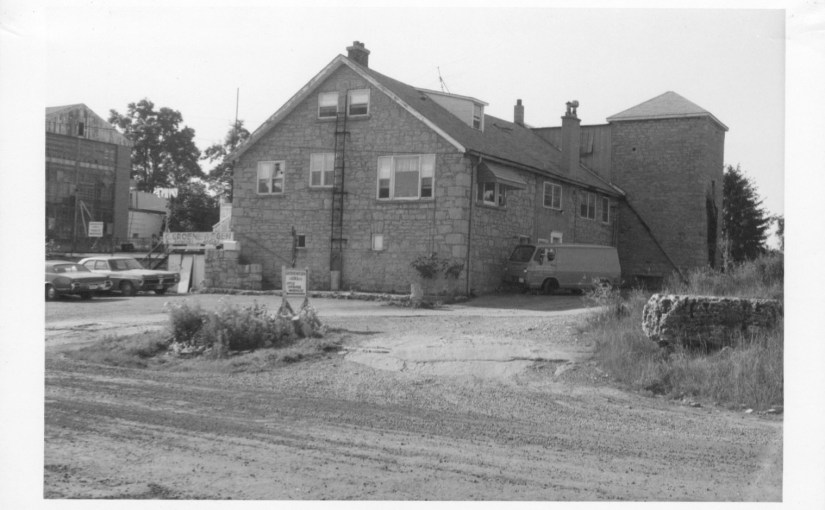
That was the first time I met that great fellow neighbour. When I met him I found out he was a great human being, of which people later informed he was a graceful Samaritan. He took the time to let me talk and answered questions. He found out who I was for a person. Then he said, “Go with me and I will show you that barn, but I keep the silo for myself. It was a stone high barn, even the silo was stone, and the inside was around, also made of stone. The basement was ideal for storing potatoes because it was hewn out of rock which made for cool moisture. Above this was room for living quarters and there was also some land behind. The price was five thousand dollars ($5,000) and he was willing to give the mortgage on it. Praise the Lord. What a deal! After a few years, when the retired doctor died, we bought his house, the silo and more land where we later built castles of empty crates we bought and sold as well as driveways to the top floors of a building we built because the back land was higher.

Praise the Lord for he is good. His faithfulness endures for ever and ever!

We brought with us from Holland the tradition of building churches and Christian day schools and Christian high schools. We had a business in used and new fruit and vegetable containers. Some people ask, “How did you ever get into the used vegetable crate business?” That time we had to bring bags with us when bringing potatoes to farms or pay good money for them. So I was gathering used potato bags and asking customers to give the empty bags in return. Anyone who had some to sell we bought because new ones were expensive. Farmers were even eager to buy used bags because the price was much different. So I gathered as many bags as I could and made even some profit this way.

When I started the vegetable business farmers were very eager to buy used crates because new ones are always very expensive and the farmers never see them back because the long distance from grower to the consumer. So there came a time when our used containers business overshadowed the vegetable business. The business was getting bigger and bigger, because I had many good people who wanted to work for us. We had trucks hauling concrete blocks from Aldershot even to deliver in Toronto.

It fit very well into the trucking business. When we hauled fruit and vegetables from the Bradford and Leamington area, we hardly drove and empty truck. Loads of crates were taken to the vegetable and fruit grower. I should mention the very good and trustworthy people who worked for us. First of all, Mr. Whaley and Gerrit Boot, who put all the building up or remodeled the building on Upper James and Limeridge Road East. The oldest son, Ted Groenewegen (now with his own business at the Food Terminal in Toronto – retired 2022), John Groenewegen (now living in Newmarket, later to London, ON) and the rest of the seven children have all more or less packed potatoes and or built wire-bound crates and helped loading and unloading trucks. Even my wife and mother of seven children helped to load trucks for crates and potatoes when a truck came in and all the men were gone on the road. Most of the business was mostly retail potatoes when all the men were gone.

I think Ted was 8 years of age, when I started peddling potatoes on the streets of Niagara Falls, Stanford and St. Catharines and he was even a encouraging figure to me. He helped me peddling, and had a potato in his pocket to show people. And he sold many bags, because that potato became very shiny in the pocket of his pants! When the people saw the potato, they bought a 75 lb. bag! Since he was eight or so Ted liked my business. As soon as he had a chance he jumped in the truck I drove. He grew up right alongside me. And he liked it so much and learned so much of it, that he now does his business without a truck, and just has an office with a telephone in it! He also has a phone in his car, which is also a great disadvantage.

We succeeded because in the first place the blessing of the Lord was in all that we did, but also for the good men who liked to work for us. One customer asked me, How do you get such good men working for you?

“Die ver van U de weelde zoekt Vergaat eerlang en word vervloekt! Gij roeit hen uit de afhoereren En U den trotse nek toekeren Maar ‘t is mij goed mij zaligst lot Nabij te wezen bij mijn God. ‘k Vertrouw op Hem geheel en al, Den Heer’, wiens werk ik roemen zal.”

“Those who from you have gone astray shall perish in their evil way. You will destroy all who, false-hearted from your commandments have departed. But as for me, in God I trust, For with his presence I am blest. My refuge is the LORD alone; I will proclaim all he has done”Book of Praise Genevan Psalm 73 verse 9

  • Featured picture -20 Limeridge Road East 1957
  • Above family & relatives picture from 1984 -45th Anniversary

This story was transcribed and edited by (daughter) Louisa Bruinsma ( 1993)

JS Posted December 4, 2025
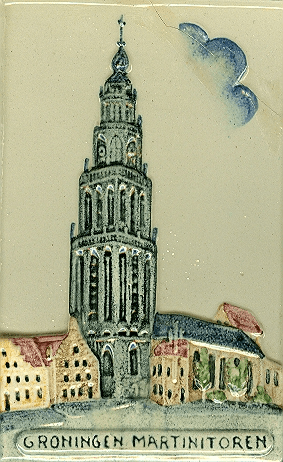
A time for change (2-4)

In the shadow of the Martini

‘The fields of the Ommelanden, are dew soaked clay-greens, wide, fresh and awesome, cradled by brisk ditch waters, high clouds/visions without end, scattered Wierden of stored forgotten lives and buried good intend-ness, bursting of possibilities with sanctuaries of Christian faith, flowing from deep soul dwellings reflecting eternal values, strength and hope, blessed treasurable life memory pieces, remembered ancestors of and in dwellings of our past, ‘t Hogeland, nearly your temple, Lord!’

My family’s recorded ancestors history can be traced back to the 18th century (1770). There were persons before but the memories are sketchy and no written history is known. My third Great grand father Gerrit Schuurman was born in 1769 (d. November 8,1812 ) in the north-eastern part of the Province of Groningen, in the Netherlands. His occupation is listed as innkeeper in the town of Bierum and he married Anje Jans Draak (b.1783) in 1806. This was during the French occupation of the Republic after Napoleon’s conquest of the Netherlands (named the Batavian Republic) in 1795. In 1809, brother Louis Bonaparte was appointed as monarch of the Kingdom of Holland. The beginning of our democratic monarchy.

The marriage of Gerrit and Anje produced a son named Jan (Gerrit) on August 8, 1808 (d. April 27,1881) who on January 6, 1838 married Anna Sterenberg. She was born on October 21, 1812 in Appingedam – daughter of Hendrik Jan Sterenberg & Albertje Klassens Drijfhamer. Jan was a beekeeper and farmer in the town of Bierum.

Bierum is an old town originally built on a Wier or Terp (man-made hill structure) as a refuge for the locals and their animals from the sea floods before the dikes were built. The population varied from 200 to 500 people at anytime. The SebastiaanKerk (Reformed church) built on the Wier, dates from the 13th century and has a unique buttress with a pointed arch to support the church tower. Today the town is part of the larger Eemsdelta Municipality.

The marriage of Jan and Anna Schuurman produced a son who they named Derk. Derk was born September 23, 1849, in Bierum (d. April 5, 1902) and married Aaltje van Bon, daughter of Pieter van Bon and Jantje Luitjes Post (born November 13, 1850-died January 12, 1927) in the city of Groningen. Aaltje was from the town of Veendam. Derk and Aaltje were married July 31,1874 when he was 24 and she was 23 years old. They had 10 children with one still-born baby boy in 1889. Derk was a warehouse worker (pakhuisknecht) probably residing in the town of Haren or Noordlaren (village suburbs south of the city of Groningen). This is where my Grand-father (Opa) Jan Schuurman was born on September 8, 1881 and as he grew older took up his profession as baker.

My Grandmother’s (Oma) name was Titia Grasdijk (born May 22,1882) and with her family lived in the village of Sauwerd, just north (7 km) of the city of Groningen. Sauwerd’s history goes back to 300 BC. Sauwerd had been home to the Onsta (Onseda) (Onstaborg) family, one of the Ommelanden old gentry families dating back to the 1300s. Father Pieter Grasdijk (born 1854 -died April 1, 1904) was a tailor and her mother’s name was Antje Hempenius (born 1858 in the north-western Frisian town of Engelum, municipality of Waadhoeke -Menaldumadeel) ) Pieter and Antje married (June 5, 1880) when he was 27 and she was 22 years of age. Pieter and Antje had 5 children and one still-born. Antje’s parents were Dirk Sikkes Hempenius and Tietje Sybrens Hoekstra.

Somehow Titia and Jan met in the city of Groningen. Jan came there to work as a young baker. Titia had also moved to the city to find work as had her brother Gerrit and a sister Boukje (Bougien) both living and working in the city. There were two other brothers named Jacob and Dirk.

After Jan and Titia met, they started to attend church and confession class (Jan probably persuaded to go by Titia who was his girl-friend). Before deciding to marry they wanted to do profession of faith together but the local pastor (dominee) felt it was better for Jan to wait awhile as Jan’s family did not practice the same upbringing as Titia’s.

Family wedding photo 1910 – middle Opa Jan with Oma Titia

Apparently when confronted with this reluctance to let Jan do profession of faith, Titia had said to the pastor, ‘Dan krijg je mij ook niet!’ (‘Then you do not get me either!’) She was not an easy push over and knew her own mind. They married September 1, 1910 (both 28 years old) and so a number of years passed before Jan and Titia did profession of their faith. When this was finally done, the children were allowed to be baptized. I believe my dad said he was by then already five years old.

Jan being a baker joined ‘Patrimonium’ part of a collective, running a bakery concern co-owned by a number of independents to serve the immediate neighbourhood. He was active in the founding of this co-operative.

The place where the Schuurman couple first lived was in the Rabenhaupt [1] Straat near the Merwerdestraat/Achterweg. Soon after, Jan and Titia decided to open their own bakery and settled at the nearby Barestraat address 44. [2] The business address was called “Nooitgedacht”.

At the time in 1910 and years following, on the south-western edge of the city of Groningen there was much new construction going on. Shanties for poor day labourers, some who lived rowdy life styles, were being replaced by new housing. These were needed here due to a constant influx of people from the rural areas. The city was growing. New employment opportunities were: a new main train station had been built in the late 1880s and new housing was needed for the railway workers. A bicycle factory ‘Fongers’ (think of the ‘Gazelle’ bike) was started (1900) on the Hereweg employing 165 people. A new jail had been built near the newly designed ‘Sterrebos’ (a park) The jail was said to have been modelled after a prison in Philadelphia, USA. There was a lots of new projects throughout the city: new streetcar electrification and modern water/sewer and other city facilities were installed. A new water tower had been built along the Hereweg. New co-operatives/non-profits were emerging to built the necessary housing facilities for the new citizens moving to the city from the rural areas because of new commercial enterprises such as the ‘Suiker fabriek’ Sugar (beet) factory (est. 1910 -Holland’s 4th largest) on the west side of town. The large housing developments ‘Rivierbuurt’ and the ‘Grunobuurt’ and a large public Park (;Stadspark’) to the south-west side of the city were all were started in the 1920s and 30s. All of these people needed to eat and so Jan & Titia’s bakery did good business in the neighbourhood.

The family had five children. Twins were born first on 14th of October, 1911, a boy and a girl. They named the girl Antje Aaltje and her twin brother was named Derk Pieter who died 10 months later on 3rd of August, 1912, probably from smallpox. (This little boy was later placed in the same grave as his parents.) My dad (Derk) was born on July 30 (Wednesday), 1913, he was the third child of Jan & Titia. Even though there had already been a child named Derk in the family (1911) my father also was named after his Grand-father Derk. This was the habit in many families at that time to ensure that the name was kept in the family. Beside his older sister Antje, he had two younger brothers named Pieter, born March 28, 1916 and Gerrit, born March 24, 1919.

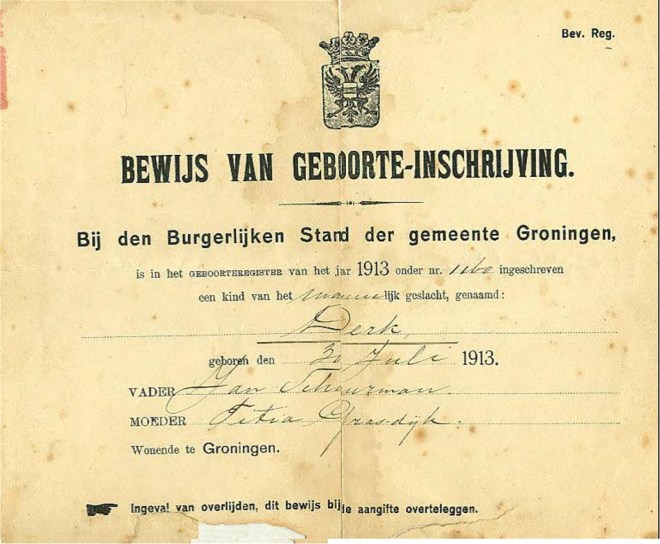
My dad’s birth certificate indicated that he was written into the civic birth directory of the City of Groningen as #1160, a child of the male species, named Derk, born on 30th of July 1913. On the bottom of the certificate is a dark hand-pointed fingerlike sign, drawing attention to the statement “that in case of death, this certificate must be accompanied with the death notice.” It appears that the records of the city’s citizenry were highly structured and the notice is perhaps an indication that some of the children died at an early age. Probably from typhus or smallpox. Smallpox had been a real child killer in Europe for years and its inoculation medical procedure (Edward Jenner-1796) was strictly enforced by the Dutch government. My dad was vaccinated for smallpox at age 3. The card describes the method and the times as well as the way the vaccine was made available to the citizen of the city.

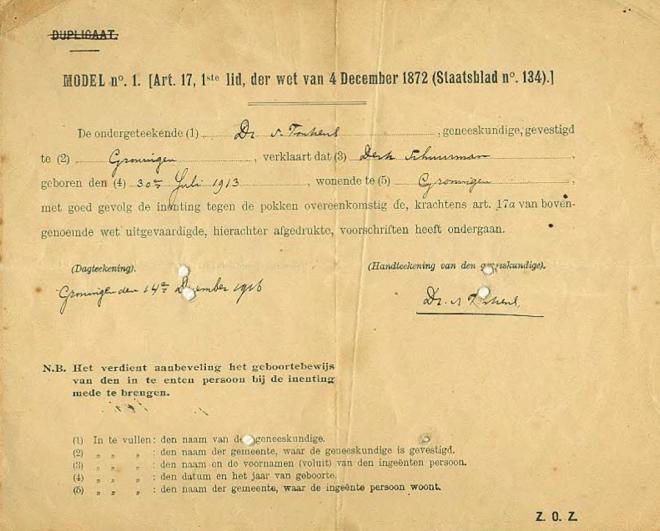
This health card certificate card [3] indicates that my dad was vaccinated for smallpox on the 14th of December 1916 under the Model #1 (Article 17 of the Dutch law of December 4th, 1872 – State paper #124.) by a Dr. S. Tonheul. The rest of the certificate gives indication as to how to fill it out. The back of the certificate is interesting. It gives full details of the instruction to the Doctor in examining the patient to insure they are healthy to receive the vaccination together with a full description as to what the doctor must do (e.g. the doctor must be sure to use antiseptics care, and if the vaccination area is not bandaged then he must make sure that no clothing will touch it up to 10 minutes after the procedure. The procedure itself consists of making 5 scrapes of 1 centimeter lengths and 2 centimeters apart from each other or 5 needle pricks, 2 centimeters removed from each other. The serum used must bear the approval of the Minister of Interior Affairs and must be stored in a cool dark place. It must be used 4 weeks after its preparation and within two weeks of its arrival at the vaccination center. In January the Minister will announce in the newspapers the places where this vaccination will be administered. (From the certificate it would appear that the Government of the Netherlands was very serious in preventing the deaths of children from small pox which was a very common deadly disease at that time)

In 1918 the family moved from the Rabenhauptstraat to the Barestraat and Jan started to operate his own bakery. It was probably shortly after, that father Jan began to plan for his boys Derk, Pieter and Gerrit, to eventually join him in the growing bakery business.

My father attended school in the Mauritsstraat and was not a very co-operative student but rather a rebellious one, who cared more for fun than study. Maybe fun is not the right word but rather ‘easiness’ was his style. Why work hard, if you can take it easy. This also appeared to be his motto for later life although when it came to working in his chosen profession of baker there was no harder worker than my dad. You could say he loved his job and was good at it too.

It appears that my dad at times could be a real nuisance at school. His younger brother Gerrit was even worse because on one of Gerrit’s report cards the teacher had noted: ‘Fooling around will be his occupation.’

It was a time of huge change in Europe and in the city of Groningen. On November 11th of 1918, the ‘Great War’ came to an end. The Dutch had escaped the conflict by taking a neutral position. The war’s end was completed with the signing of an armistice in a railroad car at the town of Compiègne, France and confirmed in June 1919 with the Treaty of Versailles. Years later Hitler used this railway coach location to force the capitulation of the French in June 1940 (much to his delight). The ‘Great War’ had seen 70 million men and boys in arms with over 9.4 million dead or out of a typical French town, one boy in five had been killed. Many widows and children without a father populated the cities of Europe and many more war-wounded disabled veterans walked the streets. People said that this had been ‘the war to end all wars’ or the ‘Great War’. Little did they know that the beasts of terror, horror and destruction were only taking a rest. On top of all this the Spanish flu [5] had broken out early that year and was to kill a further 40 million people worldwide.

Dad’s childhood was a normal one [6] and he played like all children would in his neighborhood. It was also around that time (1925) that my dad graduated from Grade 6, which was then the end of his (elementary) education. He then started working in his father’s bakery. He was 12 years old. His brothers Pieter and Gerrit who were 2 and 4 years younger than him were to follow later. Gerrit being the youngest of the family of 3 sons and one daughter was the baby and perhaps as in a lot of families, the parents were somewhat soft on him. At least that’s what was said about him.

Work days were early hours in the morning and long days. Sundays the bakery was always closed and the family attended church faithfully, two services every Sunday with extra services on religious days like Christmas, Easter, Ascension day etc.

When a boy turned twelve, he was considered to be grown-up enough to try smoking and drinking. Also the young boys at that age grew out of their short pants into long pants and were now looked upon as young adults.

There was much Christian political and social action in the Netherlands in the 1920’s and 1930’s. Although many of the political and social economic structures were dominated by the rich and affluent, even among the Reformed, there was much discussion and thought (ideas) about Christian social action. In some areas of the province of Groningen, the Reformed made up 30% to 50% of the population especially in the city and the north-western part of the province. Overall the Reformed made up 20% of the provincial population and many voted for the Anti-Revolutionary Party (ARP) started by Dr. Abraham Kuyper in 1879. [7] Young people and men’s discussion groups within the churches were very popular in those days. Also many modern inventions like: electricity, cars, radio, films, farm machinery and other modern conveniences found their way into the lives of the people and just about everybody owned a bicycle to get around. On Sundays, biking was frowned upon and most would walk to church. Actually it was quite a sight to see on Sunday morning when many families would walk to their houses of worship. (After the war however, many started to use the bike, or motorized bike-scooter (brom-fiets) and then later their cars, to go to church)

The economic situation had changed from an agricultural dominated society (by the rich provincial farmers/city leaders [4] who instituted and built the ‘Korenbeurs’ – grain-exchange in 1865 for the trading/sale of their farm grains) to an industrial and commercial city environment. Ever since 1875 when there was a general agricultural crisis, more and more people were being pushed out of the farming, agricultural employment sectors due to new mechanized farm machinery and new methods. Many who had lost their farm jobs came to the city adding to the city’s population. By 1910 the Social Democratic movement’s influences became very strong in the city of Groningen with the emergence of various Workers Unions and the new push for political and economic power which up to now had been held by the wealthy farmers, the land owners and the well-educated who occupied the important positions in the community. Also in the church there was not always a proper inclusion of people. Many farm workers were unable to be considered for office in the churches because their bosses, the farmers were also the leading persons in the church councils. Ownership of property was important and if you did not own anything, you were (presumed) not able or qualified to have any say in the daily affairs of your community including the church. The farm workers were treated poorly by many of their fellow believers and subsisted on (near) poverty wages.

With the Russian revolution of 1917, a new attitude swept over much of Europe and many new forms of community involvement and actions started to emerge. Sometimes these demonstrative actions were anarchistic and led to strikes. For instance, in 1919, 3/4 of the provincial farm workers went on strike. By 1929 (stock market crash) farm produce prices had plummeted and the Government had to step in to guaranty prices. Pork exports were stopped to England by the English government, greatly affecting farm workers employment. A six months strike ensued [8] in east Groningen, and was at times so violent that the government had to declare martial law to ensure the peace. One of the strikers was killed. In 1937 40% of the farm workers in the Netherlands were out of work and farm workers unemployment in Groningen stood at 42.5% while the country’s total was 13%. There were many unhappy people.

Many co-operative ventures and commercial enterprises were started in those days by enterprising people like the ‘Patrimonium’ that Jan worked for from 1910 to 1918. Ship building also experienced a boom during these years and many unemployed farm workers got a job building the new Groninger Coastal Ships (Groninger Kustvaarders) which were being constructed along the canals north east of the city.

Because of the continuing influx of farm workers from the province, the population of the city of Groningen increased rapidly especially during the 1930’s. In 1929 the city’s population stood at 103,584 while by 1939 it had grown to 121,070 up 16.8%, while the province increase was only 8.1% from 391,062 to 422,741.

Aunt Antje tells the story that in 1927 when she was about 17 years old there was a public awareness campaign (with an award) to push for the 100,000th citizen of the city. One of the ways in which this was advertised was for each family to have more babies and so she asked mother Titia in her innocence if they should try for the 100,000th but mother Titia said that father Jan was not interested. My aunt said she did not really understand why not.

With the growth in population, the Schuurmans did quite well as bakers (people had to eat) and were relatively well off, compared to other families, even in the depression years following 1929.

JS February 15, 2024


Pictures: Top – South side of ‘Grote Markt’ -2017 family visit – 1910 Family Wedding photo – My dad’s birth certificate (1913) – my dad’s birth certificate – my dad’s smallpox certificate.

NOTES:[1] Carl Von Rabenhaupt (1602-1675) was the man in charge of defending the city in 1672 against troops of the Bishop of Munchen.

[2] In Dutch the word Weg (Way) or Straat (street) is sometimes attached to the name of the street itself.

[3] Research documents show that around 1750 -1800 there was a negative population growth in the city of Amsterdam of which 100 out 1,000 deaths was a result of smallpox. Childhood deaths were as high as 55% from all causes. There was another epidemic with smallpox in 1872 but a consistent vaccination program started around 1800 with over 90% compliance by 1900 did much to control this dreaded disease. 

[4] These were called the ‘Regenten’ or the ruling class. See picture of Rembrand’s ‘de Staal Meesters’.

[5] Imported from the USA (presumably from swines) via soldiers coming to the war front, the Spanish Flu virus spread rapidly among the fighting men and to the local communities. It is estimated that 20 million and as high as 40 million people around the world died from the Spanish Flu. (some say the figure was as high as 100 million) Some people who were affected died suddenly even in the streets and on public transportation. Masking was used by many (enforced in some places in Canada & USA) and some hung bags of camphor around their necks to ward off the disease. Even though it originated in the USA it was called the Spanish flu because the combatant countries did not allow any news of this sickness to leak out in the press but Spain being a neutral country in the Great War gave broad coverage of this deadly virus. The virus was classified as H1N1. It took well into the 1920s for the disease to de-activate.

[6] In 1968 I met a man in Stirling, ON by the name of Broekema who knew my father when he was 12 years old and played with him in the Bare Straat in Groningen.

[7] Anti-Revolutionary Party (ARP) was a conservative Protestant party, strongly opposed to the ideals of the French Revolution. Instead of the revolutionary concepts of liberty, social equality, and brotherhood, the ARP advocated for divine providence, hierarchy, and sovereignty in its own circle. In 1980 they merged with the Catholic People Party (KVP) and the Christian Historical Union (CHU) to form the Christian Democratic Appeal (CDA)

[8] This 1929 strike was a noted event in the historical world events calendar as it co-incited with the Berlin strike where 19 were killed.

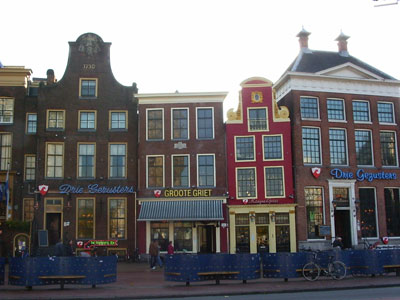
Heading picture: Buildings on the south side of Grote Markt @2017

The courtship of my parents (6)

Chapter 6 – In the shadow of the Martini
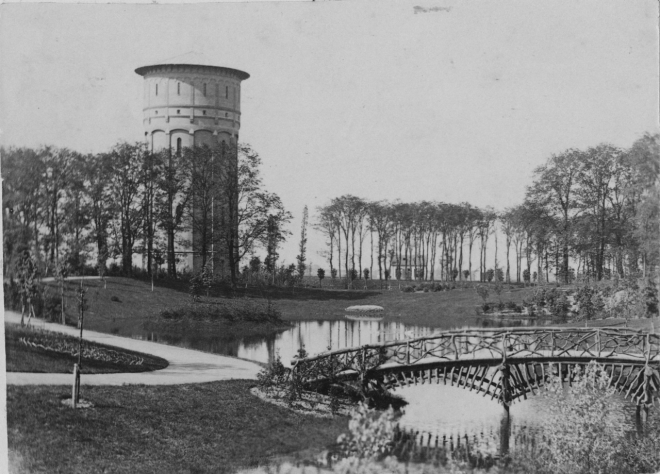
When Derk meets Trientje, he was stung. The stories about their courting are few but this recurring theme was always prominent; my Dad ‘played the field’ with all the girls he met. Sometimes he had two dates in one evening. On one occasion while biking from the direction of Delfzijl to Groningen [1] with a date, he met another girl and promptly dropped this date and started with the other. My mother always said she had to put him ‘in his place’ on more than one occasion. One time she called it quits; and so my Dad had to go to where she worked and beg her to take him back. She had told him to make up his mind: ‘Do you want me or not, there are plenty of other boys!!’ ‘Vrijen’ (smooching) was carried on in the local park ‘Het Sterrebos’ close to the Bare Straat (or Barestraat) along the Here Weg (Hereweg). Many a young couple could be found there showing their affection for each other. In those days no-one owned a car and everything was done by bike or walking.

Sterrebos with watertower

My mother’s spirited nature was well evident at this time already, and the above story was always repeated with great drama by both my Mom and Dad when they would remember this and share it with us children. In fact whenever these stories were told there would be a free flow of good ‘Grunning’s’ street language between the two of them. Sometimes, we as kids would be ashamed about this rudeness of tongue and speech to each other, but we came to realize later that this was nothing more than their continuous way of courting each other. My Dad, with his teasing talk and questions and my Mother with her dramatic speech, body movements and showings of ‘pure disgust’ with that man! ‘he is good for nothing’ she would say, and then wink with her eyes, as if she thought I even half believed her.

The story is told about my dad’s brother Gerrit who had decided to have some fun with one of his friends. He had loaded in the baggage pack of his bike, a large bottle of gin that the two of them were going to consume later that night somewhere. My Mother had gotten wind of this and had surmised that this would probably lead to no good and got a hold of the bottle, poured out all the gin and refilled it with tap water. Since gin and water are both clear liquids no one could tell the difference. Well, did my uncle get a surprise that night.

Apparently, he was a bit spoiled (being the youngest) and always in trouble with father Jan. One time he had not come home in time so father Jan went out looking for him with a large stick ready to beat him should Gerrit be found. Anyway my Mom knew where he was so she ran around the block to intercept him and warn him of father Jan’s plans. Uncle Gerrit was quite a character in his young days. The report card that he took home in Grade 6 did not have any marks on it, but the teacher had noted this comment: ‘Fooling around is his true ambition’.

His brother Pieter was a different sort and did not cause too much trouble. He appeared to be a dreamer and never really liked being a baker. Whenever the boys went out together Derk and Gerrit would look at the girls, but Piet would admire the bridges over the canals.

Anyway these two, Trientje and Derk, met and it got to be serious. However my mother soon discovered that mother Titia Schuurman also was a bit touchy herself and I’m not sure whether this was evident from the start but my mother did not endear herself immediately to the Schuurman family. The real problem was highlighted at the time before the wedding and shortly thereafter.

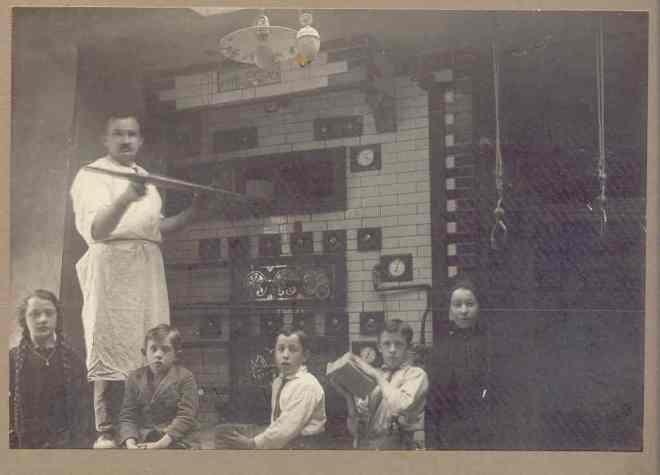
Father Jan & mother Titia & family
in the Bakery (notice the gym rings)

At the Schuurman bakery in the Barestraat the boys worked hard (and exercised) with father Jan to build up the bakery. Stories are told as to how mother Titia stood up to officials and others who gave father Jan a hard time. She was not afraid to grab a knife and tell them to get lost or else she would use it gladly.

The business was going quite well and although the thirties were tough for some people, the Schuurman’s prospered. It was father Jan’s dream that all his three boys would own their own bakeries and the Schuurman’s would have a large part of the bakery business in Groningen.

By the time 1938 rolled around a new section of town had been added just west of the Barestraat and father Jan purchased a bakery and store to set his son Derk up in business because wedding plans had been announced for Sept.1, 1938. [2]

His sister Antje had married the year before and was living in Helpman, a small village just south of Groningen. She had married a Gerard Suers who had a produce (store) business. Now it was Derk and Trientje’s turn. Mother Titia Schuurman had decided that it would be improper for Trientje to wear a white wedding gown, (her oldest daughter Antje had worn one) so Trientje should have a dark navy coloured gown. And here is where a lot of resentment started up between the new bride and her mother-in-law. Why mother Titia insisted on this mode of dress is not clear. It could be that she considered her new daughter-in-law to be a bit below her son’s family standing? and wanted to make in this way her disapproval known, or was she following the fashion of the day? My mother never really told us why this happened but resented it always as a put-down. My own feeling is that this was probably the style in those days and for variance sake mother Titia had decided to be in style, much to the dislike of her new daughter-in-law. I think there was a touch of that and the disapproval which turned up later in ‘issues’. Mother Titia was a strong headed person. My dad however never mentioned this incident and I believe he did not want to make an issue of this with his parents.

Anyway they were married. First at the City Hall. It was Wednesday and the wedding license fee and ceremony was ‘free’. Then on to church for a church wedding ceremony. It was told that they rode in a coach drawn by two horses, the usual style for that day, and that my Dad leaned out of the window and yelled at some of the girls he had known on the way to the City Hall.

The text for the wedding as chosen by the minister was from Book of Proverbs chapter 16 verse 9 “In his heart a man plans his course, but the Lord determines his steps” (“Het hart der mensen overdenkt zijnen weg, maar de HERE bestiert zijn gang.”) This text was written on a leather bookmark that my Dad used to mark his place in the Bible he read at mealtimes. I can still see him open the Bible take the bookmark out and hold it in his one hand and then when he was done reading replacing it in the page before closing the Bible. It did not occur to me until I was at least seven or eight that this was mom and dad’s wedding text because I asked him what it was and he told me. It seemed a strange text to me as its meaning at that time escaped me completely.

They moved into 123 Parkweg, corner Hoornsediep [3], right by the Park-burg ‘bridge’ over the Noord-Willems Canal. My Dad and his two brothers had already started the business and it was just a matter for the bride to move in. This was a good location and a lot of traffic passed that way out of the city. Also whole new subdivisions (Grunobuurt) were added to that part of Groningen and more were built well into the 1950s & 60s as newer housing initiatives started further south and west. The boys worked hard in building up the business and it was starting to be successful.

One of the essential factors of that success was that they were able to get to the public with their goods before anyone else. Competition was fierce in those prewar days and not always appreciated by the larger establishments.

Chamberlain makes his announcement holding the ‘agreement’

Later that September in 1938 Chamberlain, the English prime minister, announced the now famous ‘Munich’ non-aggression pact with Hitler boasting: ”This is the second time there has come back from Germany to Downing Street peace with honour. I believe it is peace for our time.” Winston Churchill warns of the futility of appeasing Adolf Hitler: “The belief that security can be obtained by throwing a small state (Sudetenland – Slovenia) to the wolves is a fatal delusion.” (Hitler had demanded that he be allowed to take over Sudetenland. Chamberlain agreed not to intervene so that “we may have peace”)

JS                    January 10, 2024

[1] Delfzijl: A harbour town on the Dollard Bay, about 30 KM NE of the city. [2] Opa Jan & Oma Titia Schuurman-Grasdijk were also married on September 1. (1910) Co-incident? Or family pressure? [3] This was actual an extension of a river that flowed through the province of ‘Drente’ to the North Sea called de ‘Drentse A’.

Rumours of War (7)

Chapter 7 – In the shadow of the Martini

But there was big trouble brewing in Europe. Hitler and his Nazi party had grabbed power in 1933 [1] and the spread of Fascism ‘nationalism’ with white (German) supremacy advocates with its large rallies had unsettled the neighbouring countries.

In the Netherlands too, people were nervous. Even though the country had remained neutral in the First World War and its citizens had escaped occupation by the enemy, unlike their Belgian neighbours who suffered severely under the constant fighting around the country side of Flanders and southern provinces. However it did not look that this time they would again be bypassed. Sure many people in the Netherlands and in Europe including Germany’s arch rivals the British and the French did not believe it could happen again, for after all the 1914-18 struggle had been the Great War to end all Wars.

The N.S.B. [2] a political fascist movement that was sympathetic to the Nazi cause was only a small party in the scheme of Dutch politics in the 1930s. Their leader Mussert received less than 5% of the vote in 1939. In fact in Groningen the vote for the NSB party was less than the country average, 3.8% of all eligible votes cast in the province (only 2,324). Wherever the ‘Reformed’ community formed the largest part of the population the vote for the NSB party was even lower than the national average of 3.8%. (This also bears out why the province also had the highest number of people involved in illegal activities during the war.)

It was at this time (September 1939) that my Dad was called back to serve in the army during this ‘mobilization’ time. This was a period when the country prepared itself for possible war and all young men where recalled to serve. Dad also was called away from home, although just married and running a new business did not matter for the State demanded that every able bodied man serve their country. Every once in a while he would come home looking unkempt and forlorn my Mom said. Dad stayed in various places in Holland. For a while was stationed near ‘Breukelen’ where my daughter-in-law Carina Oussoren comes from, around the middle of Holland (‘Utrecht, Breukelen’ area).

Dad, as in school earlier, did his level best not to show too much enthusiasm and I doubt whether he ever fired a gun. Also I heard stories of how he and his buddies always tried to get away with things. Whenever they went on patrol or training marches, they always looked for the easy way out, like: getting the sergeant of their group who was a much older man, to carry all their rifles and some of their equipment on his bike. Later Dad often laughed about these ‘episodes’ in retelling them but you could sense a bit of guilt in his tale when he referred to the sergeant, who was a career officer and much older, as ‘die arme man’ (‘that poor man, my how we teased him?’)

Later on, after the war, while I was still very small, he used to tell tales at the dinner table how he had fought and stabbed the Germans with the tip of his handkerchief and ‘they would bleed like a tear in a flour bag’ he would say and demonstrated with his hanky. I don’t know about you (the reader) but if you have ever seen a flour bag stabbed or ripped open with the flour pouring out of it and I saw many, being a baker’s son, you can imagine how this talk impressed me as a young lad. I never doubted for a moment that this was just my dad’s way of having ‘fun’. I thought this was real for a long time. My mom would smile at me, shake her head and close her eyes, an indication that although it ‘might be true’ but was nothing but a tall tale, probably just fun, a joke.

As 1939 approached Dad and Mom both realized that war was imminent and my Dad did not relish the thought of being part of it. I believe he was afraid and knew enough about the preparedness of Dutch army to understand that they were no match for the Germans if they decided to attack Holland [4]. During his younger years my Dad had fallen while skating and he had injured his wrist. This old injury bothered him from time to time and he decided to use it as an excuse to get out of the service, for he had to get back to his bride and his new business. Besides, he saw the commotion in Germany and heard the rhetoric and was convinced that the fighting that was sure to come was not for him. (when Hitler attacked Poland on Sept 1, 1939, this was the date of their first wedding anniversary)

Dad went to a doctor and explained his problem. They took an X-ray and discovered that he had a small shattered bone in his wrist. On this basis he was declared unfit for the army and sent home. The discharge papers, dated January 10, 1940, given to him, he kept in his wallet till he died. I don’t know why, but I do think that relief, guilt and pride of being part of that whole time of conflict were a major point in his life. Little did they know (I think my parents had a strong sense that eventually war was unavoidable) that a couple of months later the German boot would come and crush the country for five miserable years till May 1945. My Mom was not as afraid as Dad was about things and had established a procedure by which she would buy her weekly household necessities and then purchase extra things and store them because she was more absolutely convinced that bad times were about to come. When we played in the attic as little kids we could see some of the items she had stored away: bicycle tires and various food stuffs and tobacco etc.

With Dad returning from the army, the business (I give my Mom lots of credit for coping with the business while Dad was away) continued to grow.

It was in the evening of 9th of May and the early morning of 10th of May 1940 that Hitler’s forces entered the Netherlands. Although the Dutch and allied governments had been warned by secret messages from an allied spy-group within the ‘Abwehr’ (German Army), nevertheless the attack was a total surprise. [5] At 3 o’clock in the morning at one of the border crossing stations, at ‘Nieuweschans, Groningen’, there was a brief resistance and then the German Panzer train loaded with military equipment steamed onto the Dutch railway system and preceded unhindered towards the city of Groningen. Holland had been invaded by the Nazis. Fierce fighting erupted in several places in central Holland; at the Greppelberg, Moerburg, the Afsluitdijk, around Den Haag and Rotterdam but the German ‘blitzkrieg’ method of war was too powerful and too swift. The Germans having practiced their bombing techniques (Spanish Civil War 1934-38) on the city of ‘Guernica, Spain’ in 1937 as ally of General Franco, now also proceeded to make their intimidating superior presence felt in Rotterdam where German Airforce leveled much of the inner city to the ground causing the death of 900 civilians. Queen Wilhelmina [6] and her household with the Dutch government fled to England on May 13th [7], determined not to let her people down until her country was won back for the Dutch. On that day (five days after the invasion) General Henri Winkelman the commander of the Dutch forces capitulated. (King Leopold III of Belgium whose country had endured the terrible slaughter of the 1914–18 war (‘the war to end all wars’) gave himself up to Hitler as a political prisoner and this act was held against him dividing the Belgian people till the crown-prince Boudewijn (‘Baudouin’) finally took over in 1951 when Leopold abdicated).

Meanwhile life in the city of Groningen was in for change. The Germans arrived on May 10, 1940 and before long took over the city and provincial governments. On May 29, 1940 the Queen’s representative Dr. Homan was dismissed and their own commissioner, a West German, Dr. Conring born close to Groninger/German border and able to speak the same low-German (Nederduits) dialect that the Groningers spoke, was installed. Although the changeover was slow, it was systematic and with purpose. The city was beginning to be ruled from Berlin. The Germans took over the ‘Scholtens Huis’ (also called the ‘gates of Hell’) opposite the City Hall on the Grote Markt. Many cruel and terrible acts were committed here by the SS and company, (Sicherheitspolizei and Sicherheitsdienst). The cruelest of all was Gestapo officer Robert Lehnhoff, responsible for many executions and committing gross terror on the citizen of Groningen. 

Many of the provincial and city councilors and city hall administrators continued to work with the German regime for awhile. Slowly many had to quit their jobs when it became evident that staying at their jobs made them compromise with the Nazification, imprisonment and death of their own countrymen. Many never again were able to resume these positions even after the war.

Although the defeat of the Netherlands in the invasion by the Germans in 1940 did not make drastic differences in the way of life immediately. The Dutch soon found themselves quietly forced to support the war effort of the Germans by working for the regime in the German factories and influenced through propaganda becoming joint cohorts into the Nazi Nationalistic ideology. The Nazis had calculated that the Dutch people would aid them in their social schemes to make the German race the master race of the world and to buy into all their agendas including the destruction of the Jews who they said were to blame for all the misdeeds and misfortunes of the world. The pushback against the ‘Nazification’ programs was supported by a strong underground resistance movement. This resistance included many persons in the Reformed, Catholic and Communist and many other communities who were against the misdeeds and social engineering schemes of the Nazis. The tyrannizing of the population was beginning. These groups operated in different sections of the province and were loosely connected together. Most were cell groups so that in case of capture or infiltration there was not much chance that the entire movement would be harmed and destroyed. Many students and young men were involved. Also many young girls served as couriers. Clandestine newspapers like ‘Vrij Nederland’ and ‘Trouw’ were started to inform the people of the truth suppressed by the Nazis who had taken full control of Dutch social life and the media. My parents too were involved in this resistance movement.

My mom was the primary contact person. My dad ran the business and my mom with the type of person she was got involved with some of the young resistance fighters whom she would give shelter from time to time. Sometimes they would hide in their upstairs bedroom and wait for nightfall before proceeding to their next break-in/robbery target which was usually a food stamp distribution office [8]. Soon after the occupation all citizens were issued food stamps that allowed them to purchase food stuff, without these stamps you could not get the necessary items. This was introduced to provide ‘control’ and ‘fair’ access by all citizens to the sometimes meager supplies as the war had interrupted the supply process. I can remember that my dad spend a lot of time pasting stamps on cards that he had collected from his customers. In this way he was limited in purchasing new supplies by the amount of stamps he could hand in. The German war machine needed a lot to keep their armies well supplied. Because Dad had his bakery to run, food was never a problem in our house during the entire war time. It may have been a meager supply at times and ‘tulip bulb flour’ was not unusual with other ‘surrogate or artificial’ supplies. The hard black coal ‘coke’ used to stoke the bakery ovens, eventually gave way to ‘peat’ ‘turf’ due to lack of supplies as trains and facilities were being bombed by the Allies and the coal was rerouted to feed the war industries of the Ruhr region of Germany. Slowly on, the population was being (‘Nazified’) organized by the invaders who showed their prejudices by issuing ‘personal identification’ cards (mom’s and dad’s cards show their photos and fingerprints) to all the citizens and in this way they would find out who was who and who was Jewish. This was especially true for when the Jews were forced to wear a yellow star of David whenever they appeared outside on the street.

A sidewalk plague to remember ‘Bertha Grunberg’ who was taken away to Auschwitz – murdered in 1942

Also in Groningen, the Jews did not escape this threat even though it was perhaps not as violent on a large scale such as in the big cities like Amsterdam, Den Haag and Rotterdam. Since 1750 the Jews had obtained refuge and citizenship in the city of Groningen. Now they were being harassed and beaten by the Nazis. The Jewish synagogue [9] was shut down and Jews had their businesses taken away and families were sent to concentration camps. The Jewish synagogue building still stands to-day but is no longer in use in Groningen. Its flourishing Jewish population was almost decimated by Nazi policy and cruelty. Mom recalls a Jewish neighbour who came into the bakery store and asked whether Dad would be willing to buy his business as he had received orders to report the next morning with his family to Nazi headquarters. Later I asked Mom, why did you not do something, and she said it was a pitiful sight as there was nothing one could do. It was tough to act because of the strong control of the Nazis over the daily affairs of the citizens’ lives. They had the weapons and were always ready to use them and force fear into the hearts of the citizens. Helping Jews in those days would be punishable by death. They did not hesitate to shoot people. Their ‘excuse slogan’, that it is ‘all sabotage’ came easily out of their mouths.

WARNING: ‘Op hen, die pogen te ontvluchten……..wordt geschoten’ Tr. ‘those who try to escape……..will be shot’

The reality of this ‘tyranny’ that people had to endure was driven home to me when with my parents, we visited the ‘Five days in May’ (‘The Sweetest Spring’ – ‘De Mooiste Lente’) exhibit of the Canada Armed Forces in Ottawa back in the summer of 1990 [10]. In that display they exhibited original hand bills that the Nazis would post on the streets indicating that they were going to round up the menfolk for factory labour [11] in Germany. All able males (17 to 40 years old) were to report and stand ready with a few belongings at the street curb for pick-up. Those that refused and tried to get away ‘would be shot’. No ifs or buts. This was the way it was.

JS                      October 16, 2023


[1] In 1933 my dad up served his time in the Dutch Army. [2] NSB: Nationale Socialistise Beweging (National Socialist Organization) founded in 1931 and by 1936 turned anti-Semitic. By 1937 their representatives showed little respect for parliamentary procedures and had to be called to order by the Speaker for physical & verbal abuse. They collaborated with the Germans. [3] In Gospel of Mark chapter 13 verse 7 and Gospel of Matthew chapter 24 verse 6 we read:  ‘You will hear of wars, or that war is coming, but don’t lose heart. These things will have to happen, although it won’t mean the end yet.’ (Translation: The Voice) [4] They called their mode of war: Blitzkrieg – lightening war, fast mobile forces with concentrated firepower and air support. [5] Read the Jan Groenewegen’s story (Opa Cor Groenewegen’s oldest brother) about the Germans attacking Rotterdam and vicinity from his home on the island of Rozenburg across the river from Maassluis. [6] The Queen was married to Prince Hendrik (Duke of Mecklenburg-Schwerin) the Prince was a playboy and the marriage was not successful, however after several miscarriages, a daughter Juliana was born who succeeded her. Queen Wilhelmina (abdicated) resigned in 1948 – reigning 58 years) [7] Queen Wilhelmina vowed to stay in Holland but after many urgent appeals to leave, was picked up by the English warship ‘HMS Hereward’ from the port ‘Hoek van Holland’.’ She spent the entire war time in England broadcasting radio messages to the Dutch. Her daughter Princess Juliana and husband Prince Bernhardt spent the war years in Ottawa where Princess Margriet was born.(January 19,1943) [8] The resistance groups would steal food stamps so that those who were sheltering, the boys and men who had gone ‘underground’, (not work for Germany or because they had committed sabotage etc.) would be able to purchase the necessary things for food etc. [9] The Synagogue was constructed in 1756 in the Folkinge Straat, (one of the oldest streets in the city from 11th century)but was closed and sold in 1952. Deportation of Jews started in August 1942 with 600 people and continued till 1943. Few Groninger Jews escaped the terror of the Nazis. [10] In 1990 my parents listed their Burlington townhouse for sale and moved in 1991 to Ebenezer Senior Homes on Stone Church Road beside the Can. Ref. Church. Both my mom and dad were already showing their age. [11] These searches, roundup raids were called ‘Razzia’. On October 1st, 1944 in the town of Putten one of the worst and most vicious ‘Razzia’ of revenge took place because the local German commander had been attacked by the resistance just outside the town.

 A BRIEF HISTORY

Ancient Gaelic Blessing

Deep peace of the running wave to you.
Deep peace of the flowing air to you.
Deep peace of the quiet earth to you.
Deep peace of the shining stars to you.
Deep peace of the gentle night to you.
Moon and stars pour their healing light on you.
Deep peace of Christ,
of Christ the light of the world to you.
Deep peace of Christ to you.   (John Rutter – Hymn)

Way back in the early days of the formation of the Atlantic waters, seas of melting ice came rushing from the Icelandic regions and swirled around the western coasts of Ireland, Scotland and what is now the British Isles reaching and stretching west and then eastwards as far as the Lowlands of the continent flooding the fields of its coastal lands, creating small lakes, marshes and wetlands. In its struggles with the waters, the terrain sometimes recaptured and gained solid ground and waterlogged meadows from the seas but mostly giving way and losing an eternal battle against the raging floods pushed on by the fierce November and February [2] winds from the great stretch of sea waters then flooding west from and to the edge of the known world. 

Boudica, the Celtic Queen who challenged Rome worldhistryonline.com

The ‘Franks’, ‘Celtic’, ‘Frisian’, ‘Saxons’ and the ‘Batavian’ tribes who had settled along this sea coast expanding from western France and Belgium, north along this North Sea coast to Germania and as far as the River Weser and parts of Denmark, raised and built ‘terps’ (small rises in the land) to flee from the rising flood waters. In a land that was always full of water, they struggled to master and reclaim the fields threatened constantly by the onslaught of the water with its fierce resistance to be tamed. These dwellers who later on became a mixture of ‘Angles’ and ‘Saxons’ some of whom buried their dead (5000 B.C.) under mounts of rocks, (‘hunne bedden’ or ‘dolms’) [3] stubbornly struggled and hardly subdued by the Roman legions [4] in 5 BC, were the ones that carried the ‘seed’ of our forefathers.

Trientje Oosterveld with family & friend on a ‘Hunnebed’ – early 1930s

Although steeped in ‘heathen’ practices of forest gods and deities but with a structured and tolerant culture of chiefs and kings, they allowed the missionaries from Ireland and England to walk among their people and preach the Good News of Jesus. When missionaries Willibrod and Bonifacius arrived from the British Isles around and shortly after 700 AD and began to urge the disruptions and destruction of their holy worship places and shrines for the true Christian Gospel worship, chopping down (‘732 AD’) their sacred trees (‘Thor’s Oak’), a connection to their gods, they became enraged and killed Bonifacius near the city of Dokkum in 754 AD.

After those days, these folk were again subdued, this time by the French emperor Charles the Great (Charlemagne- 800AD) with a strong violent measure of accepting Christian baptism for loyalty to the emperor. With the rising of Christianity and dominance of the papacy Catholic church, they struggled through the Middle Ages into the age now known as the Renaissance with its new approach to community and faith, experiencing a new revival of the Christian Gospel message. Much later in the 1400s AD, they became subjects to the evolved Spanish (‘Habsburg’) empire through the uniting of the crowns of the Christian kingdoms of Castile and Aragon by the marriage of their monarchs, Isabella I and Ferdinand II, and eventually became organized into the Lowlands (including Belgium) subject to the Catholic King of Spain, Phillip II, who re-acting to a ‘rebellion’ as a result of a renewed religious ‘Protestant’ revival movement, sent the Duke of Alva and his army, backed up by the fierce and hated ‘Inquisition’, to subdue his Lowlands Dutch subjects away from this new ‘Reformation’ back towards the Roman Catholic faith, by killing thousands of God-fearing folk and laying waste many Dutch villages and towns.

Capture of de Brielle 1572 by Anthonie Waldorp
https://www.historischmuseumdenbriel.nl/nl/collectie
/verhaal/80-jarige-oorlog, Public Domain,

Striking back [5] against religious and political persecutions, they declared their resistance and religious freedoms in 1568 (eighty-years war 1568-1648) because of their commitment to the Holy Scriptures and a desire to set their independence with freedom to read their Bibles now becoming freely available to the common folk through the invention of the printing press and actively preached and promoted by the priest and philosopher John Wycliffe (translations into the local vernacular) and others. So springing loose from the grip of the ‘Holy See’ in Rome and spawning the beginnings, with Luther and Calvin, of the ‘Reformation’, they eventually formed the Dutch Republic under the leadership of Wilhelm of Nassau, the Prince of Orange.

Under this independence movement which took a long 80 years to obtain their freedom, the Republic of the Netherlands prospered and the northern provinces of Friesland and Groningen became wealthy and strong settlements in this new nation. The Frisians with their language leaning much towards the ‘Angles’ and the Groningers borrowing from the ‘Low Saxon’ languages became two very distinct regions of subjects of the Royal House of Orange, yet one people united under the tri-colour of red, white and blue flag of the ‘Republic of the seven united Netherlands’. 

Tolerant to refugees but fiercely independent and proud, they explored and settled across the world and throughout the centuries of the 16th and 17th giving both Spain [6], England and France (world powers of that day) a run for their money so to speak, in the control of the seas which they totally dominated into the 17th century. This period now known as the ‘Golden Age’ made famous by their poets and artisans like Rembrandt van Rijn being one of the greatest master painter of ‘light and darkness’ captured by his ‘Nightwatch’ forever.

Constantly caught in wars between England, France and the Austrian empires, against their Royal House of Orange [7] and although related to the English monarchy and the nobles of Germany and dominated by Napoleon in the turn of the 18th Century (1806 -1810) they fiercely held onto their independence and although sometimes loyal to German ideals have settled strongly in the last 100 years to the Atlantic alliance and counted heavily but in vain on French and English troops to deliver them from oppression during the start of the second world war, being neutral in the first war. 

PosterFreeHolland

In the last century they became world sea-farers, farmers, growers, technology experts and commercial bankers and colonizers to the rest of the world. A small nation of brave folks, they were always on or near the front pages of world events. Eternally grateful to the Canadians for their liberation from the Nazi brutes in May 1945, they prospered and their immigrants and business people are now found and respected all over the world. 

They are a sober people, many are children of the ‘Reformation’ and God fearing. As you travel through their land you will find many beautiful churches testifying to the fact that God has blessed them in all their struggles and endeavours. However many of these fine buildings stand empty now and the spirit of the ‘sacred pilgrims in their journey of life’ is now more mixed both by off-shores refugees and migrants. There is a changing in the landscape of the once pastoral, wooden shoe and Sunday religious observance ambience. Where cattle grazed before, we now see highways like modern rivers crossing the country and with the country’s borders now only in virtual mode having been absorbed by the political reality of the Union of European (27) states. Bravely facing the new 21st century, while holding on to old ways and a precious culture assaulted by contemporary ‘world culture’ twitter media, more and more becoming just a ‘fleck’ in the landscape of English speaking and modern internet connected world communities.

This is the story of an ordinary family from the Groninger North with their contribution, dreams and ideals as God-fearing Dutchmen shaping their lives’ paths as best as they could.   

Someone once said: ‘All the world is a stage and the men and women merely players’. But these folks took as their banner the now famous lines by Abraham Kuiper [9]: ‘there is not a square inch in this world that does not come under the rule of Christ’.

This strong Biblical Christian worldview would give rise to changed communities where-ever they settled. Each person contributing their small part to the completion of the grand journey of life under the protection and watchful eye of the God of all grace.

Their motto was: ‘Mijn schild en de betrouwe zijt Gij, O God mijn Heer’. op U zo wil ik bouwen, verlaat mij nimmermeer. Dat ik doch vroom mag blijven, uw dienaar t’aller stond, de tirannie verdrijven die mij mijn hart doorwondt. [10]

JS                     January 10, 2024

SCHUURMAN FAMILY GENEALOGY

Gerrit Schuurman b. 1769 – d. November 8, 1812 occ. Kastelein/Herbergier/Innkeeper from city of Groningen;  married in Bierum on January 5, 1806 to Anje Jans Draak b.1783 – d. January 27, 1859 – occ. Koopvrouw/Sales lady from Bierum.

Jan Schuurman b. August 8, 1808 – d. April 27, 1881 occ. Beekeeper/Grower/Farmer from Bierum; married in Howierde (Bierum) January 6, 1838 to Anna Sterenberg (daughter of Hendrik Jan Sterenberg & Albertje Klassens Drijfhamer) b. October 21, 1812 in Appingedam  – d. December 3, 1873 in Bierum

Derk Schuurman b. September 23, 1849 in Bierum d. April 5, 1902 in Groningen occ. Commissionair/Pakhuisknecht/Warehouse worker; married Aaltje van Bon (daughter of Pieter van Bon and Jantje Luitjes Post) b. November 11, 1850 in Veendam – d. January 12, 1927 in Groningen occ. Koopvrouw/Sales lady - they had 10 children.

Children: Pieterdina Schuurman b. January 25, 1880 in Noordlaren; Jan Schuurman b. September 8, 1881 in Haren; Derk Schuurman b. 1884 in Haren – d. February 18,1905 in Groningen; Antje Schuurman b. 1885 in Bierum; Jantje Schuurman b. December 22, 1874 in Noordlaren; Anna Schuurman b. April 20, 1876 in Noordlaren;Gerrit Hendrik Schuurman  b. January 17, 1885 in Haren; Hendrik Schuurman b. 1889 in Haren – d. February 1, 1903; dead baby boy b. October 12, 1889; Luitje Schuurman b. 1893 in Haren – d. March 9,1916; Geertje Schuurman b. March 22, 1894 – d. March 12, 1984;

Jan Schuurman [1] b. September 8, 1881 in Haren – d. May 14, 1956 in Groningen; occ. Baker; married in Groningen September 1, 1910  to Titia Grasdijk b. May 22, 1882– d. 4 Dec 1969 (daughter of Pieter Grasdijk [3] (occupation – taylor) & Antje Hempenius of Sauwerd [4]; Together they had 5 children born in Groningen. Family of 5 children

Children: Antje Aaltje b. October 14, 1911 – d. August 30, 2008 in Haren – married to Gerhard Suers d. November 10, 1993; Derk – b. July 30, 1913 d. October 28, 1991 (Hamilton, ON) – married to Trientje Oosterveld – b. February 15, 1911 d. December 27, 1991(Hamilton, ON) daughter of Hendrik Oosterveld and Renske Pruim) occ. Housekeeping maid; Pieter b. March 28, 1916 d. July 12, 1972 – married to Uilkje (Oekie) Korenhoff b. April 30, 1918 – d. August 30, 2014; Gerrit b. March 23, 1919 – d. March 29, 1999 – married to Rightje Lourens b. September 7, 1921 – September 3, 2008; there was also a son named Derk Pieter, a twin brother to Antje b. October 14, 1911 who died August 3, 1912 probably from smallpox.

Above was gleaned from https://www.genealogieonline.nl

[3] More info: Oma Titia Schuurman-Grasdijk’s parents: Pieter Grasdijk (occupation – taylor) & Antje Hempenius of Sauwerd had 5 children and 1 still born child. Trijntje  died May 29,1897  9 months old; Anna died April 4, 1889 – 1 years old; Jacob died age 27 Jan 27, 1913 was married for 2 years to Ekolina VanderVelde; and 1 still born male child Oct 9, 1901; there was a sister? named Boukje and a son named Dirk (1889) who emigrated to USA (Decatur, MI) in November 1910. Dirk had gotten in trouble with a girl and was sent to the USA. Boukje was the only one who kept contact with him, he lived in Decatur, MI – his wife’s name was Nellie Haak


Notes: [1] Translation: The Restoration of Original Sacred Name Bible (1973) [2] A huge storm occurred in February 1953 that broke through dikes and flooded many towns in Netherlands southern Zeeland province, causing the death of 2,000 people. Psalm 93 speaks of the might of the sea. [3] Stonehenge and many other stone structures in the British Isles and other parts of Europe are similar to the (54) hunnebedden or dolms that can still be found mostly in the Province of Drente. The biggest is in the town of Borger. [4] The Battle of the Teutoburg Forest (German: Schlacht im Teutoburger Wald, Hermannsschlacht or Varusschlacht), described as clades Variana (the Varian disaster) by Roman historians, took place in 9 AD, when an alliance of Germanic tribes led by Arminius of the Cherusci ambushed and decisively destroyed three Roman legions and their auxiliaries, led by Publius Quinctilius Varus. [5] Dutch sea pirates (Geuzen) capture the city of den Brielle 1572. A first strike against the oppressive Spanish rule. [6] Which ‘Dutchman’ does not know the song of Piet Hein, the Dutch ‘privateer’ captain who in 1628 defeated and captured the Spanish fleet off the coast of ‘Varadero, Cuba’, loaded with 177,000 pounds of silver, a sum of well worth over 11 million guilders. [7] The Republic became a Kingdom in 1813 under King William I. (Koninkrijk der Nederlanden) [8] Picture is of the church in Dordrecht where the ‘Canons of Dordt’ were agreed upon in 1618-1619. The five Points of Calvinism – ‘TULIP’ [9] a Dutch journalist, statesman and Neo-Calvinist theologian. Pastor in the ‘Gereformeerde Kerk’, founded a newspaper, the Free University of Amsterdam and the Anti-Revolutionary Party. He served as Prime Minister between 1901 and 1905. [10]My shield and my reliance (trust) are you, O God my Lord’ The Dutch national anthem begins with: ‘Wilhelmus van Nassouwe ben ik, van Duitsen bloed, den vaderland getrouwe blijf ik tot in den dood…………’and then the beginning sentence of the sixth stanza usually sung as a second verse (there are 26 verses) of the anthem. Translation:

d’olle Grieze

2022 will be the 540th year anniversary since its completion in 1482

The “d‘olle Grieze” has stood watch over the houses of the city and its nearby lands [1] for over 500 years. In all kinds of weather and seasons it looked proud and tall [2] on the north east corner of the center of the great square (‘Grote Markt’). The ‘kerk’ was snuggled up beside it, touching its eastern side to almost halfway the height of the first tower balcony and fanning out with its ten peaks, five back to back on each side like separate buildings joined together with their black slate roofs and brick walls, and in each peak a large window.

The far eastern end of the church was narrower again with a slate roof on which perched a choir loft straining in height and towering over the ten peaked roofs like a massive stone tent.It looked like a church should look. Majestic and grand, with its tower reaching up to the heavens, taller than any other structure around it. Against the south side and beside its main entrance way were two smaller houses called ‘het brood & boter huisje’ [3] while just around the corner on the south side and tightly nestled into the corner of the church and against one leg of the tower was the house of the ‘tower watch’, guarding the entrance to one of the three stone portals, on the south, west and north side that gave access to the tower. From here one could enter through a door to the stairway leading upwards. The stone steps worn by the thousands of shuffled footsteps, turned like a coiled snake inside the brick structure of the tower going round and round. A rope was attached in the center for support as one circled up the tower. Narrow slits in the walls gave a little light in finding the next step. At the first balcony one could see the massive bells [4] hung on large and thick beams and directly outside on the south side, a sun dial was hung to check the accuracy of the towers clocks situated just above the second balcony, their clock faces turned to the north, south, east and west. Above that and just below the gleaming golden crown the bell carillon was hung which played during the day at the top of the hour and could be heard over the ‘Grote Markt’.[5]

At the top – what a view one had of the city and beyond to the country side!

Back at street level, on gaining entrance to the church through its large doors, one was struck by the vastness of the place. It was large and stately, reminiscent of a great cathedral. In front against the tower wall, one could see the great organ built originally in 1480 by Rudolphus Agricola and rebuilt and expanded by the famous F.C. Schnitger in 1834, beautifully decorated with gold leaf in the decor of its time. It had been and has again become world famous. Organists have traveled from the Americas to ask for permission to touch it ivory keys and hear the pipes speak in their clear and germanic tones.[6] As it was played, the sound would travel through the walls and could be heard clearly as one climbed the worn out steps of the tower. Huge stone slabs covered the floor and as was common, contained the last resting places of those who had been a somebody in the city going back to 1550 or even before that. During the last renovations a discovery was made of 8 Christmas and 6 Easter scenes painted in the ceiling of the choir loft. Although for a short time Catholic, the populace turned with the Reformation into a solidly Reformed people who in 1672 defeated the attempts of the Bishop of Munchen (also known as ‘Bommen-Berend’)[7] even though he had launched a series of bombs to force it to surrender and take-over the city. That victorious event is still celebrated each year on the 28th of August [8] with a civic holiday and much festivity enjoyed by young and old.

The tower of grey stone, blackened over the years, was originally over a 100 meters high and boasted as the highest structure in the Kingdom of the Netherlands. Its height and it grand stature was the proud emblem of wealth and economic wellbeing of the northern province (‘t golden laand’) with the same name as the city, Groningen (‘áin wondre stad’). By the locals the tower was known as the “olde grieze” (the old grey one) That expression conjured up the idea that there was wisdom, strength and life experience in the structure that many a ‘Grunninger’ could look up to from a long distance away. Yes, there was even more, a feeling of comfort, of home and of family. This was their tower, their ‘Martini tor’n’, and their city. The only city (stad) of status [9] in the northern provinces of the Kingdom. Invincible, energetic, strong and proud. Like its citizens, reflecting the true Calvinistic work ethic which said that ‘van hard werken ga je niet dood’ (you do not die from working hard). They were a people with a conservative bend, quiet, industrious and yet with a dry humour that made them seem real and believable, deep but true and steadfast. Their dialect was hard to understand and had various variations as one traveled through the province, but they were all one.

In Groningen you either ‘goan noar stad’ or ‘komt oet stad’. (‘go to the city’ or ‘you come from the city’)

Around this setting my parents grew up and lived most of their lives. It provided for them a shelter, roots, a place of identity, a place that spoke of who they were and where they had come from.

This place was their home!

JS February 2021


[1] Also known as ‘Stad en Ommelaand’. The Groninger folksong mentions this phrase in the song meaning the city and its nearby country lands. Gruninger Volks Lied. [2] Built around 1250, rebuilt in 1469 and restored during 1889-94 and then again in 1926 with major work done over a 20 year period to 1948.  In 1465 the tower was struck by lightning and in 1468 it collapsed, causing it to fall and destroy a large portion of the church, except for the extreme eastern part which remained intact. In 1469 the building of a new tower was begun taking 80 years to complete. In 1627 the wooden crown was placed on top of the structure. Its height is 96 meters. [3] ’’Butter and Bread’’ house. [4] First bell was made in 1627 and weighted 7850 kg. [5] ’Grote Markt’ means ‘large market or square’. This was directly to the south-west of the tower. At the west end stood the City hall started in 1777 and not completed till 1810 (due to the Napoleonic wars, when the Kingdom of the Netherlands became a province of the French Empire) in the grand gothic style with four massage stone pillars in front and two large stone steps leading up to the first floor front balcony. To me it looks very Napoleonic like. Right behind it stood the ‘Collecte huis’ also known by the locals as ‘Goud Kantoortje’ (Gold office) because here the citizen had to make their city tax payments. Above the front was fixed in Latin the saying of Jesus, ‘Date Caesar quake sent Caesar’ (‘Give to Caesar what belongs to Caesar’ Gospel of Mark Chapter 12 verse 17) [6] Some of J.S.Bach’s organ works such as his trio-sonatas were recorded in the church in 1989 for the Naxos label. The organ was played by the famous organist Wolfgang Rubsaum. [7] The city was ably defended by General Rabenhaupt who refused to be intimidated by the Bishop’s fire power. [8] One of those festivities was a fireworks display on the market “Grote Market” in front of the tower every 28th of August. It started sharp with the striking of 10 PM on the tower clock. An event that I was allowed to watch several times, although my mother didn’t think I should stay out that late being only 10 years old. [9] There were others who had also been granted the privilege of city status but the ‘Groningers’ always tried to dominate the entire northern part of the Kingdom so that already in 1473 there was a law that forced the farmers to bring their grain to ‘stad’ to be milled and processed. In 1487 the city received authority from the German emperor Frederick to establish its own mint.