
May 5, 1945 is the date when we (Dutch immigrants and our children) remember the end of the war in the Netherlands, the end of the German Nazi expansion. The defeat of the ‘Deutschland Uber Alles’ notion of superiority. The end of the evil slaughter of the expendables and innocents, but mostly the slaughter of the Jews and then of course, our celebration of renewed freedom.
In Europe and especially in the Netherlands we continue commemorating that ‘Most beautiful Spring’ (‘de Mooiste Lente’) of 1945. Our fatherland, finally given back to their own volk, a land returned to rest, although that also took years of recovery and well-being. Yet without special days marking this event how soon we forget the pain and the agony of that time.
Recently I have again been going through the stories of the book ‘Hoe Groningen Streed’. (How Groningen Fought – a commemoration of 1949-45 actions against the Nazi terror in the Province of Groningen) In this book published in 1949, we have stories of brave men and women who resisted the evil schemes of the Nazi regime. In the back of this book are 300 pictures of those who lost their lives for the fatherland and for the decency and justice in our communities. (one of those is a Johannes C. Borgdorff, he was caught distributing the illegal newspaper ‘Trouw’) The commandment ‘ Love your neighbour as yourself’ in Gospel of Mark chapter 12 was their high motive and calling. The golden rule.
The remembrances of those who died resisting the enemy are now marked by special monuments and notices that started to appear around the Netherlands and throughout Europe as the memory of the war became more distant and the living experiences faded with the passing of those who lived these events. Yearly remembrance services help keep alive this precious and precarious historic events, for the honour of those who paid the ultimate price of freedom.
But there are many nameless others who were identified as a threat to the security of the Nazi state and deemed expendable; criminals by association, deemed to be dangerous to the welfare of the Nazi Uber Mensch simply by being who they were. Hated with a passion.
It is noted 6 million Jews alone (The Final Solution) were searched out, rounded up, transported and herded into camps and killed in gas chambers or simply shot in the woods outside their quiet Polish and Ukrainian villages. Those Razzias took the ones, we cannot know except for the efforts of a man who decided they too should have their memory marked and stored so the generations who follow, will know.
So the Stolpersteine project was started by the German artist Gunter Demnig in 1992. The placement of each Stolpersteine are meant to stop us, draw our attention and commemorate those picked for liquidation and execution. On these stones are inscribed the details of them, who were removed by the Nazi regime because they were not worthy. They were Christians, Catholics, Jews, Gypsies, homosexuals, communists, Socialists, the disabled, those who fought or helped against the terrors of the regime and many others, all were persecuted and faced brutal punishment and death.
In the past during the desecration and vandalization of Jewish cemeteries, the gravestones were used to pave uneven paths and even city walkways. Sometimes people would trip over these stones and this saying became a familiar response: “A Jew must be buried under there!”. So the placement of these ‘Stolpersteine’ carried a double meaning.
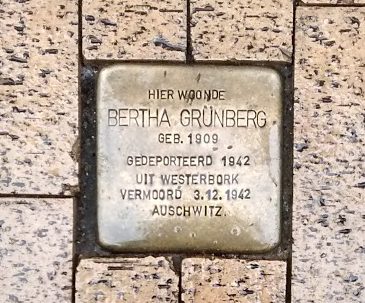
These are 4 inch square cube stones capped with a brass plate and inscribed with the following info: (see below picture) Hier woonde (here resided – lived) BERTHA GRUNBERG – Born 1909 – Deported 1942 from Westerbork – Murdered – December 3, 1942 in Auschwitz. This one we found in the Folkinge straat in the city of Groningen, a few steps from the old Synagogue.
People enthusiastically responded to this idea of these ‘remembrance-stones’ and since 1993 over 100,0000 have been placed all over Europe from Russia, Ukraine to Denmark and France, everywhere. In Holland there are 14,000 of these cube stones. They are Silent witnesses to the horror and frightening evil of a time never to be forgotten. A recent media article shows teen-age school children doing their yearly polishing of the stones in Stadskanaal, a city in Holland. Already for years schoolchildren have attended with care to the graves of the fallen Canadian soldiers. Thank you Canada! What a great way for the younger generation to remember. (In our extended family we have a small connection remembering the brave actions of Gaele Visser from Hamilton, killed by a sniper a few days before the end of the war. He is buried at the Holten War Cemetery)
Stones in the Scriptures are also significant items for remembrance. The Israelites were told to carry 12 stones out the river Jordan to remember the journey of Gods deliverance. “When your children ask you, “Why are these stones piled up here?” You will tell them how the waters of the Jordan parted as the covenant chest of the Eternal One crossed the river, and these stones will fix that memory for the Israelites forever. Book of Joshua Chapter 4 The Voice
In Jeremiah’s book of Lamentations Chapter 2 we read: Raise your cry to the Lord with all your might! Take no relief; be ceaseless in grief. ……. O walls, may your stones cry out, cry out for daughter Zion; Make rivers with tears of sorrow, rushing. Do not cease from your weeping. Tr The Voice
As Jesus enters Jerusalem riding on a donkey, the people shout ‘Hosanna, Blessed is he who comes in the name of the Lord.’ Some of the Pharisees in the crowd spoke to Jesus. “Teacher,” they said, “tell your disciples to stop!” “I tell you,” He replied, “if they keep quiet, the stones will cry out.” Gospel of Luke Chapter 19
These ‘Stolpersteine’, for some people, are unhappy attention getting reminders, even today, they find them embarrassing and unwanted reminders: Struikel steentjes…Stumbling stones!
For we also read in the apostle Peter’s first letter chapter 2 – about the Jesus stone: “See, I lay in Zion a stone, a chosen and precious cornerstone; and the one who believes in Him will never be put to shame.” To you who believe, then, this stone is precious. But to those who do not believe, “The stone the builders rejected has become the cornerstone,” and “A stone of stumbling and a rock of offense.”
Listen! the ‘Stolpersteine’ are crying out! May we never forget!
JS May 1, 2025


 On the Road