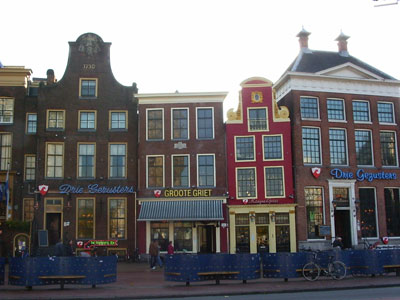
In the shadow of the Martini
‘The fields of the Ommelanden, are dew soaked clay-greens, wide, fresh and awesome, cradled by brisk ditch waters, high clouds/visions without end, scattered Wierden of stored forgotten lives and buried good intend-ness, bursting of possibilities with sanctuaries of Christian faith, flowing from deep soul dwellings reflecting eternal values, strength and hope, blessed treasurable life memory pieces, remembered ancestors of and in dwellings of our past, ‘t Hogeland, nearly your temple, Lord!’
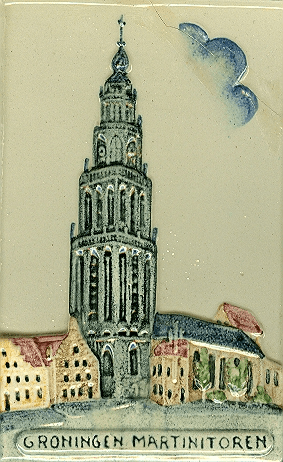
My family’s recorded ancestors history can be traced back to the 18th century (1770). There were persons before but the memories are sketchy and no written history is known. My third Great grand father Gerrit Schuurman was born in 1769 (d. November 8,1812 ) in the north-eastern part of the Province of Groningen, in the Netherlands. His occupation is listed as innkeeper in the town of Bierum and he married Anje Jans Draak (b.1783) in 1806. This was during the French occupation of the Republic after Napoleon’s conquest of the Netherlands (named the Batavian Republic) in 1795. In 1809, brother Louis Bonaparte was appointed as monarch of the Kingdom of Holland. The beginning of our democratic monarchy.
The marriage of Gerrit and Anje produced a son named Jan (Gerrit) on August 8, 1808 (d. April 27,1881) who on January 6, 1838 married Anna Sterenberg. She was born on October 21, 1812 in Appingedam – daughter of Hendrik Jan Sterenberg & Albertje Klassens Drijfhamer. Jan was a beekeeper and farmer in the town of Bierum.
Bierum is an old town originally built on a Wier or Terp (man-made hill structure) as a refuge for the locals and their animals from the sea floods before the dikes were built. The population varied from 200 to 500 people at anytime. The SebastiaanKerk (Reformed church) built on the Wier, dates from the 13th century and has a unique buttress with a pointed arch to support the church tower. Today the town is part of the larger Eemsdelta Municipality.
The marriage of Jan and Anna Schuurman produced a son who they named Derk. Derk was born September 23, 1849, in Bierum (d. April 5, 1902) and married Aaltje van Bon, daughter of Pieter van Bon and Jantje Luitjes Post (born November 13, 1850-died January 12, 1927) in the city of Groningen. Aaltje was from the town of Veendam. Derk and Aaltje were married July 31,1874 when he was 24 and she was 23 years old. They had 10 children with one still-born baby boy in 1889. Derk was a warehouse worker (pakhuisknecht) probably residing in the town of Haren or Noordlaren (village suburbs south of the city of Groningen). This is where my Grand-father (Opa) Jan Schuurman was born on September 8, 1881 and as he grew older took up his profession as baker.
My Grandmother’s (Oma) name was Titia Grasdijk (born May 22,1882) and with her family lived in the village of Sauwerd, just north (7 km) of the city of Groningen. Sauwerd’s history goes back to 300 BC. Sauwerd had been home to the Onsta (Onseda) (Onstaborg) family, one of the Ommelanden old gentry families dating back to the 1300s. Father Pieter Grasdijk (born 1854 -died April 1, 1904) was a tailor and her mother’s name was Antje Hempenius (born 1858 in the north-western Frisian town of Engelum, municipality of Waadhoeke -Menaldumadeel) ) Pieter and Antje married (June 5, 1880) when he was 27 and she was 22 years of age. Pieter and Antje had 5 children and one still-born. Antje’s parents were Dirk Sikkes Hempenius and Tietje Sybrens Hoekstra.
Somehow Titia and Jan met in the city of Groningen. Jan came there to work as a young baker. Titia had also moved to the city to find work as had her brother Gerrit and a sister Boukje (Bougien) both living and working in the city. There were two other brothers named Jacob and Dirk.
After Jan and Titia met, they started to attend church and confession class (Jan probably persuaded to go by Titia who was his girl-friend). Before deciding to marry they wanted to do profession of faith together but the local pastor (dominee) felt it was better for Jan to wait awhile as Jan’s family did not practice the same upbringing as Titia’s.

Apparently when confronted with this reluctance to let Jan do profession of faith, Titia had said to the pastor, ‘Dan krijg je mij ook niet!’ (‘Then you do not get me either!’) She was not an easy push over and knew her own mind. They married September 1, 1910 (both 28 years old) and so a number of years passed before Jan and Titia did profession of their faith. When this was finally done, the children were allowed to be baptized. I believe my dad said he was by then already five years old.
Jan being a baker joined ‘Patrimonium’ part of a collective, running a bakery concern co-owned by a number of independents to serve the immediate neighbourhood. He was active in the founding of this co-operative.
The place where the Schuurman couple first lived was in the Rabenhaupt [1] Straat near the Merwerdestraat/Achterweg. Soon after, Jan and Titia decided to open their own bakery and settled at the nearby Barestraat address 44. [2] The business address was called “Nooitgedacht”.
At the time in 1910 and years following, on the south-western edge of the city of Groningen there was much new construction going on. Shanties for poor day labourers, some who lived rowdy life styles, were being replaced by new housing. These were needed here due to a constant influx of people from the rural areas. The city was growing. New employment opportunities were: a new main train station had been built in the late 1880s and new housing was needed for the railway workers. A bicycle factory ‘Fongers’ (think of the ‘Gazelle’ bike) was started (1900) on the Hereweg employing 165 people. A new jail had been built near the newly designed ‘Sterrebos’ (a park) The jail was said to have been modelled after a prison in Philadelphia, USA. There was a lots of new projects throughout the city: new streetcar electrification and modern water/sewer and other city facilities were installed. A new water tower had been built along the Hereweg. New co-operatives/non-profits were emerging to built the necessary housing facilities for the new citizens moving to the city from the rural areas because of new commercial enterprises such as the ‘Suiker fabriek’ Sugar (beet) factory (est. 1910 -Holland’s 4th largest) on the west side of town. The large housing developments ‘Rivierbuurt’ and the ‘Grunobuurt’ and a large public Park (;Stadspark’) to the south-west side of the city were all were started in the 1920s and 30s. All of these people needed to eat and so Jan & Titia’s bakery did good business in the neighbourhood.
The family had five children. Twins were born first on 14th of October, 1911, a boy and a girl. They named the girl Antje Aaltje and her twin brother was named Derk Pieter who died 10 months later on 3rd of August, 1912, probably from smallpox. (This little boy was later placed in the same grave as his parents.) My dad (Derk) was born on July 30 (Wednesday), 1913, he was the third child of Jan & Titia. Even though there had already been a child named Derk in the family (1911) my father also was named after his Grand-father Derk. This was the habit in many families at that time to ensure that the name was kept in the family. Beside his older sister Antje, he had two younger brothers named Pieter, born March 28, 1916 and Gerrit, born March 24, 1919.
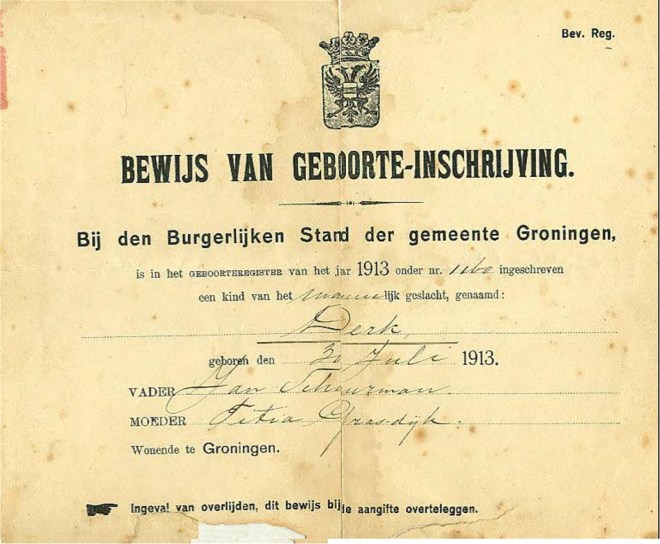
My dad’s birth certificate indicated that he was written into the civic birth directory of the City of Groningen as #1160, a child of the male species, named Derk, born on 30th of July 1913. On the bottom of the certificate is a dark hand-pointed fingerlike sign, drawing attention to the statement “that in case of death, this certificate must be accompanied with the death notice.” It appears that the records of the city’s citizenry were highly structured and the notice is perhaps an indication that some of the children died at an early age. Probably from typhus or smallpox. Smallpox had been a real child killer in Europe for years and its inoculation medical procedure (Edward Jenner-1796) was strictly enforced by the Dutch government. My dad was vaccinated for smallpox at age 3. The card describes the method and the times as well as the way the vaccine was made available to the citizen of the city.
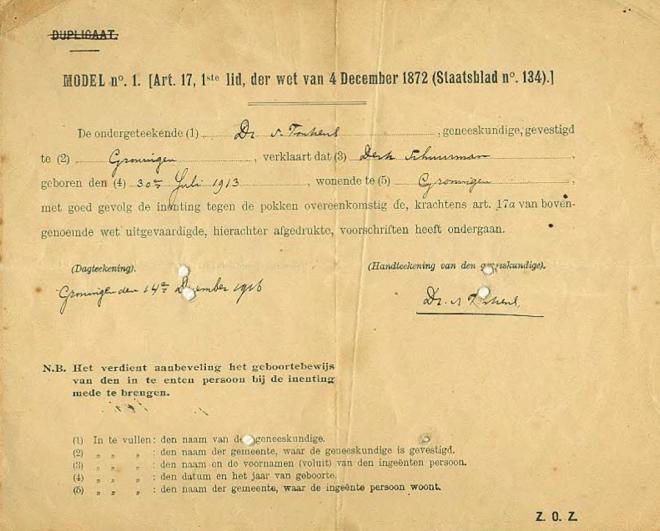
This health card certificate card [3] indicates that my dad was vaccinated for smallpox on the 14th of December 1916 under the Model #1 (Article 17 of the Dutch law of December 4th, 1872 – State paper #124.) by a Dr. S. Tonheul. The rest of the certificate gives indication as to how to fill it out. The back of the certificate is interesting. It gives full details of the instruction to the Doctor in examining the patient to insure they are healthy to receive the vaccination together with a full description as to what the doctor must do (e.g. the doctor must be sure to use antiseptics care, and if the vaccination area is not bandaged then he must make sure that no clothing will touch it up to 10 minutes after the procedure. The procedure itself consists of making 5 scrapes of 1 centimeter lengths and 2 centimeters apart from each other or 5 needle pricks, 2 centimeters removed from each other. The serum used must bear the approval of the Minister of Interior Affairs and must be stored in a cool dark place. It must be used 4 weeks after its preparation and within two weeks of its arrival at the vaccination center. In January the Minister will announce in the newspapers the places where this vaccination will be administered. (From the certificate it would appear that the Government of the Netherlands was very serious in preventing the deaths of children from small pox which was a very common deadly disease at that time)
In 1918 the family moved from the Rabenhauptstraat to the Barestraat and Jan started to operate his own bakery. It was probably shortly after, that father Jan began to plan for his boys Derk, Pieter and Gerrit, to eventually join him in the growing bakery business.
My father attended school in the Mauritsstraat and was not a very co-operative student but rather a rebellious one, who cared more for fun than study. Maybe fun is not the right word but rather ‘easiness’ was his style. Why work hard, if you can take it easy. This also appeared to be his motto for later life although when it came to working in his chosen profession of baker there was no harder worker than my dad. You could say he loved his job and was good at it too.
It appears that my dad at times could be a real nuisance at school. His younger brother Gerrit was even worse because on one of Gerrit’s report cards the teacher had noted: ‘Fooling around will be his occupation.’
It was a time of huge change in Europe and in the city of Groningen. On November 11th of 1918, the ‘Great War’ came to an end. The Dutch had escaped the conflict by taking a neutral position. The war’s end was completed with the signing of an armistice in a railroad car at the town of Compiègne, France and confirmed in June 1919 with the Treaty of Versailles. Years later Hitler used this railway coach location to force the capitulation of the French in June 1940 (much to his delight). The ‘Great War’ had seen 70 million men and boys in arms with over 9.4 million dead or out of a typical French town, one boy in five had been killed. Many widows and children without a father populated the cities of Europe and many more war-wounded disabled veterans walked the streets. People said that this had been ‘the war to end all wars’ or the ‘Great War’. Little did they know that the beasts of terror, horror and destruction were only taking a rest. On top of all this the Spanish flu [5] had broken out early that year and was to kill a further 40 million people worldwide.
Dad’s childhood was a normal one [6] and he played like all children would in his neighborhood. It was also around that time (1925) that my dad graduated from Grade 6, which was then the end of his (elementary) education. He then started working in his father’s bakery. He was 12 years old. His brothers Pieter and Gerrit who were 2 and 4 years younger than him were to follow later. Gerrit being the youngest of the family of 3 sons and one daughter was the baby and perhaps as in a lot of families, the parents were somewhat soft on him. At least that’s what was said about him.
Work days were early hours in the morning and long days. Sundays the bakery was always closed and the family attended church faithfully, two services every Sunday with extra services on religious days like Christmas, Easter, Ascension day etc.
When a boy turned twelve, he was considered to be grown-up enough to try smoking and drinking. Also the young boys at that age grew out of their short pants into long pants and were now looked upon as young adults.
There was much Christian political and social action in the Netherlands in the 1920’s and 1930’s. Although many of the political and social economic structures were dominated by the rich and affluent, even among the Reformed, there was much discussion and thought (ideas) about Christian social action. In some areas of the province of Groningen, the Reformed made up 30% to 50% of the population especially in the city and the north-western part of the province. Overall the Reformed made up 20% of the provincial population and many voted for the Anti-Revolutionary Party (ARP) started by Dr. Abraham Kuyper in 1879. [7] Young people and men’s discussion groups within the churches were very popular in those days. Also many modern inventions like: electricity, cars, radio, films, farm machinery and other modern conveniences found their way into the lives of the people and just about everybody owned a bicycle to get around. On Sundays, biking was frowned upon and most would walk to church. Actually it was quite a sight to see on Sunday morning when many families would walk to their houses of worship. (After the war however, many started to use the bike, or motorized bike-scooter (brom-fiets) and then later their cars, to go to church)
The economic situation had changed from an agricultural dominated society (by the rich provincial farmers/city leaders [4] who instituted and built the ‘Korenbeurs’ – grain-exchange in 1865 for the trading/sale of their farm grains) to an industrial and commercial city environment. Ever since 1875 when there was a general agricultural crisis, more and more people were being pushed out of the farming, agricultural employment sectors due to new mechanized farm machinery and new methods. Many who had lost their farm jobs came to the city adding to the city’s population. By 1910 the Social Democratic movement’s influences became very strong in the city of Groningen with the emergence of various Workers Unions and the new push for political and economic power which up to now had been held by the wealthy farmers, the land owners and the well-educated who occupied the important positions in the community. Also in the church there was not always a proper inclusion of people. Many farm workers were unable to be considered for office in the churches because their bosses, the farmers were also the leading persons in the church councils. Ownership of property was important and if you did not own anything, you were (presumed) not able or qualified to have any say in the daily affairs of your community including the church. The farm workers were treated poorly by many of their fellow believers and subsisted on (near) poverty wages.
With the Russian revolution of 1917, a new attitude swept over much of Europe and many new forms of community involvement and actions started to emerge. Sometimes these demonstrative actions were anarchistic and led to strikes. For instance, in 1919, 3/4 of the provincial farm workers went on strike. By 1929 (stock market crash) farm produce prices had plummeted and the Government had to step in to guaranty prices. Pork exports were stopped to England by the English government, greatly affecting farm workers employment. A six months strike ensued [8] in east Groningen, and was at times so violent that the government had to declare martial law to ensure the peace. One of the strikers was killed. In 1937 40% of the farm workers in the Netherlands were out of work and farm workers unemployment in Groningen stood at 42.5% while the country’s total was 13%. There were many unhappy people.
Many co-operative ventures and commercial enterprises were started in those days by enterprising people like the ‘Patrimonium’ that Jan worked for from 1910 to 1918. Ship building also experienced a boom during these years and many unemployed farm workers got a job building the new Groninger Coastal Ships (Groninger Kustvaarders) which were being constructed along the canals north east of the city.
Because of the continuing influx of farm workers from the province, the population of the city of Groningen increased rapidly especially during the 1930’s. In 1929 the city’s population stood at 103,584 while by 1939 it had grown to 121,070 up 16.8%, while the province increase was only 8.1% from 391,062 to 422,741.
Aunt Antje tells the story that in 1927 when she was about 17 years old there was a public awareness campaign (with an award) to push for the 100,000th citizen of the city. One of the ways in which this was advertised was for each family to have more babies and so she asked mother Titia in her innocence if they should try for the 100,000th but mother Titia said that father Jan was not interested. My aunt said she did not really understand why not.
With the growth in population, the Schuurmans did quite well as bakers (people had to eat) and were relatively well off, compared to other families, even in the depression years following 1929.

JS February 15, 2024
Pictures: Top – South side of ‘Grote Markt’ -2017 family visit – 1910 Family Wedding photo – My dad’s birth certificate (1913) – my dad’s birth certificate – my dad’s smallpox certificate.
NOTES:[1] Carl Von Rabenhaupt (1602-1675) was the man in charge of defending the city in 1672 against troops of the Bishop of Munchen.
[2] In Dutch the word Weg (Way) or Straat (street) is sometimes attached to the name of the street itself.
[3] Research documents show that around 1750 -1800 there was a negative population growth in the city of Amsterdam of which 100 out 1,000 deaths was a result of smallpox. Childhood deaths were as high as 55% from all causes. There was another epidemic with smallpox in 1872 but a consistent vaccination program started around 1800 with over 90% compliance by 1900 did much to control this dreaded disease.
[4] These were called the ‘Regenten’ or the ruling class. See picture of Rembrand’s ‘de Staal Meesters’.
[5] Imported from the USA (presumably from swines) via soldiers coming to the war front, the Spanish Flu virus spread rapidly among the fighting men and to the local communities. It is estimated that 20 million and as high as 40 million people around the world died from the Spanish Flu. (some say the figure was as high as 100 million) Some people who were affected died suddenly even in the streets and on public transportation. Masking was used by many (enforced in some places in Canada & USA) and some hung bags of camphor around their necks to ward off the disease. Even though it originated in the USA it was called the Spanish flu because the combatant countries did not allow any news of this sickness to leak out in the press but Spain being a neutral country in the Great War gave broad coverage of this deadly virus. The virus was classified as H1N1. It took well into the 1920s for the disease to de-activate.
[6] In 1968 I met a man in Stirling, ON by the name of Broekema who knew my father when he was 12 years old and played with him in the Bare Straat in Groningen.
[7] Anti-Revolutionary Party (ARP) was a conservative Protestant party, strongly opposed to the ideals of the French Revolution. Instead of the revolutionary concepts of liberty, social equality, and brotherhood, the ARP advocated for divine providence, hierarchy, and sovereignty in its own circle. In 1980 they merged with the Catholic People Party (KVP) and the Christian Historical Union (CHU) to form the Christian Democratic Appeal (CDA)
[8] This 1929 strike was a noted event in the historical world events calendar as it co-incited with the Berlin strike where 19 were killed.
Heading picture: Buildings on the south side of Grote Markt @2017

 On the Road