
Ancient Gaelic Blessing
Deep peace of the running wave to you.
Deep peace of the flowing air to you.
Deep peace of the quiet earth to you.
Deep peace of the shining stars to you.
Deep peace of the gentle night to you.
Moon and stars pour their healing light on you.
Deep peace of Christ,
of Christ the light of the world to you.
Deep peace of Christ to you. (John Rutter – Hymn)
In the beginning Elohim created the heavens and the earth. Now the earth had become waste and wild and darkness was on the face of the roaring deep but the Spirit of Elohim was brooding on the face of the waters. [1] Book of Genesis 1 : 1 & 2
Way back in the early days of the formation of the Atlantic waters, seas of melting ice came rushing from the Icelandic regions and swirled around the western coasts of Ireland, Scotland and what is now the British Isles reaching and stretching west and then eastwards as far as the Lowlands of the continent flooding the fields of its coastal lands, creating small lakes, marshes and wetlands. In its struggles with the waters, the terrain sometimes recaptured and gained solid ground and waterlogged meadows from the seas but mostly giving way and losing an eternal battle against the raging floods pushed on by the fierce November and February [2] winds from the great stretch of sea waters then flooding west from and to the edge of the known world.
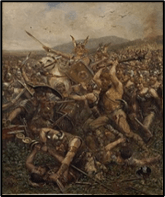
The ‘Franks’, ‘Celtic’, ‘Frisian’, ‘Saxons’ and the ‘Batavian’ tribes who had settled along this sea coast expanding from western France and Belgium, north along this North Sea coast to Germania and as far as the River Weser and parts of Denmark, raised and built ‘terps’ (small rises in the land) to flee from the rising flood waters. In a land that was always full of water, they struggled to master and reclaim the fields threatened constantly by the onslaught of the water with its fierce resistance to be tamed. These dwellers who later on became a mixture of ‘Angles’ and ‘Saxons’ some of whom buried their dead (5000 B.C.) under mounts of rocks, (‘hunne bedden’ or ‘dolms’) [3] stubbornly struggled and hardly subdued by the Roman legions [4] in 5 BC, were the ones that carried the ‘seed’ of our forefathers.

Although steeped in ‘heathen’ practices of forest gods and deities but with a structured and tolerant culture of chiefs and kings, they allowed the missionaries from Ireland and England to walk among their people and preach the Good News of Jesus. When missionaries Willibrod and Bonifacius arrived from the British Isles around and shortly after 700 AD and began to urge the disruptions and destruction of their holy worship places and shrines for the true Christian Gospel worship, chopping down (‘732 AD’) their sacred trees (‘Thor’s Oak’), a connection to their gods, they became enraged and killed Bonifacius near the city of Dokkum in 754 AD.
After those days, these folk were again subdued, this time by the French emperor Charles the Great (Charlemagne- 800AD) with a strong violent measure of accepting Christian baptism for loyalty to the emperor. With the rising of Christianity and dominance of the papacy Catholic church, they struggled through the Middle Ages into the age now known as the Renaissance with its new approach to community and faith, experiencing a new revival of the Christian Gospel message. Much later in the 1400s AD, they became subjects to the evolved Spanish (‘Habsburg’) empire through the uniting of the crowns of the Christian kingdoms of Castile and Aragon by the marriage of their monarchs, Isabella I and Ferdinand II, and eventually became organized into the Lowlands (including Belgium) subject to the Catholic King of Spain, Phillip II, who re-acting to a ‘rebellion’ as a result of a renewed religious ‘Protestant’ revival movement, sent the Duke of Alva and his army, backed up by the fierce and hated ‘Inquisition’, to subdue his Lowlands Dutch subjects away from this new ‘Reformation’ back towards the Roman Catholic faith, by killing thousands of God-fearing folk and laying waste many Dutch villages and towns.

https://www.historischmuseumdenbriel.nl/nl/collectie
/verhaal/80-jarige-oorlog, Public Domain,
Striking back [5] against religious and political persecutions, they declared their resistance and religious freedoms in 1568 (eighty-years war 1568-1648) because of their commitment to the Holy Scriptures and a desire to set their independence with freedom to read their Bibles now becoming freely available to the common folk through the invention of the printing press and actively preached and promoted by the priest and philosopher John Wycliffe (translations into the local vernacular) and others. So springing loose from the grip of the ‘Holy See’ in Rome and spawning the beginnings, with Luther and Calvin, of the ‘Reformation’, they eventually formed the Dutch Republic under the leadership of Wilhelm of Nassau, the Prince of Orange.
Under this independence movement which took a long 80 years to obtain their freedom, the Republic of the Netherlands prospered and the northern provinces of Friesland and Groningen became wealthy and strong settlements in this new nation. The Frisians with their language leaning much towards the ‘Angles’ and the Groningers borrowing from the ‘Low Saxon’ languages became two very distinct regions of subjects of the Royal House of Orange, yet one people united under the tri-colour of red, white and blue flag of the ‘Republic of the seven united Netherlands’.

Tolerant to refugees but fiercely independent and proud, they explored and settled across the world and throughout the centuries of the 16th and 17th giving both Spain [6], England and France (world powers of that day) a run for their money so to speak, in the control of the seas which they totally dominated into the 17th century. This period now known as the ‘Golden Age’ made famous by their poets and artisans like Rembrandt van Rijn being one of the greatest master painter of ‘light and darkness’ captured by his ‘Nightwatch’ forever.
Constantly caught in wars between England, France and the Austrian empires, against their Royal House of Orange [7] and although related to the English monarchy and the nobles of Germany and dominated by Napoleon in the turn of the 18th Century (1806 -1810) they fiercely held onto their independence and although sometimes loyal to German ideals have settled strongly in the last 100 years to the Atlantic alliance and counted heavily but in vain on French and English troops to deliver them from oppression during the start of the second world war, being neutral in the first war.

In the last century they became world sea-farers, farmers, growers, technology experts and commercial bankers and colonizers to the rest of the world. A small nation of brave folks, they were always on or near the front pages of world events. Eternally grateful to the Canadians for their liberation from the Nazi brutes in May 1945, they prospered and their immigrants and business people are now found and respected all over the world.
They are a sober people, many are children of the ‘Reformation’ and God fearing. As you travel through their land you will find many beautiful churches testifying to the fact that God has blessed them in all their struggles and endeavours. However many of these fine buildings stand empty now and the spirit of the ‘sacred pilgrims in their journey of life’ is now more mixed both by off-shores refugees and migrants. There is a changing in the landscape of the once pastoral, wooden shoe and Sunday religious observance ambience. Where cattle grazed before, we now see highways like modern rivers crossing the country and with the country’s borders now only in virtual mode having been absorbed by the political reality of the Union of European (27) states. Bravely facing the new 21st century, while holding on to old ways and a precious culture assaulted by contemporary ‘world culture’ twitter media, more and more becoming just a ‘fleck’ in the landscape of English speaking and modern internet connected world communities.
This is the story of an ordinary family from the Groninger North with their contribution, dreams and ideals as God-fearing Dutchmen shaping their lives’ paths as best as they could.
Someone once said: ‘All the world is a stage and the men and women merely players’. But these folks took as their banner the now famous lines by Abraham Kuiper [9]: ‘there is not a square inch in this world that does not come under the rule of Christ’.
This strong Biblical Christian worldview would give rise to changed communities where-ever they settled. Each person contributing their small part to the completion of the grand journey of life under the protection and watchful eye of the God of all grace.
Their motto was: ‘Mijn schild en de betrouwe zijt Gij, O God mijn Heer’. op U zo wil ik bouwen, verlaat mij nimmermeer. Dat ik doch vroom mag blijven, uw dienaar t’aller stond, de tirannie verdrijven die mij mijn hart doorwondt. [10]

JS January 10, 2024
SCHUURMAN FAMILY GENEALOGY
Gerrit Schuurman b. 1769 – d. November 8, 1812 occ. Kastelein/Herbergier/Innkeeper from city of Groningen; married in Bierum on January 5, 1806 to Anje Jans Draak b.1783 – d. January 27, 1859 – occ. Koopvrouw/Sales lady from Bierum.
Jan Schuurman b. August 8, 1808 – d. April 27, 1881 occ. Beekeeper/Grower/Farmer from Bierum; married in Howierde (Bierum) January 6, 1838 to Anna Sterenberg (daughter of Hendrik Jan Sterenberg & Albertje Klassens Drijfhamer) b. October 21, 1812 in Appingedam – d. December 3, 1873 in Bierum
Derk Schuurman b. September 23, 1849 in Bierum d. April 5, 1902 in Groningen occ. Commissionair/Pakhuisknecht/Warehouse worker; married Aaltje van Bon (daughter of Pieter van Bon and Jantje Luitjes Post) b. November 11, 1850 in Veendam – d. January 12, 1927 in Groningen occ. Koopvrouw/Sales lady - they had 10 children.
Children: Pieterdina Schuurman b. January 25, 1880 in Noordlaren; Jan Schuurman b. September 8, 1881 in Haren; Derk Schuurman b. 1884 in Haren – d. February 18,1905 in Groningen; Antje Schuurman b. 1885 in Bierum; Jantje Schuurman b. December 22, 1874 in Noordlaren; Anna Schuurman b. April 20, 1876 in Noordlaren;Gerrit Hendrik Schuurman b. January 17, 1885 in Haren; Hendrik Schuurman b. 1889 in Haren – d. February 1, 1903; dead baby boy b. October 12, 1889; Luitje Schuurman b. 1893 in Haren – d. March 9,1916; Geertje Schuurman b. March 22, 1894 – d. March 12, 1984;
Jan Schuurman [1] b. September 8, 1881 in Haren – d. May 14, 1956 in Groningen; occ. Baker; married in Groningen September 1, 1910 to Titia Grasdijk b. May 22, 1882– d. 4 Dec 1969 (daughter of Pieter Grasdijk [3] (occupation – taylor) & Antje Hempenius of Sauwerd [4]; Together they had 5 children born in Groningen. Family of 5 children
Children: Antje Aaltje b. October 14, 1911 – d. August 30, 2008 in Haren – married to Gerhard Suers d. November 10, 1993; Derk – b. July 30, 1913 d. October 28, 1991 (Hamilton, ON) – married to Trientje Oosterveld – b. February 15, 1911 d. December 27, 1991(Hamilton, ON) daughter of Hendrik Oosterveld and Renske Pruim) occ. Housekeeping maid; Pieter b. March 28, 1916 d. July 12, 1972 – married to Uilkje (Oekie) Korenhoff b. April 30, 1918 – d. August 30, 2014; Gerrit b. March 23, 1919 – d. March 29, 1999 – married to Rightje Lourens b. September 7, 1921 – September 3, 2008; there was also a son named Derk Pieter, a twin brother to Antje b. October 14, 1911 who died August 3, 1912 probably from smallpox.
Above was gleaned from https://www.genealogieonline.nl
[3] More info: Oma Titia Schuurman-Grasdijk’s parents: Pieter Grasdijk (occupation – taylor) & Antje Hempenius of Sauwerd had 5 children and 1 still born child. Trijntje died May 29,1897 9 months old; Anna died April 4, 1889 – 1 years old; Jacob died age 27 Jan 27, 1913 was married for 2 years to Ekolina VanderVelde; and 1 still born male child Oct 9, 1901; there was a sister? named Boukje and a son named Dirk (1889) who emigrated to USA (Decatur, MI) in November 1910. Dirk had gotten in trouble with a girl and was sent to the USA. Boukje was the only one who kept contact with him, he lived in Decatur, MI – his wife’s name was Nellie Haak
Notes: [1] Translation: The Restoration of Original Sacred Name Bible (1973) [2] A huge storm occurred in February 1953 that broke through dikes and flooded many towns in Netherlands southern Zeeland province, causing the death of 2,000 people. Psalm 93 speaks of the might of the sea. [3] Stonehenge and many other stone structures in the British Isles and other parts of Europe are similar to the (54) hunnebedden or dolms that can still be found mostly in the Province of Drente. The biggest is in the town of Borger. [4] The Battle of the Teutoburg Forest (German: Schlacht im Teutoburger Wald, Hermannsschlacht or Varusschlacht), described as clades Variana (the Varian disaster) by Roman historians, took place in 9 AD, when an alliance of Germanic tribes led by Arminius of the Cherusci ambushed and decisively destroyed three Roman legions and their auxiliaries, led by Publius Quinctilius Varus. [5] Dutch sea pirates (Geuzen) capture the city of den Brielle 1572. A first strike against the oppressive Spanish rule. [6] Which ‘Dutchman’ does not know the song of Piet Hein, the Dutch ‘privateer’ captain who in 1628 defeated and captured the Spanish fleet off the coast of ‘Varadero, Cuba’, loaded with 177,000 pounds of silver, a sum of well worth over 11 million guilders. [7] The Republic became a Kingdom in 1813 under King William I. (Koninkrijk der Nederlanden) [8] Picture is of the church in Dordrecht where the ‘Canons of Dordt’ were agreed upon in 1618-1619. The five Points of Calvinism – ‘TULIP’ [9] a Dutch journalist, statesman and Neo-Calvinist theologian. Pastor in the ‘Gereformeerde Kerk’, founded a newspaper, the Free University of Amsterdam and the Anti-Revolutionary Party. He served as Prime Minister between 1901 and 1905. [10] ‘My shield and my reliance (trust) are you, O God my Lord’ The Dutch national anthem begins with: ‘Wilhelmus van Nassouwe ben ik, van Duitsen bloed, den vaderland getrouwe blijf ik tot in den dood…………’and then the beginning sentence of the sixth stanza usually sung as a second verse (there are 26 verses) of the anthem. Translation:

 On the Road