
We all got together as brothers and sisters (and spouses and children & grandchildren) over last week-end (June 18, 2023) to remember with our children and grand-children how and where our parents spent much of their lives in the Hamilton, Ontario area.
The ‘Groenewegen’ family (with 5 children – youngest was 6 weeks old) arrived in Canada from the Hague, Netherlands (both parents were born in the village of Rozenburg) shortly after the ending of WW2 in June 1947 on the S.S. Waterman, at that time a troop carrier sailing from the port of Rotterdam to Montreal, Canada with approximately 1,100 immigrants of which most of the men had been sponsored to work on Canadian farms.
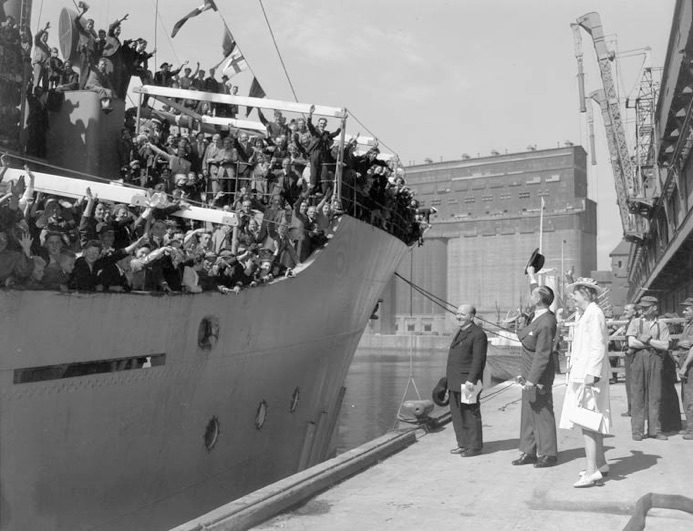
This was one of the first ships of Dutch immigrants after WW2 with many to follow through the 40ies and into the 50s with the bulk arriving in the early 50s. Canada needed workers in agriculture and many men for the Netherlands were looking for new opportunities.
The ‘Groenie’ family travelled by train from Montreal and due to a language barrier arrived in Hamilton on the way to Brantford, until someone checked their train ticket and noticed the destination should be Bradford (Lefroy). Not knowing the language it was easy to make a mistake. The Hamilton Spectator had a reporter at the train station who covered the event and the family’s arrival became a front-page news feature in the June 27, 1947 edition complete with family picture.

From Bradford (LeFroy) the family moved to several places and settled on the Larkin Farms at Queenston Heights. The kids remembered the building of the floral-clock (1950). Mr. Digweed (see his obituary) was the manager of this large farming enterprise but allowed father Cor to practice his occupation which was selling potatoes and produce door to door in the local area in his spare time. (Stamford Township permit – April 1949)
On a family journey to the church in Hamilton (where dutch services were held) he noticed at Upper James Street (Highway #6 and Limeridge Road) a large lime-stone barn (with a square silo) apparently unoccupied; and came up with the idea that this may be a good place to start his own business.
The property was owned by the Bethune family (Dr. William Bethune **) who father Cor approached and asked if the building was available to purchase. Yes, it was and so a price was agreed to with the owner holding a mortgage.
The family moved into the barn’s grainery and began to convert it into their own living quarters and with two separate apartments. This converting lasted a couple of years. The place however was ideal for it contained a large space under the barn built into the hill which had a constant suitable temperature, great for storing potatoes year-round. However since it was located in Barton Township it had no sewer and water was to be carried from a well with a pump situated along the road side on Upper James Street. Afterall it was just a barn.
To make it livable for the family, now counting 9 people (there were 7 children) some of the limestone blocks were knocked out and window space was made. The local kids would come by and say: ‘My dad says: any more blocks removed and the building will fall in’.
After sometime Upper James Street was widened and the well covered up, so water was transported in 5 gallon pails from Upper James Street and Fennel Ave to serve the family of 9 persons. This hauling of water lasted till about the mid 70s when the Barton Township was amalgamated officially into the City of Hamilton in 1973 and water and sewer services finally arrived.
The business was run out of the barn and thrived. However they were unable to obtain permission to sell at the Hamilton market because only ‘growers’ were allowed at the city market and the family business was classified as a ‘huckster’ enterprise, since they did not grow the product but bought from farmers locally, in Shelburne and Leamington for their supplies. So they did business at Welland City Market for many many years. (City of Welland permit – November 1948)
Overtime, many immigrants found at this family home a welcome, a place that was their ‘receiving’ and ‘welcome to Canada’ station. The family worked hard with all the children pitching in as they were eager to establish themselves and contribute to the welfare of the community especially those who had immigrated from the Netherlands. For a time they also branched into the trucking of Florida produce and other enterprises beside the potato whole-sale and retail.
The barn also became a gathering place for the children and their friends. On many a Sunday night a hymn sing could be heard or a beach outing was organized. Everyone was welcomed and a few young teenagers remembered working for the family business as their summer jobs. Some even met their future spouses here.
The city, however, grew around them and the place acquired a unique identity in the neighbourhood. As Upper James Street was widened, many businesses sprang up along its way. The city also had big plans for the area in the early 1960s; there were plans for an Express Way from Ancaster to the Red Hill Creek Valley running down the escarpment into the QEW.
Opposition to this plan (especially the route through the Red Hill Creek Valley) delayed the implementation for many many years with the property placed into ‘expropriation’ mode as the planning would show that the property would form part of the Upper James intersection. After much time and legal effort, a price was agreed for sale by the city in 1977 and the building was quickly torn down. The Lincoln M. Alexander Parkway exit to Upper James Street North is now where the building used to stand.
So at last week’s family gathering, we collectively as a family children, grandchildren made a journey to that exact spot (now a just walk-way as there is no trace of this building anymore). Even the landscape packed with an earthen noise-barrier shows no sign of what was there in earlier days, although in recorded history there is mentioned about the barn and the adjacent lime kiln with the Bethune family dwelling. See the book: Mountain memories: A pictorial history of the Hamilton Mountain published January 2000 by the Hamilton Mountain Heritage Society.
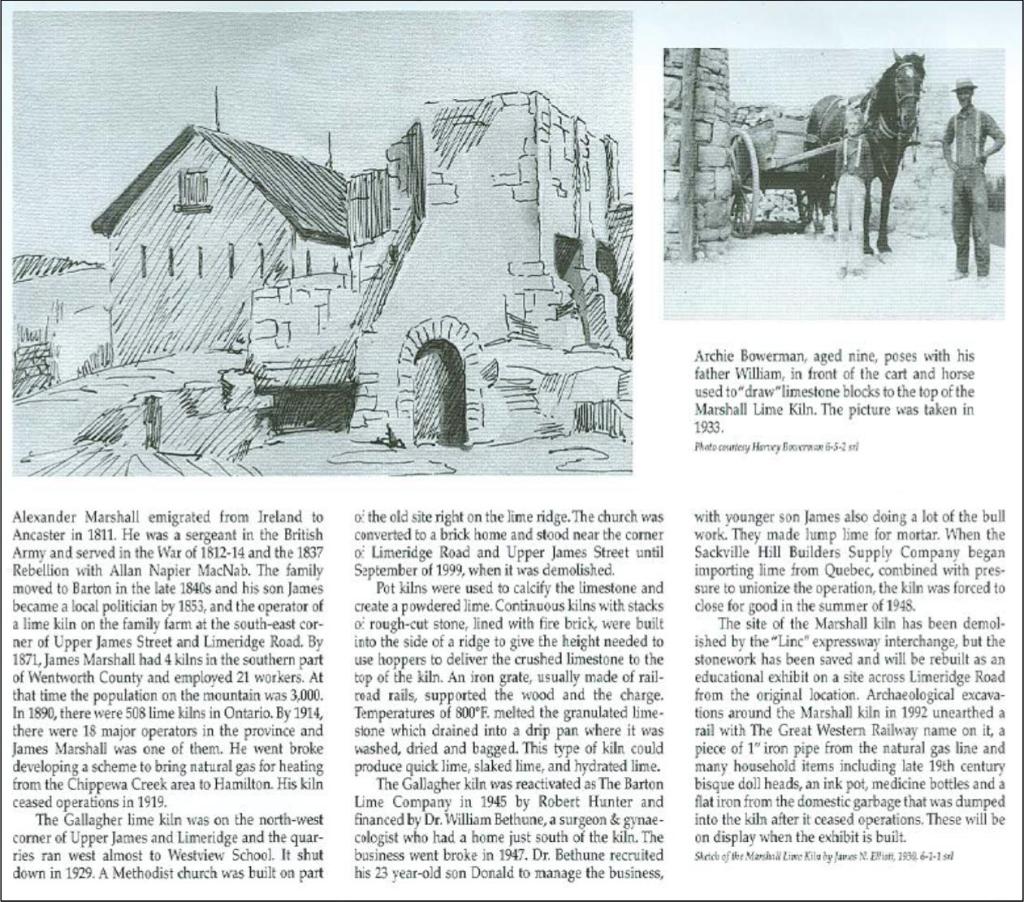
We stood on the walk-way path that runs from Limeridge/Ridge Road corner to Upper James Street and remembered the days when the family business was here and children played in the field and on the property of 20 Limeridge Road East.
There was no evidence of all of this history at this location now. No rock or stone or incidental items can be seen or found. It is history, past times, when young lives were formed and new opportunities were given to new Canadians families eager to contribute to the religious faith mosaic, exercise and share their commercial expertise and practice community welfare by making Canada their new home. Perhaps those events now live only in the minds of us elders, who were there and who remember.
Psalm 103 reminds us: The children of Adam are like grass; their days are few; they flourish for a time like flowers in a meadow. As the wind blows over the field and the bloom is gone, it doesn’t take much to blow us out of the memory of that place.……but the unfailing love of the Eternal is always and eternal for those who reverently run after Him. He extends His justice on and on to future generations, to those who will keep His bond of love and remember to walk in the guidance of His commands. (translation: The Voice)
JS June 18, 2023
* Book of Psalms number 103 verse 16 (NLT translation)
** Dr. William Bethune Park in his memory is located at 60 Dicenzo Drive off Stone Church Road East
December 4, 2023 – Update: Google Maps location https://www.google.ca/maps/place/Groenewegen+Park/@43.21955,-79.8856049,17z/data=!4m14!1m7!3m6!1s0x882c9b096de84c21:0x3bfc1485222ee8af!2sGroenewegen+Park!8m2!3d43.21955!4d-79.88303!16s%2Fg%2F11tn3lbm5t!3m5!1s0x882c9b096de84c21:0x3bfc1485222ee8af!8m2!3d43.21955!4d-79.88303!16s%2Fg%2F11tn3lbm5t?entry=ttu

 On the Road
Opa Jan! I came across your blog when I was on Google Maps. I live in the area of Upper James & Limeridge and walk my dog daily near the park named Groenewegen Park. I always wondered about that name. It is certainly unique.
I am a 56 year old first generation Canadian. My parents immigrated from Holland in the mid 50’s. So the Groenewegen part of the name always peaked my interest.
So glad I stumbled upon this blog. And so wonderful to learn the history of this small greenspace.
Blessings to you!
Kelly Potma-Veysey